
Simanaitis Says
On cars, old, new and future; science & technology; vintage airplanes, computer flight simulation of them; Sherlockiana; our English language; travel; and other stuff
FROM MOTHER EARTH TO YOUR CAR’S TANK; SLEUTHING ADDED PART 2
MOLLY BOIGON GOT US OFF TO A GOOD START with her “Fluctuating Fuel Costs: How Refiners, Retailers and Regulators Set the Price at the Pump.” We continue today in Part 2, with continued sleuthing as well.

Pricing the Final Product State-Side. Molly Boigon observes, “The price of crude oil makes up about 50 percent of the price of gasoline. Areas of the country are starting with different crude prices that vary based on the benchmark. Another quarter of the price of gas is determined by the cost of refinery.”
“Refining costs different amounts in different states,” Boigon notes. “California has strict environmental requirements that cost more. The stringency of the regulations there has prompted oil companies to idle their refineries over the last couple of years.”
Boigon quotes Eric Smith, associate director of the Tulane Energy Institute: “People are sick and tired of trying to deal with the Californians. They’re the single biggest source of heavy oil in the United States, and they don’t want to produce it.”

Yet More Sleuthing. Neither Smith nor Boigon cites that California’s gasoline is CaRFG3, its Phase 3 Reformulated Gasoline. As described by the state’s Air Resources Board, “A 2003 Assessment of the Impacts of CaRFG has indicated that the benefits of the program have been equivalent to the removal of 3.5 million vehicles from California’s roads.”
Peter Nelson offers a timely “The Difference Between California-Produced Gas And the Other 49 States,” Jalopnik, March 30, 2026. Among other aspects (much higher state fuel taxes, for example), he observes, “In order to understand California’s high gas prices, it’s important to note where the state is located. For the most part, the Rocky Mountains disallow the formation of a pipeline between the rest of the country’s oil refineries and its boundaries; thus, California produces most of its 87-91 octane and diesel in-house. According to the U.S. Energy Information Administration (or EIA), very few refineries outside of California can even meet the state’s blending requirements, which adds to refining costs.”

Also, as noted by the U.S. Environmental Protection Agency (this particular item, not yet dismantled by Trump’s cohorts), “The [federal] reformulated gasoline program was mandated by Congress in the 1990 Clean Air Act amendments…. The first phase of the RFG program began in 1995 and the second (current) phase began in 2000.”
That is, federal RFG is Phase 2. Think of CaRFG3 as its logical successor. But, with the EPA (the “Economic Protection Agency”?) currently evolving, don’t bother thinking too hard.
EPA continues “RFG is currently used in 17 states and the District of Columbia. About 25 percent of gasoline sold in the U.S. is reformulated. In addition, the sale of California Phase 3 RFG is required throughout the entire State of California.”
To paraphrase Eric Smith, I’m personally sick and tired of trying to deal with those ignoring environmental matters.
Back to Boigon: Gasoline Prices As Of April 6, 2026. “The remainder of the cost to consumers,” Boigon recounts, “is determined by federal and state taxes, distribution, marketing and retail…. Alaska has the lowest gas tax at about 9 cents per gallon. California has the highest at about 71 cents per gallon.”
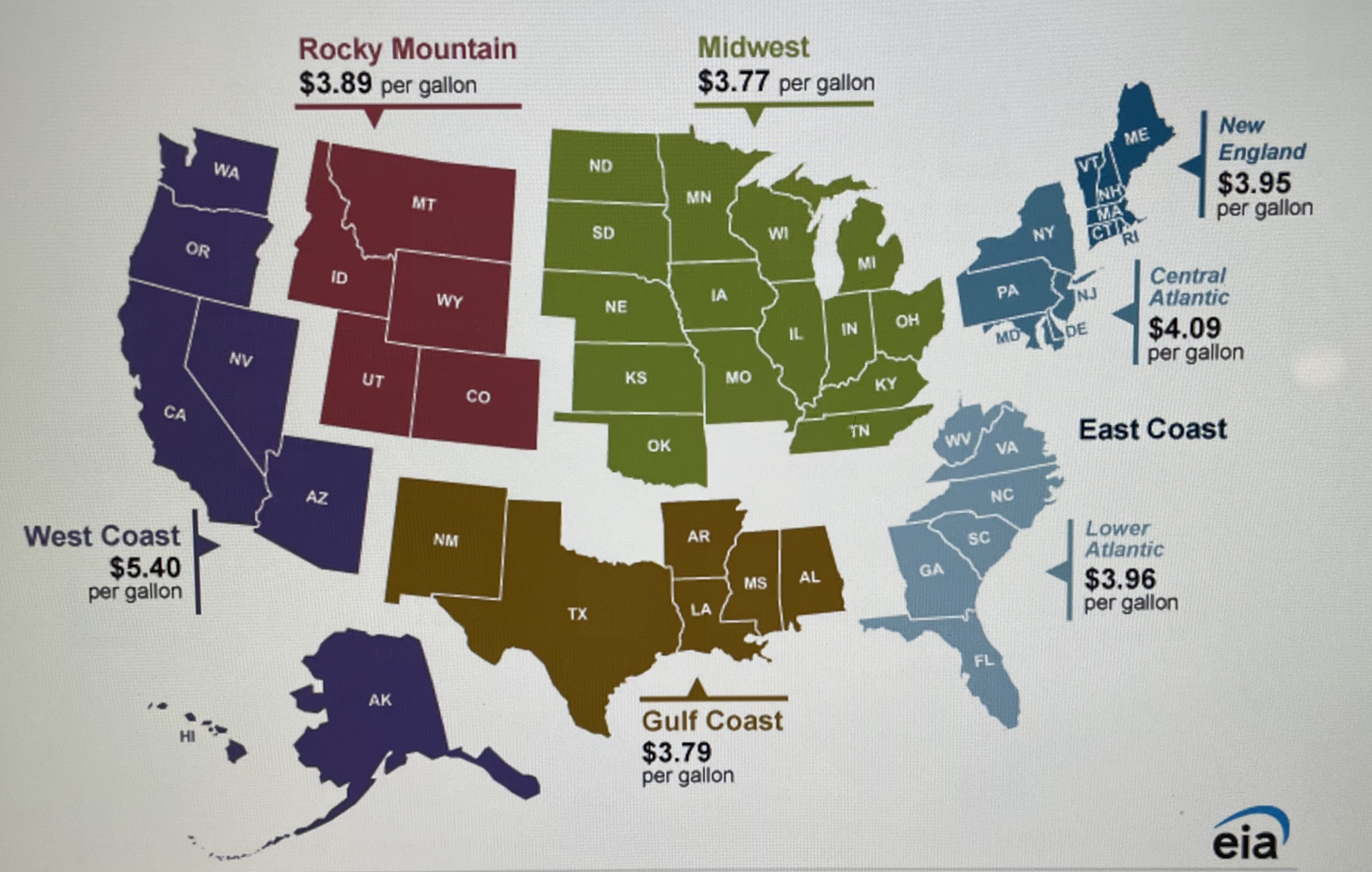
Image from Automotive News. Data source: U.S. E.I.A.
Boigon continues “Refineries service parts of the U.S. via pipeline, which is the cheapest, fastest and cleanest method of transporting gasoline. For example, New York gets a lot of its gas via pipeline, [Stanford University’s] Sonin said. There are no major pipelines bringing gasoline into California.”
Recall Peter Nelson’s Jalopnik comment about pipelines and the Rockies.
Also, Boigon notes, “At different times of the year, gas costs more or less. The government normally mandates a switch to a summer blend of gasoline that is less impacted by evaporation during hot weather. That summer blend is more expensive. In response to the higher gas prices because of the war, the EPA is waiving that summer fuel requirement temporarily.”
Which, alas, is counter to environmental concerns. Yet, as Trump noted at Truth Social, “The United States is the largest Oil Producer in the World, by far, so when oil prices go up, we make a lot of money.”
And already noted in “Trump and Fossil Thinking,” “we”??
Thanks, Molly Boigon and Automotive News, for a thoughtful article (and for prompting the sleuthing). ds
© Dennis Simanaitis, SimanaitisSays.com, 2026
 Simanaitis Says
Yes, “we” .
I have oil stocks and they’re making record profits .
I also live in So. Cal’s San Gabriel Valley where the choking smog of the 1970’s had to be experienced to be believed .
Chevron, who’s prices are consistently the highest anywhere has once again begun a dishonest campaign claiming our pump prices are high due to taxes rather than their un checked greed .
Gasoline prices used to be regulated to prevent price gouging, the republicans as usual lied and said gasoline would become far cheaper if only the price regulations were removed, as if anything de regulated has ever gone down in price .
Yes California has high taxes but we also have a far better quality of life than elsewhere .
No one is forced to live here, I manage to live well on my paltry $50,000 / year .
Back in the 1970’s we had a fake ‘gas shortage’ manufactured by the bi oil companies to drive all the little independent gas stations out of business .
I used to drive to San Pedro at night after work, I could see oil tankers lined up to the horizon, all full of crude waiting to be unloaded, some “shortage” .
No one ever stops to think why there used to be far less cars yet more than 4 X the filling stations , all that changed when the gasoline prices were deregulated .
-Nate
BTW : I am loving your pastoral scenes .
-Nate
Trump’s EPA = Environmental Pollution Agency