
Simanaitis Says
On cars, old, new and future; science & technology; vintage airplanes, computer flight simulation of them; Sherlockiana; our English language; travel; and other stuff
THAT MOVIE STANK! PART 1
BUT MAYBE IT WAS SUPPOSED TO STINK. A recent “Letters” column in London Review of Books, February 19, 2026, follows up on a citation of mine: Susannah Clapp’s reference to a “whiffy play” with its own olfactory addition. These letters, in turn, encouraged my usual Internet sleuthing of the topic.

Indeed, there’s an extensive (9268-word!) article “Scent and the Cinema,” by Charles Spence (great-great-grandson of Randall Williams, an early specialist in the field), i-Perception, November 25, 2020.
Here, in Parts 1 and 2 today and tomorrow, are tidbits gleaned from these and other sources.

Whiffy. LRB reader David Elstein writes, ‘Susannah Clapp has sparked a correspondence about ‘whiffy plays’ (LRB, 25 December 2025). Cooking on stage carries more than olfactory hazards. In a performance of David Hare’s Skylight at the Cottesloe in 1995, Lia Williams, in character, was preparing spaghetti while arguing with her co-star, Michael Gambon. At one point, she banged her fists on the kitchen counter. A knife and fork duly flew through the air and landed in my lap. Williams didn’t miss a beat, and continued with her harangue. When I told the director, Richard Eyre, what had happened, and suggested that he might put a warning in the programme notes, he replied that sitting in the front row always carries a risk.”
A letter from Gilbert O’Brien recounts, “The 1960 film Scent of Mystery attempted to incorporate the sense of smell using a technology with the unprepossessing name Smell-O-Vision. [The flick had a later odorless release as Holiday in Spain.] Odours such as pipe smoke were released from the viewer’s cinema seat at key moments (with a good deal of noise). The film, directed by Jack Cardiff and starring Denholm Elliott, Peter Lorre and a cast of British actors including Diana Dors (as well as a ‘guest appearance’ by Elizabeth Taylor), was, predictably, said to be a stinker. The theory had been that the various scents fed into the cinema would help the audience solve the mystery, but the odours were indistinguishable. Cardiff said later that Scent of Mystery was ‘the one film I want to erase from my memory … a complete disaster.’ ”
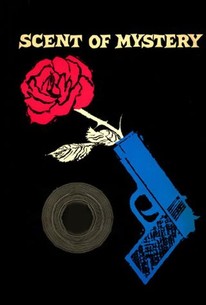
Image from Rotten Tomatoes.
Smell-O-Vision. O’Brien’s letter nudged my memory needle: Smell-O-Vision has been mentioned here at SimanaitisSays: And, coincidentally, not in my discussion but as a response from reader Bob Storck who cited “the brief foray into the piped-in ‘Smell-O-Vision’ spraying in floral scents, etc. as appropriate. Hopefully never used in swamp or musky wildlife movies.”
Wikipedia recounts, “Created by Hans Laube, the technique made its only appearance in the 1960 film Scent of Mystery, produced by Mike Todd Jr., son of film producer Mike Todd. The process injected 30 odors into a movie theater’s seats when triggered by the film’s soundtrack.”
Other Concepts. “Roughly similar concepts integrating odor experiences into entertainment performances date back at least to 1868 for live theatre, with the first film usage in 1906,” Wikipedia details. “Other approaches include General Electric‘s “Smell-O-Rama” in 1953 and the rival ‘AromaRama’ system in 1959. In cheeky homage to this era, John Waters enhanced his 1981 film Polyester with an ‘Odorama’ scratch-n-sniff card.”
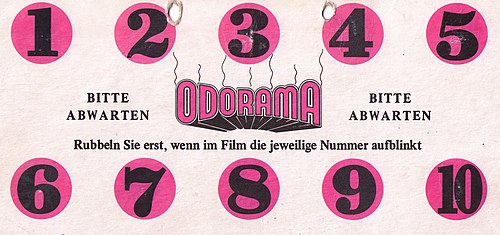
A scratch-n-sniff card from Polyester‘s German release. The ten smells were roses, flatulence, model airplane glue, pizza, gasoline, skunk, natural gas, new car smell, dirty shoes, and air freshener. Image from Wikipedia.
Talk about a collectible card!!
Tomorrow in Part 2, we’ll continue with specifics of cinema scent technologies; alas, with environmental concerns as well. ds
© Dennis Simanaitis, SimanaitisSays.com, 2026
 Simanaitis Says
You have a good memory, Dennis, but that’s your forte’!
Touted in a late ’50s downtown San Antonio theater, there were hints at which areas had best benefit, and to me the most effective use was when a scent would precede an event or appearance of a character, i.e. perfume or tobacco.The down side was clearing the odor, which in this theater required a large blower with noticeable noise to prepare for next wafting.
Cheers, Bob
Thank a well-worded Google request. And thank you, Bob.—ds