
Simanaitis Says
On cars, old, new and future; science & technology; vintage airplanes, computer flight simulation of them; Sherlockiana; our English language; travel; and other stuff
AN IMPORTANT PROGRAM IS EXPANDING
EMILY MULLIN WRITES IN WIRED, July 15, 2024, “It Will Soon be Easier for Americans to Recycle Batteries.”

“This month,” Mullin writes, “the US Department of Energy announced a $14 million program that will fund more than 1,000 consumer battery collection sites across the country at Staples and Batteries Plus stores. It’s part of a larger $62 million effort announced by the Biden administration in April to boost battery recycling.”


Mullin continues, “Smartphones can’t be discarded in household garbage or recycling bins. They contain lithium-ion batteries that can leak toxic chemicals into the environment or spark dangerous fires if damaged, punctured, or exposed to excessive heat.”
“And disposing of batteries improperly isn’t just an environmental problem,” she notes. “The Department of Energy sees it as an economic problem as well. Many rechargeable batteries contain lithium, nickel, cobalt, graphite, and manganese—critical materials needed to make clean energy technologies, including wind turbines and electric vehicles. With EV sales growing in the US, more of these materials will be needed.”
In My Little Corner of the OC. Notice as well, even traditional batteries require special disposal. Here in Orange County, California, and elsewhere throughout the country, we have three disposal bins: recyclables, trash, and organics. This third one, hitherto called yard waste, resulted from finding that food waste and food-soiled paper placed in land fills of traditional trash generated uncontrolled methane (an extremely volatile hydrocarbon).

By contrast, these days acceptable trash includes non-recyclable plastics, styrofoam, dishes and glassware, clothing and bedding, and diapers and pet waste (the latter albeit having traces of organics). These are acceptable landfill which, in the long term, result in usable property. For example, what used to be the road to the dump here in OC has evolved into an upmarket neighborhood.
Recyclable garbage includes paper and cardboard, metal cans, and those plastics and glass identified with a recyclable arrow icon. Notable exclusions are electrical appliances—and batteries of any sort.
The China Edge. Mullin quotes Energy Secretary Jennifer Granholm on battery recyclables: “Up to now, China has largely cornered the market on processing those, and in many cases on extracting them as well. We want to be able to create multiple ways for us to access those critical materials in the United States, and recycling is one component of that.” She added that US battery recycling capacity has been “very underutilized.”
Recycled Performance. “When batteries are thrown away,” Mullin writes, “those materials can’t be recovered. If they’re recycled, these resources can be used over and over again—and research has found that recycled battery materials can work as well as new ones.”
She cites Martin Bazant, a professor of chemical engineering at MIT who leads the Center for Battery Sustainability, a joint effort of MIT and Northeastern University: “What we don’t want is to be losing critical minerals from the supply chain. We have to be able to recycle them.”
Mullin continues, “Bazant says it makes sense for the government to work with retail stores that sell consumer electronics and batteries to increase the recovery of these materials. ‘These companies are very visible,’ he says. But he acknowledges that it could be a challenge to get people to recognize not only the importance of preserving these materials, but also the environmental damage they can do if not disposed of properly.”

Old Batteries. I’ve been collecting defunct batteries, AAAs, AAs, and the occasional portable-radio Ds, in a plastic (non-renewable) bag next to the trash. One of these days I’ll take it to a nearly Staples Recycling.
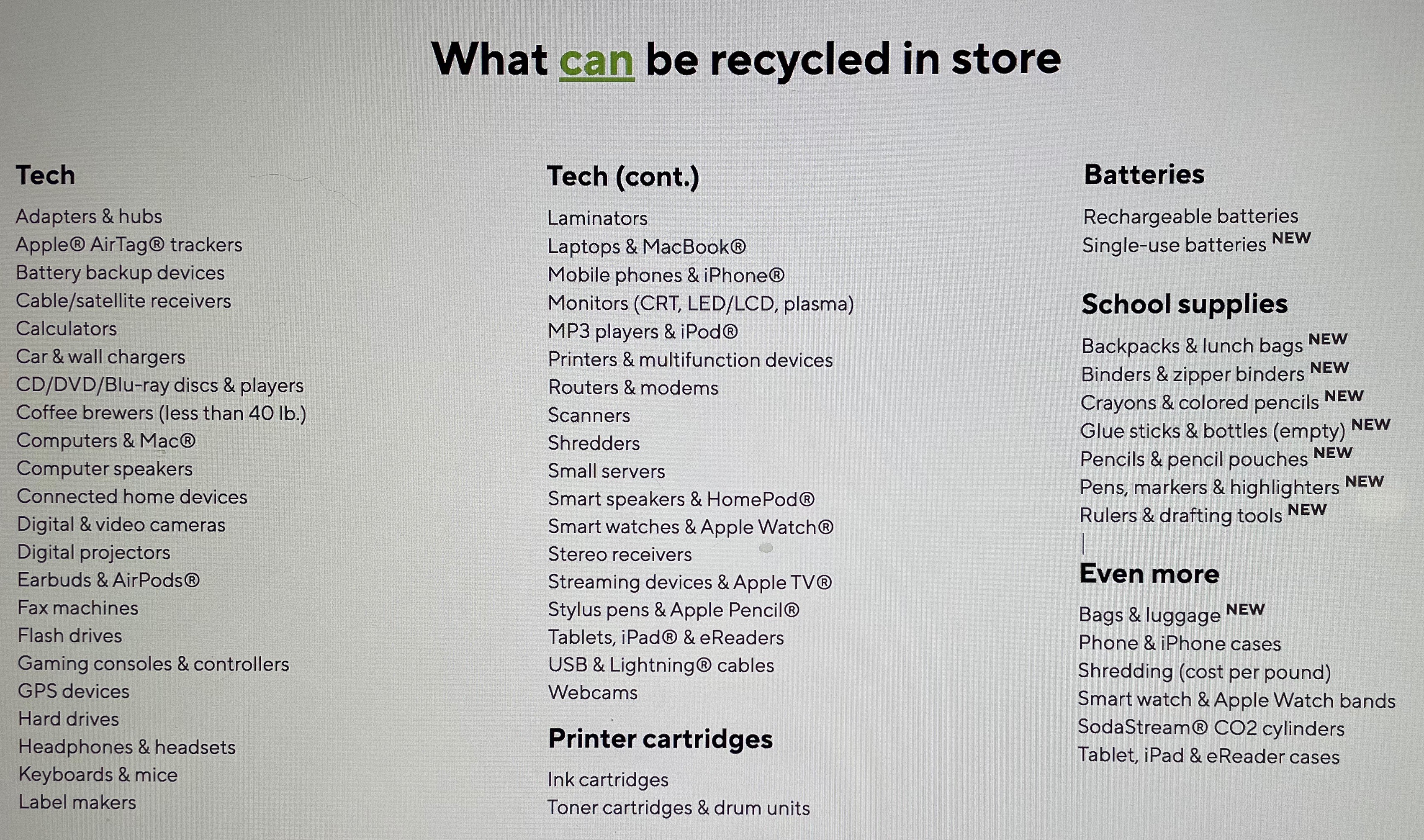
Image from Staples.
What can’t be recycled includes air conditioners, floor-mounted printer & copiers, home & kitchen appliances, medical devices, and wet-cell & heavy batteries (over 11 lb.). Many cities have recycling centers for these. And thanks, Staples, for setting this up.
My iPhone Family. Luddite that I am, all this recycling got me thinking about my trusty iPhone 6s (introduced in 2015) only recently having given up the ghost. Its charge port corroded to the point of requiring excess fiddling to establish a connection. My friendly local Apple store transferred its sim card to Wife Dottie’s iPhone 12 (left uncharged since 2021). The 12 is back in service again.
I prefer the 6s’s Home Button to the 12’s sweep, but that’s progress for you.
I use another 6s (the silver one) as storage for old-time-radio shows. As it’s a non-phone, it requires charging only rarely for its storage and playbacks. And I still have an ur-iPhone of indeterminate vintage.

From left to right, my old-time-radio 6s, the corroded 6s, and the ur-iPhone. Missing is the 12; it took the pic.
More on the Ur-iPhone. My ur-iPhone had performed old-time-radio service until its battery got pesky in accepting a charge. That’s when I switched over to the silver 6s.
But in assembling these tidbits, I thought it would be fun to show the ur-iPhone’s classically wide charge cable. Also, as a non-functioning display, it makes an interesting contrast to the others: smaller but considerably heavier.
Just for fun (as shown in the photo above), I plugged it in. And guess what!? The ur-iPhone fired up!

I even tried taking a pic with the ur-iPhone, shown below.

There’s only one problem with this image: The ur-iPhone doesn’t have AirDrop. Nor, of course, does it have any Internet. Thus, this image is solely lodged within.
Gee, I’m having so much fun with these recyclable iPhones that they’re staying home on my next recycling trip. Sorta like vintage cars. All in good fun. ds
© Dennis Simanaitis, SimanaitisSays.com, 2024
 Simanaitis Says
*New* program?
My usual grocery store (Winco) has barrels right at the entrance for (non-rechargeable) battery recycling, along with film plastic, and has been doing that for years.
Most cell phone (and laptop) manufacturers in the US will take back old phones for recycling, and will send you a label and often proper packaging (if you don’t still have the original box) to ship it. Has been that way for more than 5 years. Disposed of 2 obsolete Nokias (one of them a Windows phone) that way. Some phone makers (such as Google) also offer a trade-in program that gives you some nominal scrap value against a new phone.
My city waste collection dept offers up to 2 household hazmat/e-waste pickups (including all types of batteries) a year, as part of the general service (no extra charge). They’ve been doing that for the 25 years I’ve lived here.
Granted, this is in California. YMMV.
Yep, as I’ve noted before, we Californians are hep. For which I am thankful.