
Simanaitis Says
On cars, old, new and future; science & technology; vintage airplanes, computer flight simulation of them; Sherlockiana; our English language; travel; and other stuff
PUTTING ART DECO TO WORK
NEW YORK’S POSTER HOUSE ANNOUNCES its exhibition “Art Deco: Commerciailizing the Avant-Garde” with a provocative statement: “The term ‘Art Deco’ did not exist until the 1960s.”
This in itself got my attention. Didn’t it all start with the 1925 Paris Exposition internationale des arts décoratifs et industriels modernes (International Exhibition of Modern Decorative and Industrial Arts)?
Some Etymology. Well, yes, this exhibition certainly focused attention on the genre. However, as Wikipedia notes, “though the diverse styles that characterised it had already appeared in Paris and Brussels before World War I.”
Indeed, Wikipedia says, “Arts décoratifs was first used in France in 1858 in the Bulletin de la Société française de photographie…. In 1875, furniture designers, textile, jewellers, glass-workers, and other craftsmen were officially given the status of artists by the French government. In response, the École royale gratuite de dessin (Royal Free School of Design), founded in 1766 under King Louis XVI to train artists and artisans in crafts relating to the fine arts, was renamed the École nationale des arts décoratifs (National School of Decorative Arts).”
Though Le Courbusier titled an essay “1925 EXPO. ARTS. DÉCO,” the actual term “art deco” did not appear until 1966, Wikipedia notes, “in the title of the first modern exhibition on the subject, held by the Museum of Decorative Arts in Paris, Les Années 25: Art déco, Bauhaus, Stijl, Esprit nouveau, which covered a variety of major styles in the 1920s and 1930s. The term was then used in a 1966 newspaper article by Hillary Gelson in The Times (London, 12 November), describing the different styles at the exhibit.”
The Poster House Exhibit. Eve M. Khan describes the Poster House exhibit, running September 28, 2023, to February 25, 2024, in The New York Times, August 31, 2023: She terms it “When Advertisements Were Art.”

A 1936 poster, designed by Gert Sellheim. This and other images, credit: William W. Crouse and Poster House from The New York Times.
Khan writes, “Between the 1920s and World War II, illustrators and designers slashed bands of color across advertisements to tempt consumers with ever faster modes of travel and cleverer machinery. The era’s frenetic pace of change is vividly represented in posters hung throughout the homes of the collectors William and Elaine Crouse, and they have partly denuded their walls to lend 58 pieces to ‘Art Deco: Commercializing the Avant-Garde,’ an exhibition that opens Sept. 28 at Poster House in New York City.”
Ads With Panache. “The works on view,” Khan says, “were targeted at potential customers for Japanese trains, American racecars, Swiss clothing, Dutch glassware, Italian liqueurs, French cigarettes, Cuban cigars, and sports events in Poland, Israel, Argentina and Uruguay.”
Here are several examples.

An advertisement for Osaka Railways designed by Toyonosuke Kurozumi, circa 1935.
Note how the Japanese characters have taken on some Art Deco modernism.
“Mr. Crouse,” Kahn describes, “who long worked as a biotech venture capitalist, said that in amassing more than 1,000 posters, he has been particularly drawn to examples with ‘clean geometric lines and bright colors.’ Poster House is borrowing works as vast as Cassandre’s ad for a French furniture store, 13 feet long, with a silhouetted lumberjack felling a tree against a backdrop of twilight sky. A crane was required to remove the poster from a third-floor hallway in the Crouses’ Florida home.”
Cheers. Khan writes, “The couple’s other collections include Art Deco glassware and cocktail shakers, which, historically, were used to concoct and serve drinks with the very same ingredients that the Crouses’ posters advertised.”

Above, a Cassandre design for the French aperitif Dubonnet. Below, a Loupot for St. Raphaël

A quinquina, pronounced “ka-kina,” is a sweet wine with a dose of quinine added. Esquimalt describes “Until 1946, quinine was the most effective treatment against malaria. During the ages of empire, the British response to malaria was to provide Tonic Water to its soldiers aboard, while in France, Tonic Wine, or Quinquina, was the treatment of choice.”
Driving with Style. Donnet originally manufactured the Donnet-Denhaut flying boat series for the French Navy. Switching to automobiles after World War I, Donnet became the fourth largest car maker in France by 1927.
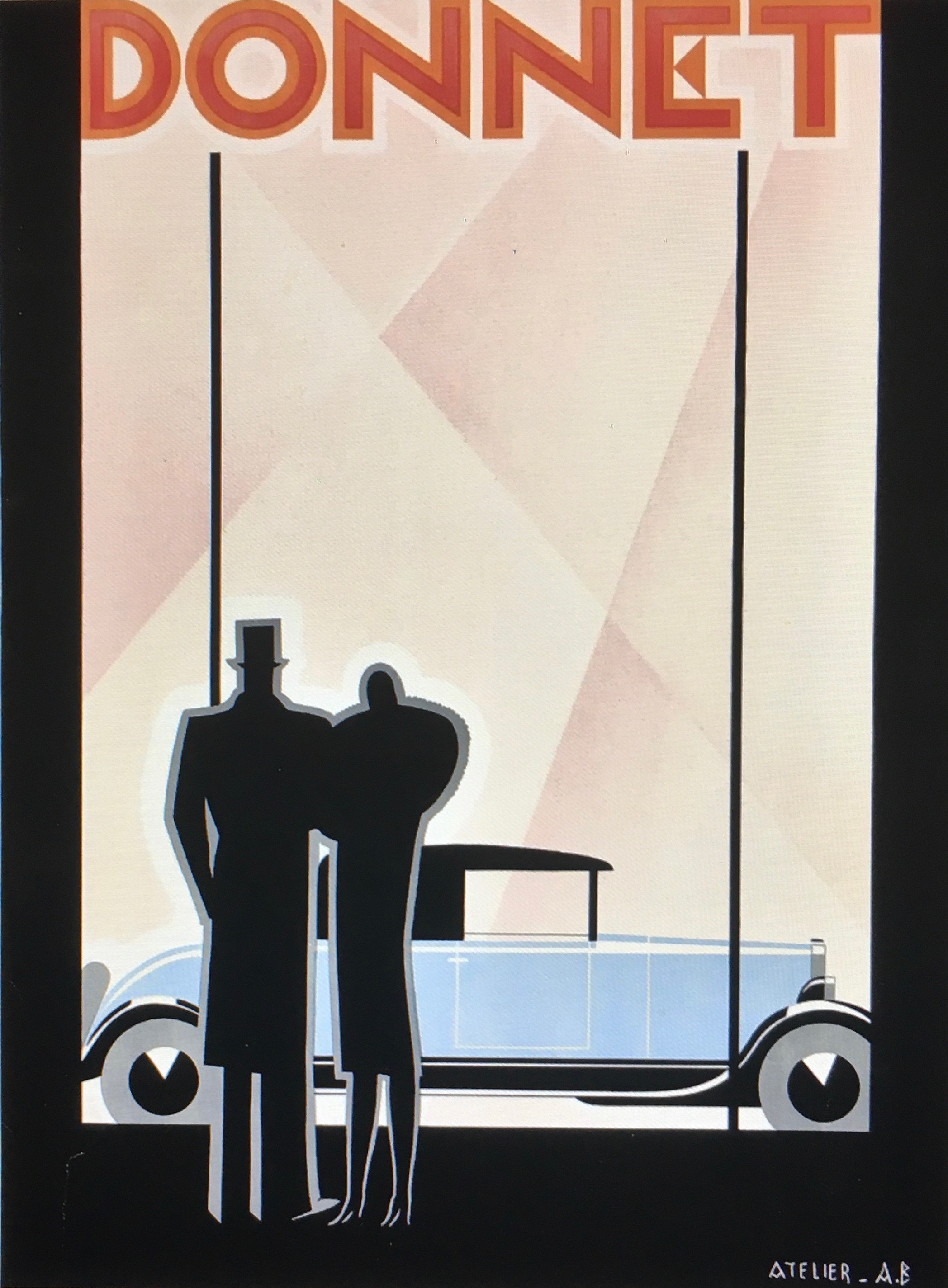
Donnet, 1928, by Alexey Brodovitch.
According to Wikipedia, the company’s “impressive modern factory at Nanterre was sold to SIMCA at the end of 1934.”
But Only Awhile. Poster House writes, “This exhibition chronicles the rise and fall of what would come to be known as Art Deco, starting with the 1925 Paris Exhibition where various factions of the European avant-garde were distilled through commercial endeavors to become the visual language of capitalism, and ending as Deco graphics became more nationalistic in the lead up to World War II.” ds
© Dennis Simanaitis, SimanaitisSays.com, 2023


I am going thru +/- 40 years of “Motor Sports” and “Classic & Sportscar” and taking out all the wonderful auto related art work for my collection.Also taking all the Morgan related items.John McNulty