
Simanaitis Says
On cars, old, new and future; science & technology; vintage airplanes, computer flight simulation of them; Sherlockiana; our English language; travel; and other stuff
THE LOST WORLD 1925 PART 1
I HAVE LONG ADMIRED ARTHUR CONAN DOYLE, literary agent for Sherlock Holmes and, it can be noted, for another notable as well: Brigadier Gerard. Indeed, you may recognize Conan Doyle himself as an accomplished author: See The Story of the Lost Special, 1898, and The Lost World, 1912. The latter is particularly memorable engendering a silent movie rendering, The Lost World, 1925, and, indeed, an entire genre of dinosaur/sci-fi flicks.

The Lost World, by Arthur Conan Doyle, Hodder & Staughton, 1912. Image of the 1898 novel.
Offered today and tomorrow in Parts 1 and 2, the following tidbits are gleaned from a variety of sources.
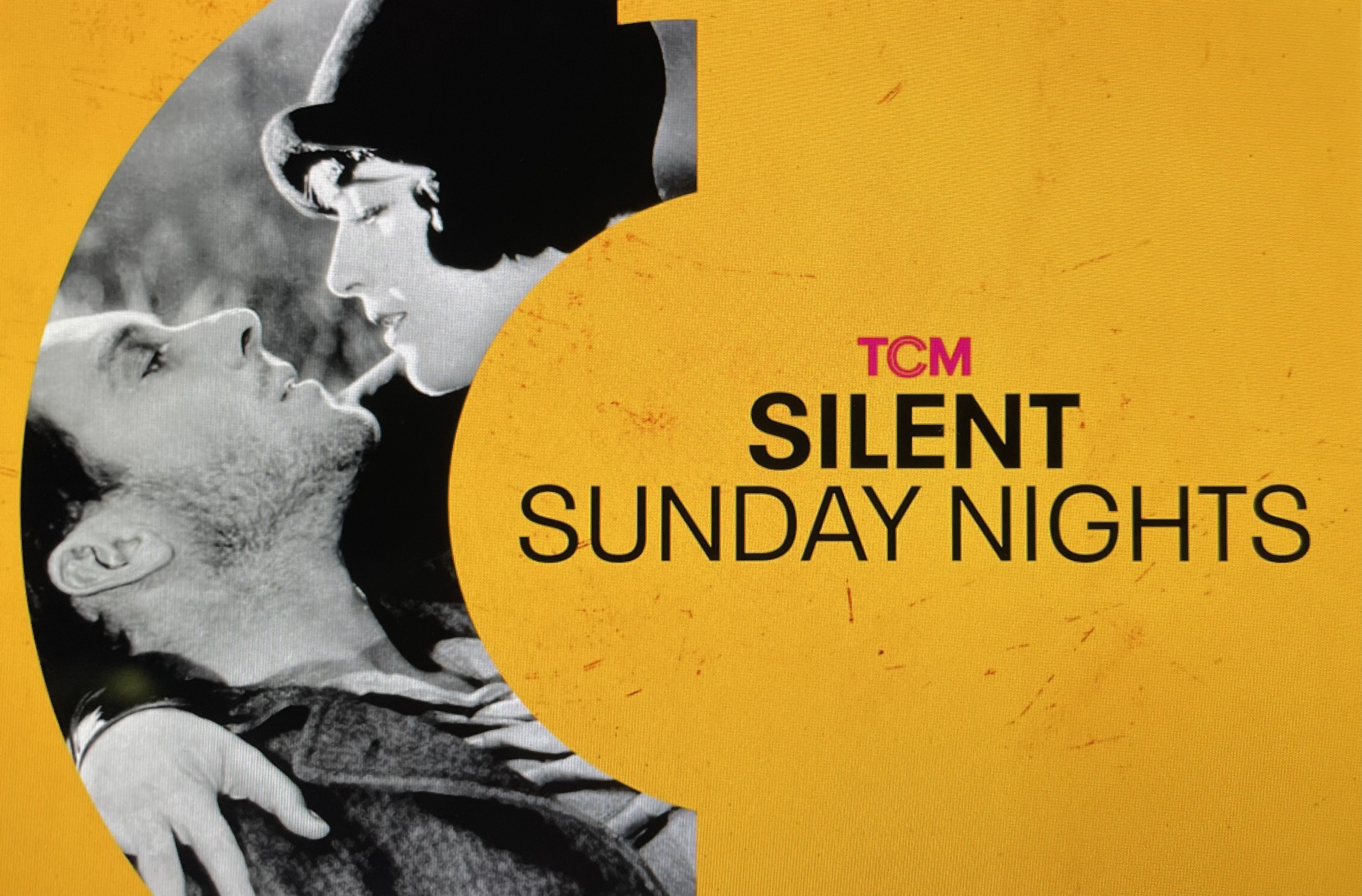
Silent Movies. Though I am hooked on Turner Classic Movies, only rarely does its “TCM Silent Sunday Nights” capture my attention. One stunning exception was “A Real Lulu of a Silent Flick Part 2.” The movie Pandora’s Box, 1929, attracting me as a cinematic precursor of Alban Berg’s 1937 opera Lulu.
Another is TCM’s recently featured The Lost World, 1925, rich in cinematic rendering of the Conan Doyle novel and its innovative stop-motion animations, not to say its tidbit-rich actor links as well.

Stop-Motion Animation. Wikipedia describes stop-motion as an cinematic technique “in which objects are physically manipulated in small increments between individually photographed frames so that they will appear to exhibit independent motion or change when the series of frames is played back.”

This and other images from tv screen grabs of The Lost World via TCM.
In particular, The Lost World was the first feature-length film to use this technique. Willis H. O’Brien “combined animated dinosaurs with live-action footage of human beings, but at first he was able to do this only by separating the frame into two parts (also known as split screen). As work went on, O’Brien’s technique grew better and he could combine live-action and stop-motion footage in the same part of the screen.”
By the way, O’Brien was to continue developing his art in King Kong (1933), The Last Days of Pompeii (1935), and Mighty Joe Young (1949), for which he won the 1950 Academy Award for Best Visual Effects.
The Lost World, an Aviation First. Wikipedia continues, “The film received its world premiere at the Astor Theatre in New York City on February 8, 1925. In April 1925, on a London-Paris flight by Imperial Airways, The Lost World became the first film to be shown to airline passengers. As film stock of the era was nitrate and highly flammable, this was a risky undertaking on a wood and fabric-hulled plane such as this converted First World War bomber, the Handley-Page O 400.”
The Novel vs the Flick. The movie opens with a tribute to Sir Arthur Conan Doyle.
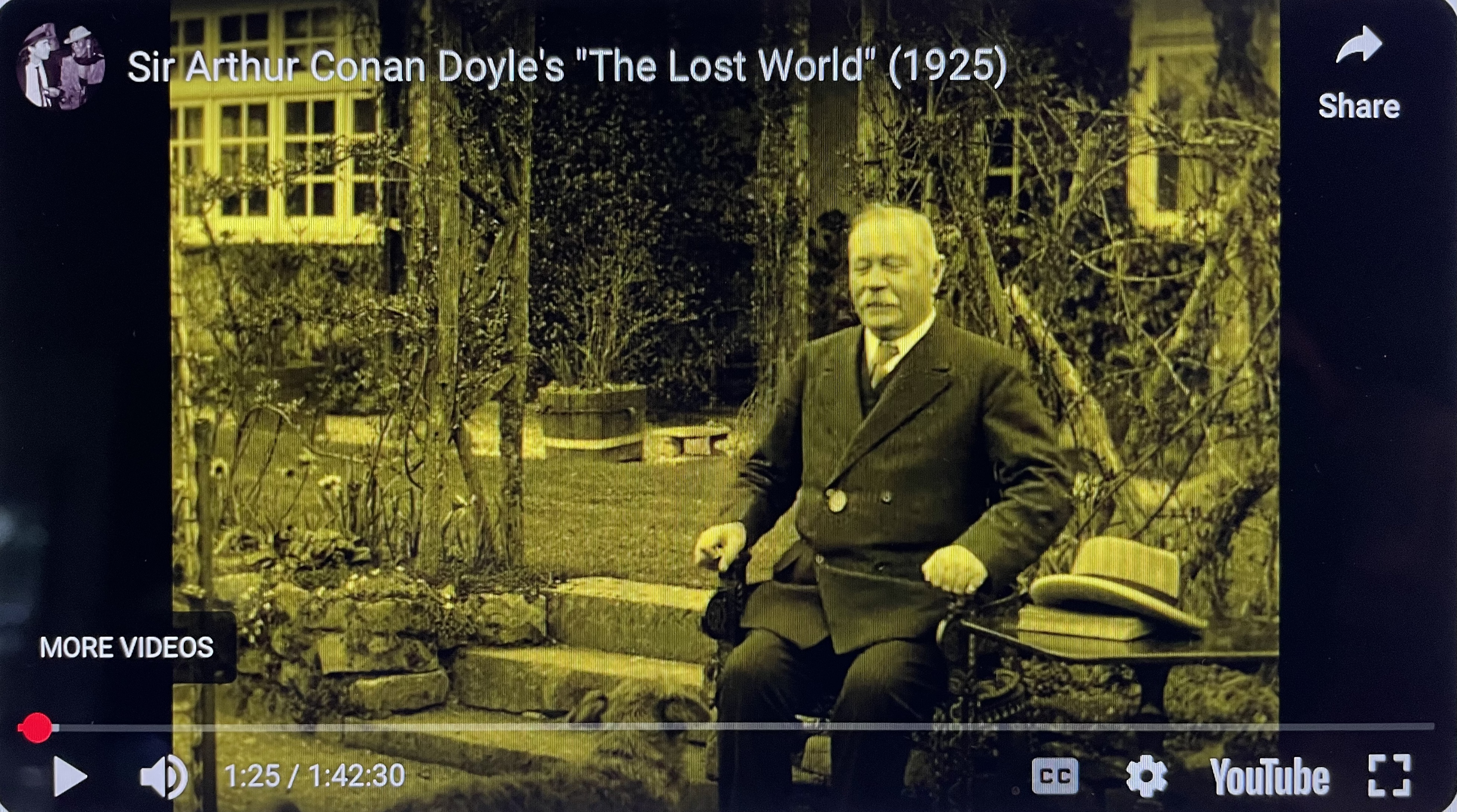
Sir Arthur Conan Doyle. Below, his novelistic aspiration. By the way, such silent-flick blurbs are known as “intertitles.”

Both novel and book refer to a plateau in the Amazon basin where allegedly dinosaurs thrive. An expedition survivor, Professor Challenger, is ridiculed as he has only a tattered diary as proof.
Daily Gazette reporter Edward Malone seeks to impress fiancée Gladys with his heroics, so he joins a new expedition along with Challenger, the latter’s rival scientist Professor Summerlee, and adventurous hunter Lord John Roxton.
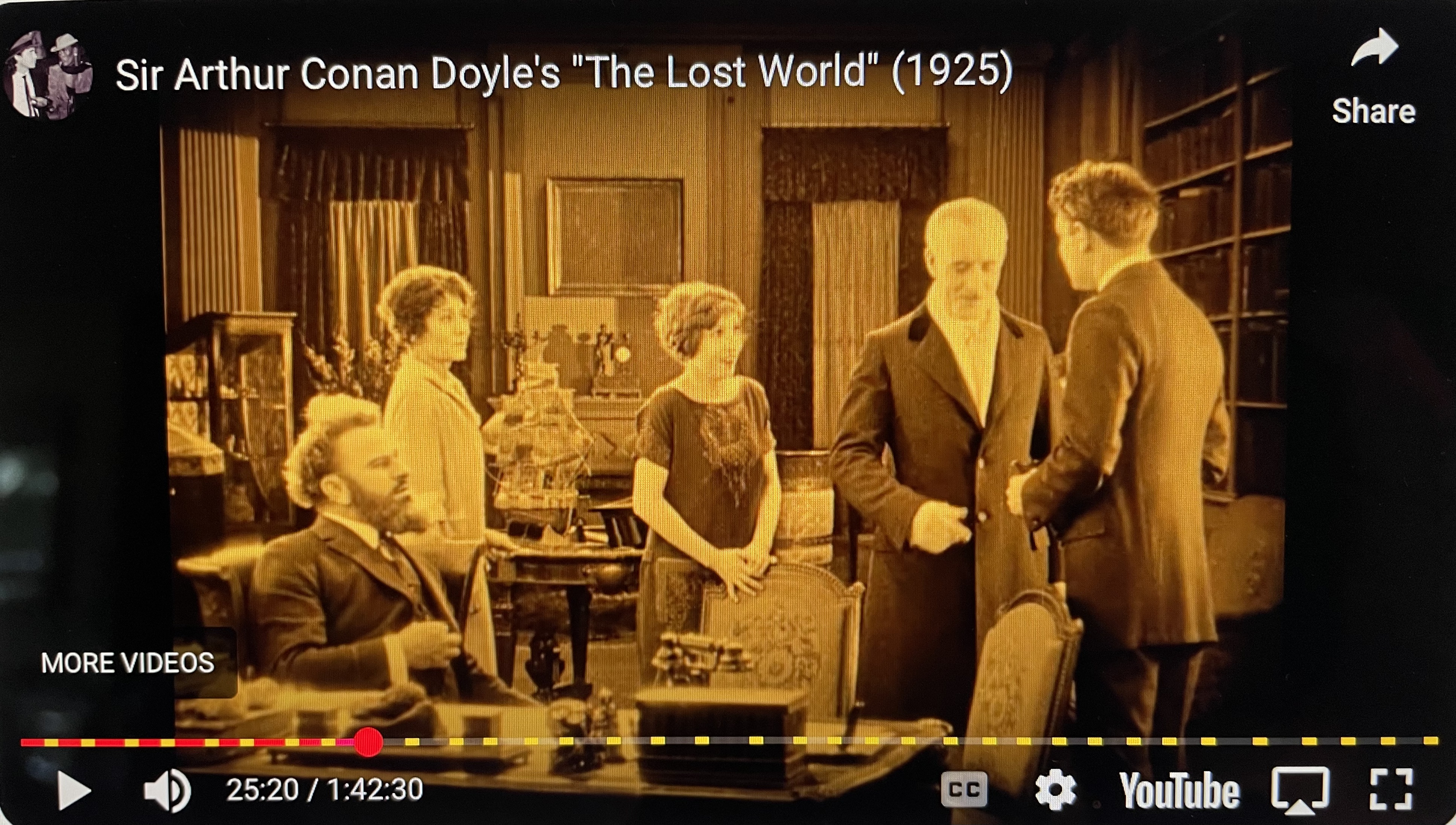
A visit to the Challengers. From left to right, Professor Challenger (Wallace Beery), Mrs. Challenger (Margaret McWade), Paula White (Bessie Love), Sir John Roxton (Lewis Stone), and Edward Malone (Lloyd Hughes).
The movie introduces a love interest; indeed, sorta a love quadrangle: Lord Roxton has a middle-age attraction to Paula White, daughter of the explorer/diarist Maple White. Though promised to Gladys, Malone (more appropriately aged) gets the hots for Paula as well. Paula is portrayed by Bessie Love, a real dish (of which more anon when we focus on actor links).
The expedition also includes Zambo, the book’s South American Black/the flick’s Indian servant, portrayed in the era’s blackface even in his captioned comments.
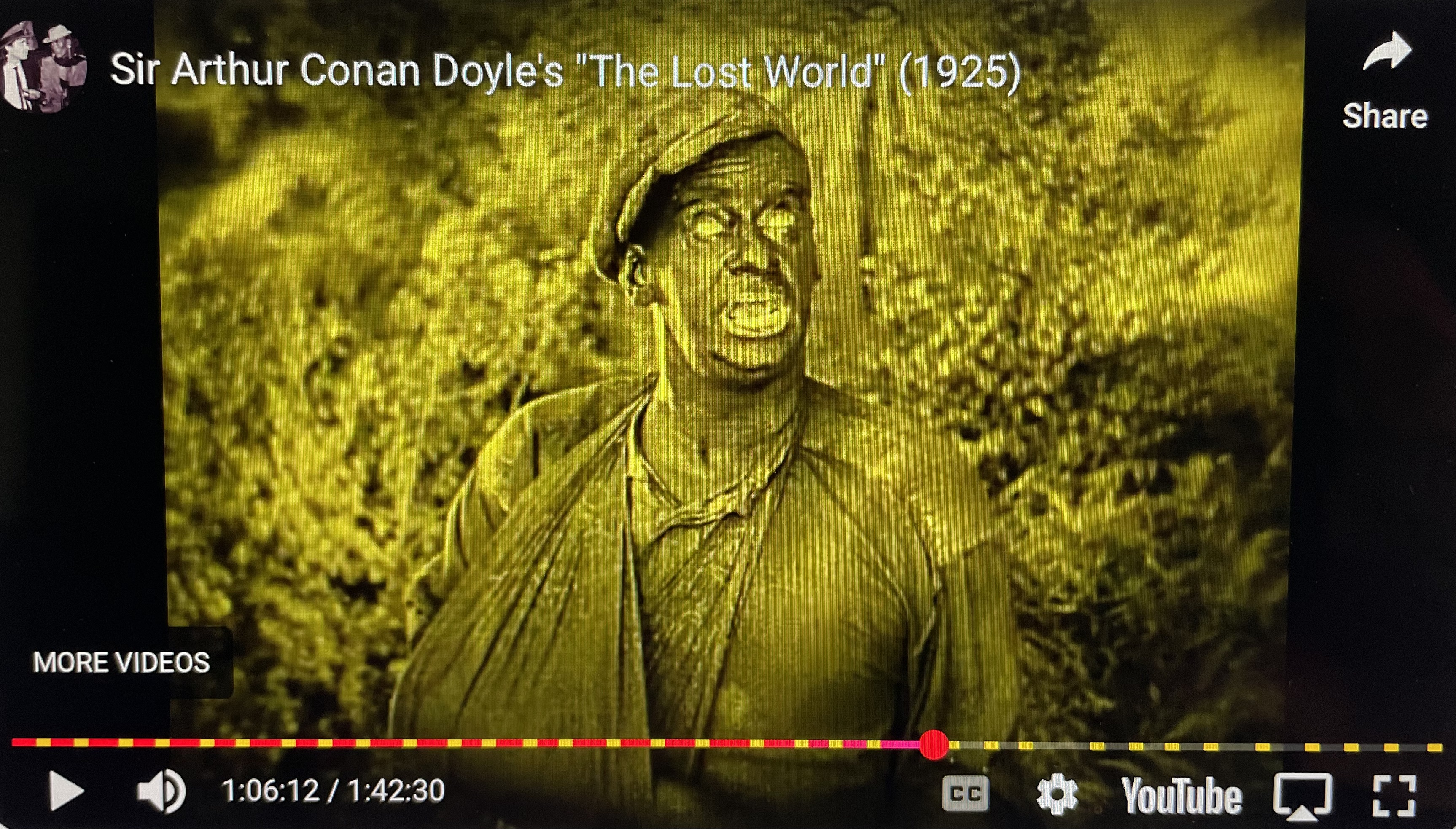
Zambo (Jules Cowl).

The flick also has Austin (Challenger’s butler). Both novel and movie have Jocko the monkey, a Paula pal who plays a pivotal role in the flick.
Tomorrow in Part 2, we’ll provide a few teasers and the real scoop on Paula portrayer Bessie Love.
© Dennis Simanaitis, SimanaitisSays.com, 2025
 Simanaitis Says