
Simanaitis Says
On cars, old, new and future; science & technology; vintage airplanes, computer flight simulation of them; Sherlockiana; our English language; travel; and other stuff
A LOT OF BRITISH CARS—WITH TALES TO TELL PART 2
YESTERDAY WE SELECTED MEMORABLE BRIT CARS from Classic & Sports Car magazine’s A-Z of Cars: 1947–1970. Here in Part 2 we continue with tales of a Ginetta drive, a Jewett-enhanced job offer, Rob Walker’s little known Opus HRF, and even Georgia fried rice.
Ginetta. A-Z recounts, “The enthusiastic Walkett brothers, Bob, Ivor, Trevor, and Douglas, made their first production vehicle, the G2, in 1958.” By the 1960s, “the cars were remarkably successful in club racing….”
Amazingly enough, SimanaitisSays wrote in 2014, “Ginetta was founded in 1958 and continues to this day as a specialized sports car manufacturer (www.ginetta.com).”

The G4, 1961-1968 (production: approx. 390); revived in Mk IV guise in 1981.
SimanaitisSays continued that once “wife Dottie and I visited the company’s Midlands works and drove a G33. Great cottage-industry fun.” I recall taking a charming young pub waitress for a quick thrill ride in the car.
Jowett. A–Z calls Jowett “Yorkshire’s finest car, but then not that many came from Yorkshire…” The company dates from 1906, “but the marque’s most exciting period was after 1945: both the Javelin and Jupiter were technologically advanced by the admittedly backward British industry standards of the day.”
Ouch.

Jewett Javelin. 1947–1953 (production: 22,799).
When interviewing for a post-academic position at the Society of Automotive Engineers in the mid-’70s, I made up for corporate innocence by knowing about the Jewett Jupiter which one of the SAE execs used to race in SCCA events of the era. He became a respected pal.

This Jupiter took a class win at Le Mans in 1950; the year before, a Javelin had done likewise. See “A Yorkshireman’s Sports Car.”
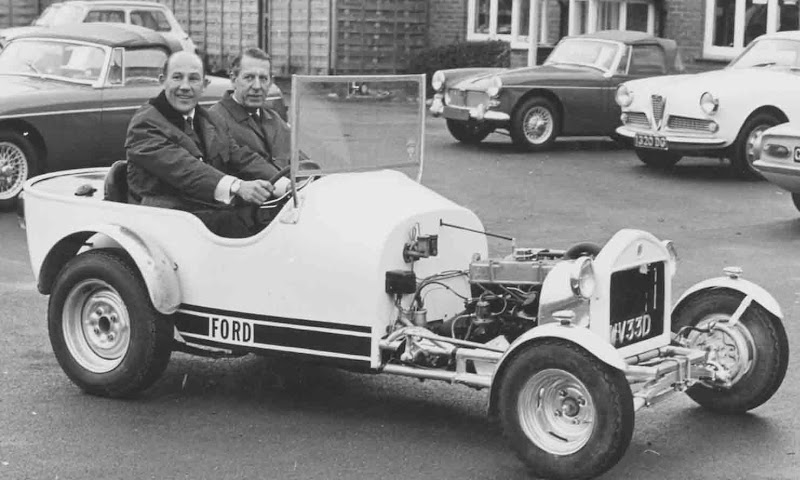
Opus HRF. A–Z describes, “Basicially a cheap fun car, this delight was produced at first by Rob Walker, the famous race team owner…. A sort of lowboy T-bucket of Neville Trickett’s devising… Tubular frame, old-school Ford Pop front axle, 105E Anglia brakes, Mini wheels, and any Ford mechanicals you wanted. Said to cost £300 on the road if you made it yourself. Hairy anyhow, as one might expect with only 8cwt.”

Opus. 1966–1972 (production: approx 250).
Classic and Recreation Sports Cars offers this marvelous photo of Rob with one of his drivers (a really famous one).
Scootacar. A–Z recounts this was “a bizarre vehicle produced by Scootacars Ltd in Leeds, whose parent company was Hunslets, famous for making locomotives.”

Scootacar Coupé. 1957–1965 (production: 1000 all types). “Fifty mph with Villiers single, twins faster, but only about 10 made.” A–Z notes there’s a club for the breed.
“Inspiration, for the car, it is claimed,” says A–Z, “was that a Hunslets director’s wife wanted something smaller and easier to park than her Jaguar….”
TVR. “Somehow,” A-Z observed in 1986, “TVR has survived to this day, and is still making exciting sports cars. Yet its history has been full of ups and downs.” TVR Engineering was set up in 1947 by Trevor Wilkinson, though he hadn’t been involved with the marque since 1965. The New York Times reported his death in 2008: at age 85 on the island of Minorca. The firm TVR is still here in 2025.
Back in 1983, R&T’s Richard Baron and I had a real TVR adventure traveling to Newman, Georgia, southwest of Atlanta, to test the Tasmin Convertible: “There, TVR importer/ex-pat Englishman Peter Bircumshaw told us, ‘I saw that cover story in March 1981, and the part about no U.S. importer gave me the idea. So you people are responsible for whatever happens now, you see.’ ”

Our 1983 Georgia Tamsim.
I recounted that during Georgia touring “we encountered the Mirror of Korea restaurant. Its charming waitress, perhaps Georgia-bred, had the neatest southern drawl (“Fu’wahd wice, suh?”). The kimchi was great too.” ds
© Dennis Simanaitis, SimanaitisSays.com, 2025
 Simanaitis Says
I love ‘LBC’s .
Some (scootacar) are simply a bridge too far but they’re always so much fun to drive .
-Nate
In Yorkshire in about 1950, my dad had a Jowett van, made in Idle, near Bradford. We often drove by “the works” but never stopped in. After The Great Misunderstanding, brilliant German automotive engineer Robert Eberan von Eberhorst, who had designed the Auto Union Type D Grand Prix car, moved to England to work for ERA, where he designed the chassis of the Jowett Jupiter.