
Simanaitis Says
On cars, old, new and future; science & technology; vintage airplanes, computer flight simulation of them; Sherlockiana; our English language; travel; and other stuff
CLASSICAL.COMPOSERS@MUSIC
THE INFORMATION HIGHWAY (AND SEWER) HAVE PLENTY OF WEBSITES for creative types: authors, composers, entertainment personalities, (even presidents, see parenthetical comment above). SiriusXM‘s “Symphony Hall” morning host John Clare suggested an interesting variation: classical.composers websites dedicated to the greats. Here are tidbits concocted along this theme.

Bach.family@Late Baroque. Wikipedia recounts, “The Bach family already had several composers when Johann Sebastian was born as the last child of a city musician, Johann Ambrosius, in Eisenach….” And Johann Sebastian sure did his best to expand the brand: Catherina Dorothea, singer; Wilhelm Friedemann, organist and teacher (taught Johann Gottlieb Goldberg, of Variations fame); Carl Philipp Emanuel (Mozart said of him, “He is the father, we are the children); Johann Christoph Friedrich (the Buckeburg Bach,” not to be confused with his younger brother); Johann Christian (the “London Bach” of the Classical era; born when his father was 50).
Wikipedia notes, “Since the 19th-century Bach Revival, he has been widely regarded as one of the greatest composers in the history of Western music.”

Classic fM recounts, “209 surviving church cantatas, dozens of concertos, countless organ preludes and fugues. And 20 children. J.S. Bach was a very busy man.”
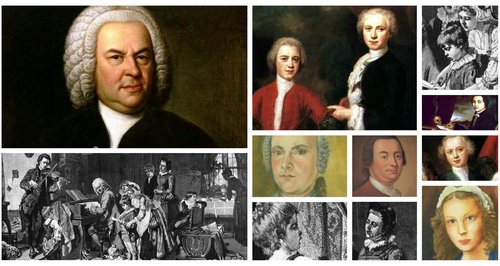
“How many children did J.S. Bach have?” Classic fM asks. “Loads. Here’s what we know: Johann Sebastian Bach, with his wives Maria Barbara (m. 1707–1720) and Anna Magdalena (m. 1721–1750), fathered 20 children over his lifetime. His first was born in 1708 when Bach was 23, with his last coming into the world in 1742, when the composer was 57. Sadly, only ten survived through to adulthood.”
And a goodly number of these would populate the Bach musical website.
Beethoven.Genius@Classical. As noted at “The Arrogance of Genius” here at SimanaitisSays, “It is generally observed that geniuses have no lack of ego.” (This was written in 2014, before genius/ego was discussed in the context of “really stable….”)
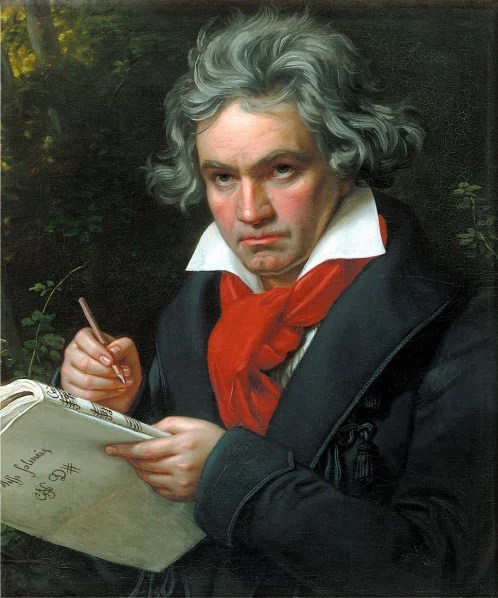
Ludwig van Beethoven, 1770-1827, German composer and pianist, a genius in the transition from the Classical to the Romantic era. Portrait by Joseph Karl Stieler.
Beethoven’s website could open with my favorite story: “Beethoven and German writer and statesman Johann Wolfgang von Goethe encountered some royals strolling toward them. Goethe moved out of their path; Beethoven did not. Beethoven commented later, ‘Prince, what you are, you are by accident of birth…. There have been thousands of princes and will be thousands more; there is only one Beethoven.”
Wagner.RingCycle@Gesamtkunstwerk. The word gesamtkunstwerk, literally “total work of art,” describes how Richard Wagner “sought to synthesise the poetic, visual, musical and dramatic arts, with music subsidiary to drama.” Or so notes Wikipedia.

Wilhelm Richard Wagner, 1813–1883, German composer, theatre director, essayist, and conductor. Image by Franz Hanfstaengl.
With Margravine Wilhelmine, favorite sister of Frederick the Great of Prussia, Wagner built Bayreuth, his own personal performance venue. So why not establish something easy like a website?
Https://www.leonardbernstein.com/. Last, there already is a website for the wonders of composer Leonard Bernstein.

Leonard (born Louis) Bernstein, 1918–1990, American composer, conductor, pianist, music educator, author, and humanitarian. Image from Boston Symphony Orchestra.
Leonard Bernstein also inspired me to compose “Happy 100th Birthday, Maestro!”

For some of the best of yet another medium, see television’s Omnibus, October 16, 1955, when it offered “Bernstein on the Blues.”
What would be your composer websites to consider? ds
© Dennis Simanaitis, SimanaitisSays.com, 2025
 Simanaitis Says
Begs the question: do you have to be dead to be a Classical Composer? I’m old enough to remember Leonard Bernstein alive … which probably makes me an antique. I also remember when his music was considered very modern, though classically inspired.
No, Mike. It’s the genre I have in mind, not the longevity. Both Philip Glass and John Adams, my favorite living composers, come to mind as having online presence.
Well recall Leonard Bernstein’s Young People’s Concerts, first broadcast 1958, through 1972, on CBS, the network already renowned for a long and deep line of premiere journalists offering intensive news, such lost in today’s me-too, pile-on corporate reportage.
Bernstein’s above television shows brought classical music to children and families across the nation (syndicated around the world) whose sole exposure to great music would’ve been limited to occasional snippets of classic lite on the Ed Sullivan Show.
The preceding, and Charlie Rose’s interview with Yehudi Menuhin, were examples of what television could be, reflecting on Dennis’s opening line above.