
Simanaitis Says
On cars, old, new and future; science & technology; vintage airplanes, computer flight simulation of them; Sherlockiana; our English language; travel; and other stuff
MERCEDES-BENZ W196R—FOR THE WELL-HEELED COLLECTOR
MY FAVORITE CAR MAGAZINE, Classic & Sports Car, reports that “Moss and Fangio’s Mercedes-Benz W196R is for sale.” This is surely to be a highpoint of the February 1, 2025, RM Sotheby auction in Stuttgart featuring 11 cars from the Indianapolis Motor Speedway Museum (which had acquired the car in a 1965 donation from Mercedes-Benz).
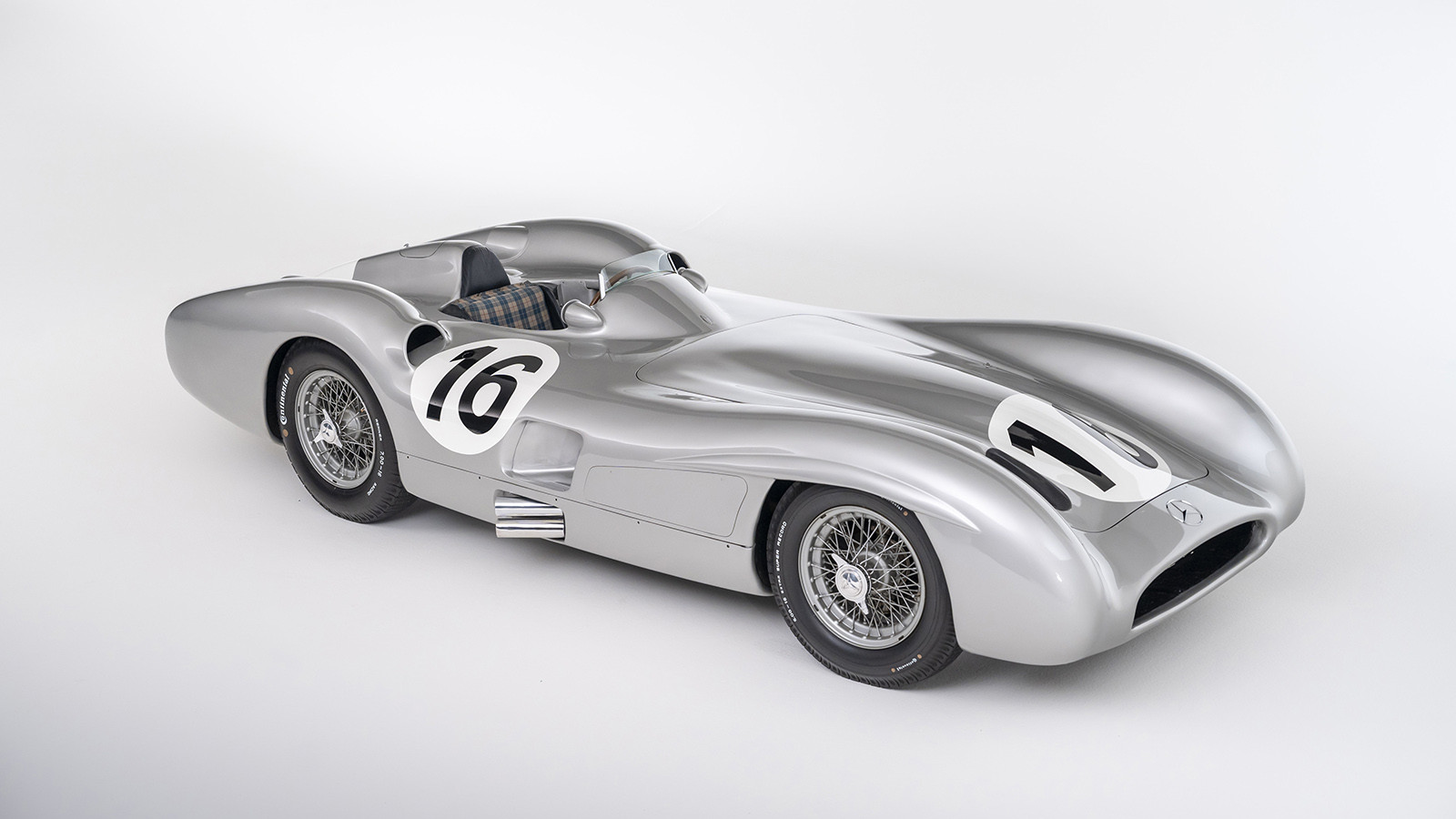
The W196R 00009/54. This and following images from C&SC.
Here are tidbits about this fabulous Grand Prix car gleaned from C&SC and from my usual Internet sleuthing, together with my own custodianship of the model in question.
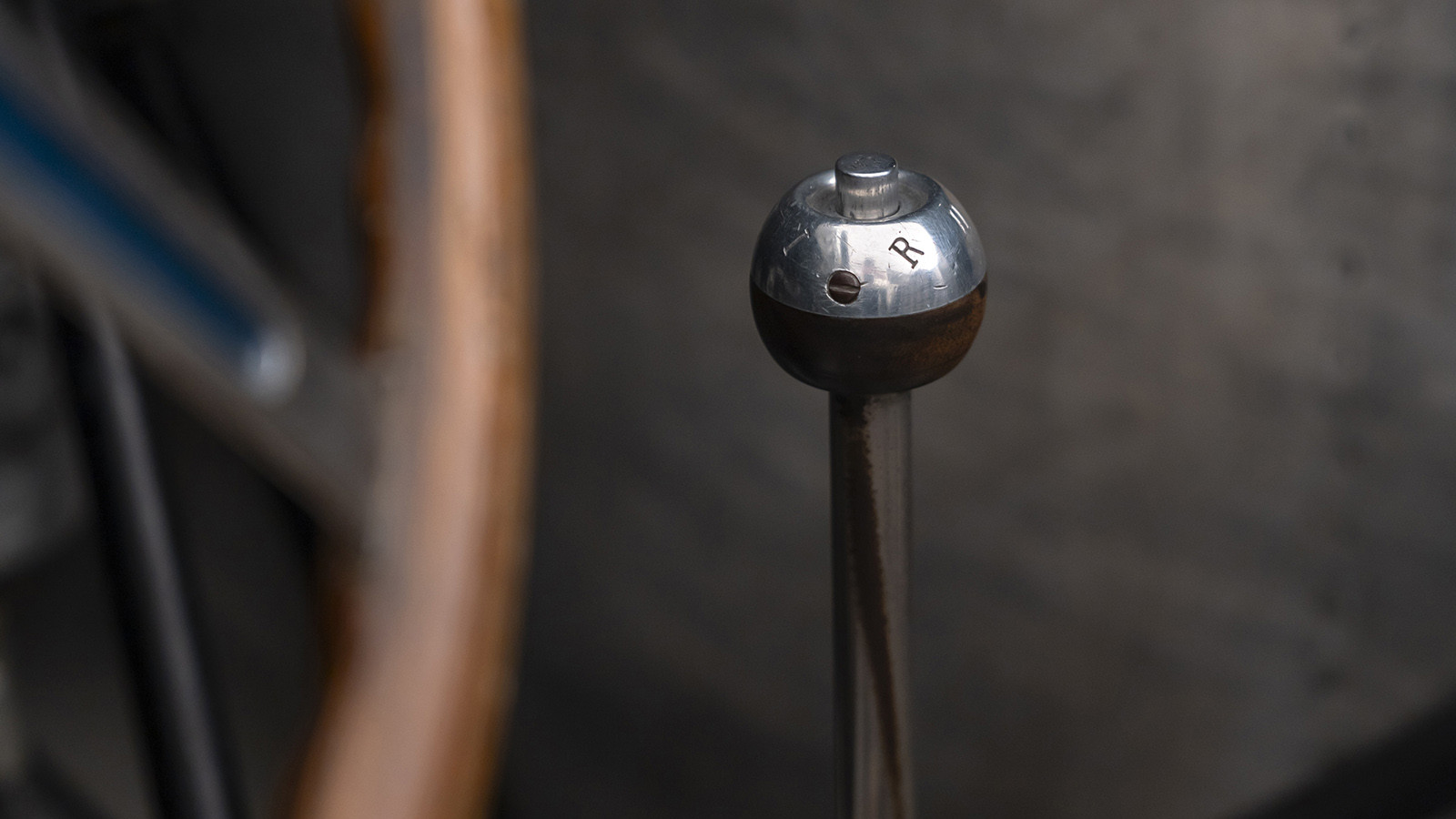
Front-Engine GP Cars—with Shift Levers. As I’ve already observed, the 2.5-liter era of GP, 1954-1960, was memorable.
Juan Manuel Fangio dominated with four consecutive Driver’s World Championships, 1954-1957, of his total five. He and Stirling Moss drove the W196 Mercedes-Benz to victories in 9 of the 12 races in which it competed.
And With Fenders Yet! The W196 debuted at the 1954 French Grand Prix with fully enclosed bodywork enhancing its aerodynamics for the Rheims circuit. Fangio and Karl Kling finished 1-2; teammate Hans Herrmann posted fastest lap.
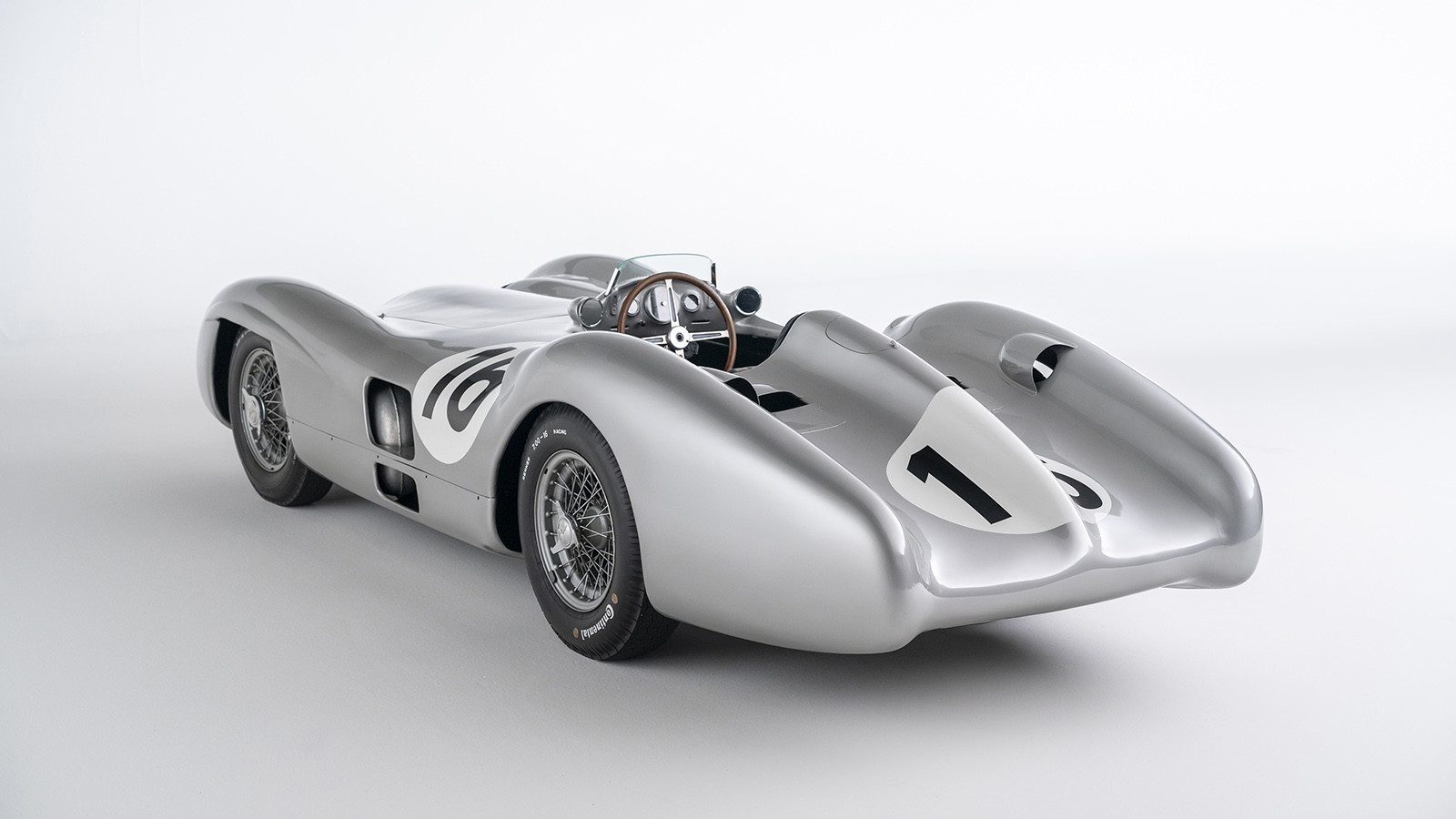
At the next race, the Stromlinienwagen fenders proved a liability with Fangio hitting a number of oil barrels defining the Silverstone circuit. Mercedes subsequently countered with open-wheel W196 cars when appropriate.
At the 1955 British Grand Prix, for example, C&SC recounts, “Mercedes achieved a 1-2-3-4, Moss winning from Fangio, kKling, and Piero Taruffi,” all four in open-wheel W196s. Wikipedia notes, “Several people, including Moss, believed that the Argentine allowed his British protégé to claim his debut win in front of his home crowd. This was, however, at Moss’ inquiry, consistently denied by Fangio, who claimed that Moss ‘was simply faster that day.’ ”
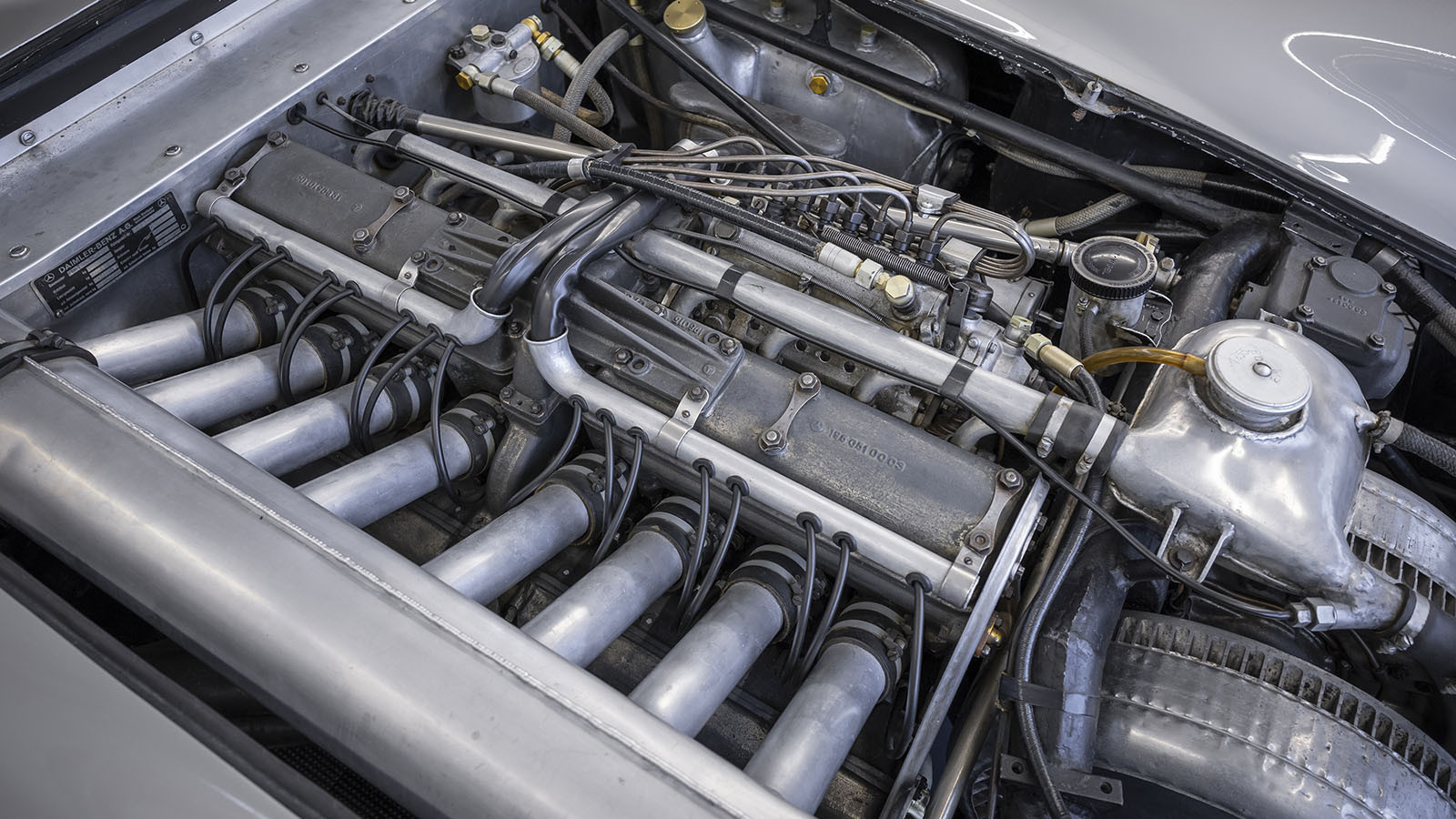
The 2.5-liter direct-injected straight eight was actually two four cylinder blocks with drive taken from the middle. Its desmodromic valves were positively actuated, open and close. Note as well the car’s front brakes, like the rears inboard to reduce unsprung weight.
Stromlinienwagen 00009/54. Fangio drove this particular car to victory at the 1955 Buenos Aires Grand Prix. Stirling Moss posted fastest lap in it the 1955 Italian Grand Prix at Monza.
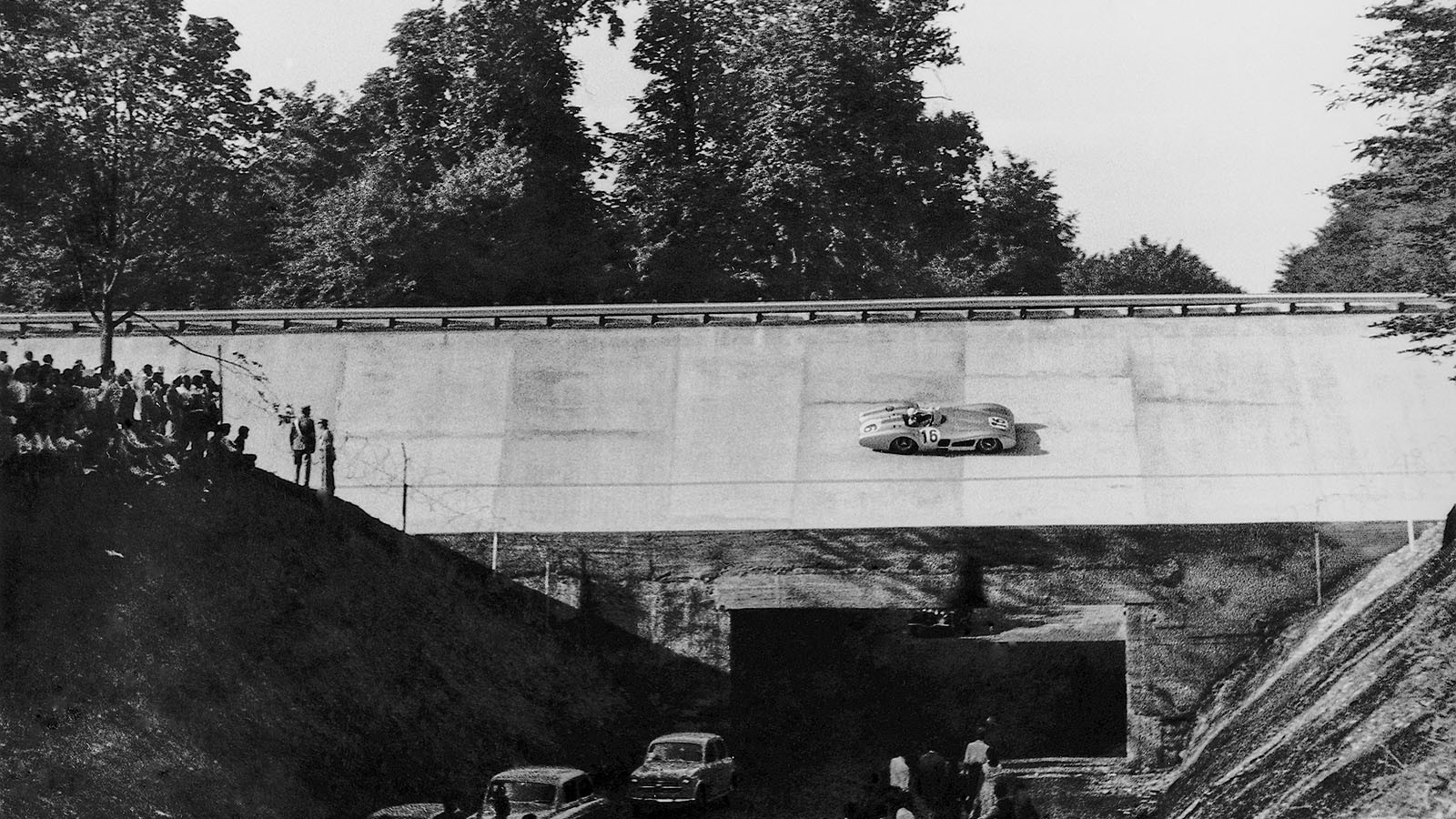
Moss on the Monza banking in 1955.
Sotheby’s notes that this is the first streamlined W196R ever offered for private ownership. See “Mercedes-Benz W196 Ex-Fangio” for details of an open-wheel variant changing hands for $29.7 million in 2013.
A related design, the fabled Uhlenhaut Coupé, one of only two road-going variants, sold for an incredible €135 million ($142.5 million) in 2022.
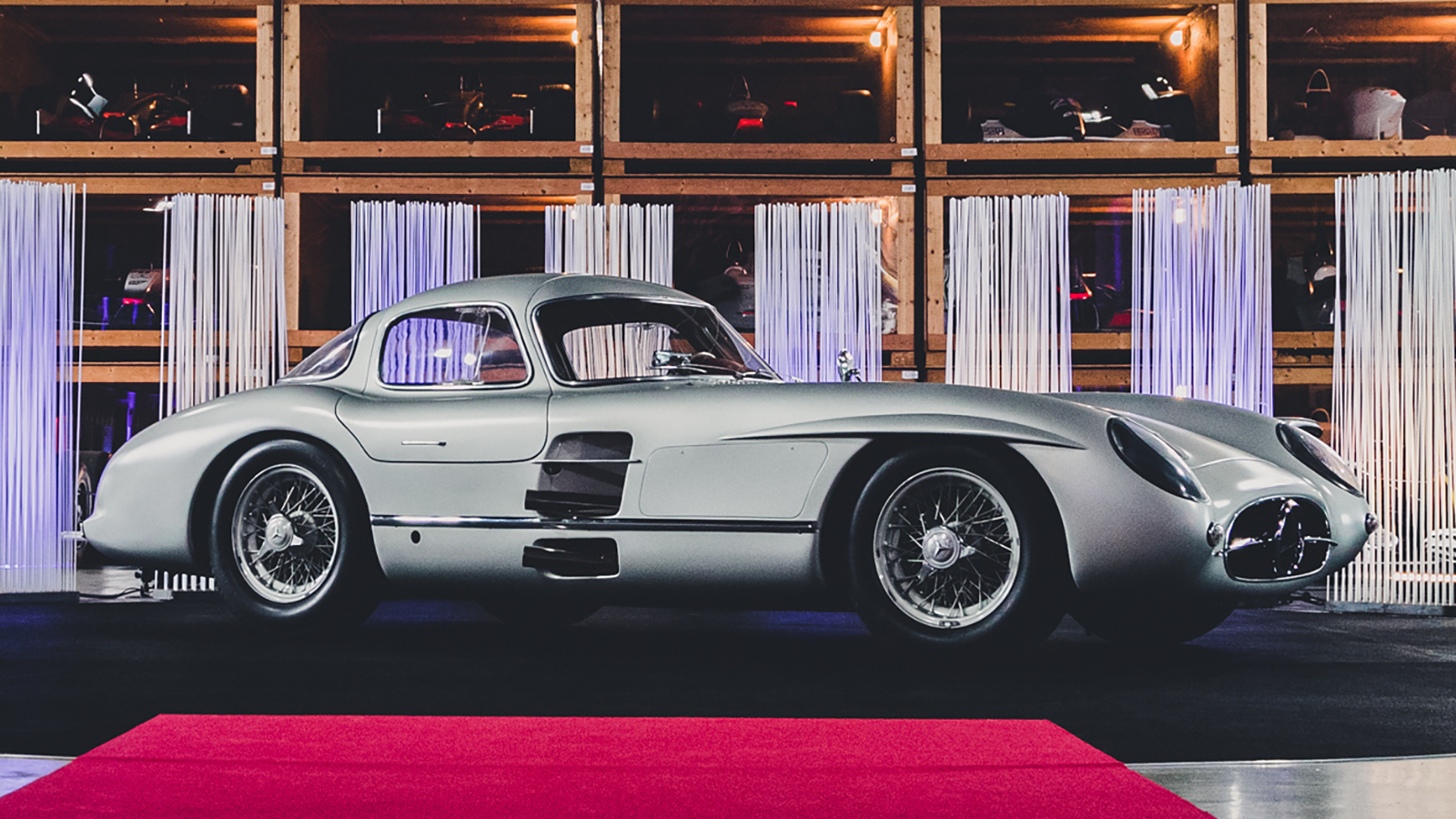
A Uhlenhaut Coupé. Image from C&SC.
C&SC estimates that the Stromlinienwagen GP car “is predicted to reach in excess of €50 million ($55 million).”
My Modest Custodianship. Compulsion Sculpture of Bromley, England, fashioned my own personal Stromlinienwagen of pewter. (The actual car weighs 1828 lb.; mine, a hefty 2.1 lb.)

The Compulsion Sculpture model of a Mercedes-Benz W196R, pewter, 7 1/2 in. long.
Googling its name fails to find the company, but eBay lists several of Compulsion Sculpture’s artful offerings. Mine resides next to a sainted R&T Tapley Meter and is not for sale. ds
© Dennis Simanaitis, SimanaitisSays.com, 2024
 Simanaitis Says
Straight eights were once the preferred mode in both competition and luxe cars, so it was interesting to us vintage fans and inline eight owners to see the exalted Mercedes campaign such an engine layout in the mid-1950s.
Apparently, crank whip was not a problem even at the 196R’s 8,250 rpm horsepower peak and beyond.
Hah. “Front ending with shift lever,” indeed. Something we auld road car owners can relate to.
Thanks for this.
Notice the drive taken off the two four-cylinder split reduced crank whip.
Typo. Meant “…front-engined with shift lever…”
Right y’are, Monsignor Simanaitis, and that point not lost on some of us. Still, eight cylinders inline in a world-class racing car in the mid-1950s both novel and a connection to the earlier greats.
Something poetic about inline sixes and eights, the only engines to have natural, inherent balance; V-12s and V-16s merely the same things but with their firing impulses halved for less crankpin loading, but suffering more parts, complexity, more to go wrong, as an auld friend puts it, “too much of a good thing,”
In this day of so many vintage cars, not just Fords and Chevrolets, but even Packards and Pierce-Arrows, losing their engines–an automobile’s soul–“retro rodded” with SBC 350 V-8 “crate engines” and the like, it’s heartening to read the inline eight swan song above.
For some of us case hardened autoholics, for sporting and GT cars including Jaguar XKs, Aston-Martins, big Healeys, a straight six’s burble is the ticket; or old road cars, luxe or not, whether Buicks, Auburns, Packards, Pierces, Railtons, Alfas, an inline eight’s murmur all you need; automotive Valhalla.
Pardon ramble. Something there is about opening the hood and seeing all cylinders in one tidy row.