
Simanaitis Says
On cars, old, new and future; science & technology; vintage airplanes, computer flight simulation of them; Sherlockiana; our English language; travel; and other stuff
THE GREENEST CARS OF 2024—OVERALL
EACH YEAR THE AMERICAN COUNCIL for an Energy-Efficient Economy ranks cars on an overall measure. Not just the energy used in their propulsion, but also that employed in their manufacture and eventual disposal. Hannah Lutz reports “Toyota Plug-In Hybrid Tops 2024 Greenest Car Ranking,” in Automotive News, March 13, 2024.

Overall Criteria. The ACEEE assess overall costs to human health from air pollution, everything from vehicle manufacture, the production and distribution of fuel or electricity, the vehicle’s tailpipe emissions, and its eventual disposal. In particular, ACEEE notes, it includes air pollution associated with battery manufacturing for EVs.

Methodology. As its technical paper Rating the Environmental Impacts of Motor Vehicles: ACEEE’s greenercars.org Methodology 2016 Edition describes, “The production, use, and disposal of an automobile affect the environment in numerous ways. Impacts start with the extraction of raw materials that go into a vehicle and continue throughout materials conversion and fabrication processes, which involve many different industries.”
“While a vehicle is in use,” ACEEE continues, “fuel consumption, driving, storage, and maintenance create air, water, and noise pollution as well as greenhouse gas (GHG) emissions. Disposal of worn parts (tires, batteries, motor oil, etc.) occurs throughout a vehicle’s life. Finally, the vehicle itself is discarded. Steel and other components can be, and increasingly are, reclaimed and recycled, but none of these processes are impact-free.”
The Greenest of the Green. In its list of the Greenest cars in 2024, two of the top six are PHEVs, in part because of their lighter weights compared to EVs. Hannah Lutz quotes Greg Davis, professor of mechanical engineering at Kettering University: “Heavy battery packs contribute to the weight discrepancy, and manufacturing the large packs is energy intensive…. If you go with a hybrid or even just a plug-in hybrid, the battery size is significantly smaller than the battery size for a typical EV of the same size.”
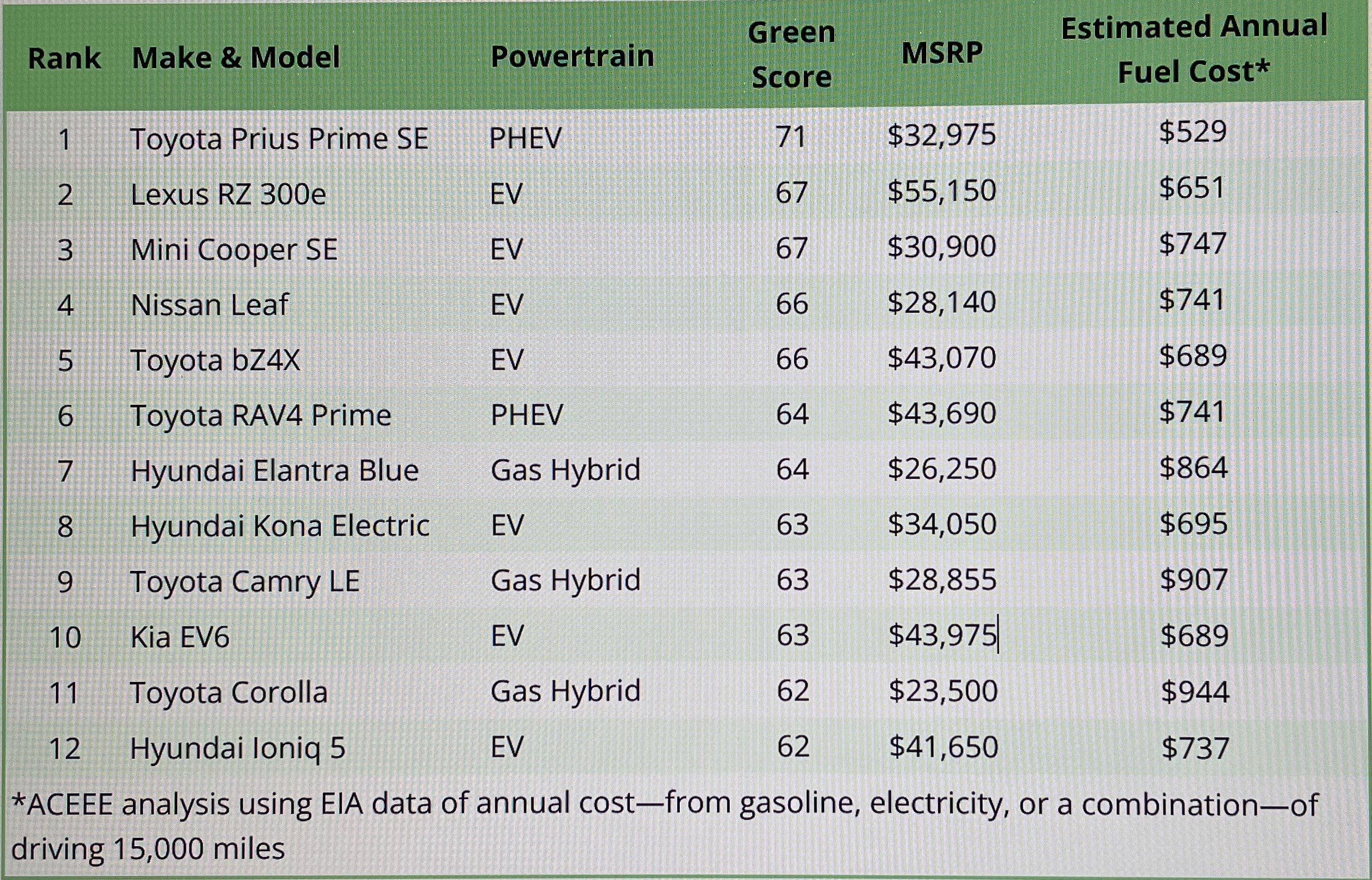
The Greenest of the Green. This and following lists are from the ACEEE. An abbreviated version of this one appeared in Automotive News, March 18, 2024.
A PHEV Beats EVs? Lutz notes, “A PHEV leading the green ranking of mostly EVs didn’t surprise Peter Huether, senior transportation research associate and lead researcher for the GreenerCars rankings. ‘The Prius plug-in hybrid is a very efficient vehicle in general and also has a fairly small battery pack,’ he said. Its electric range is among the longest in the PHEV market at an EPA-estimated 44 miles.”
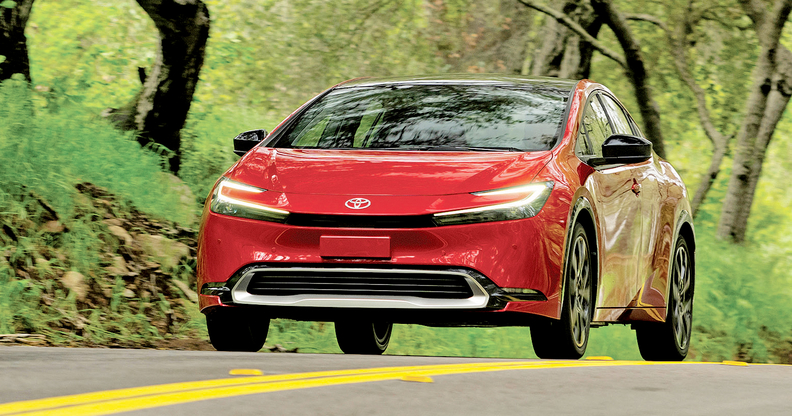
Toyota and Lexus Make Up Half of the Top 12. The Toyota Prius, after all, was the first production hybrid. “Toyota is focused historically on fuel efficiency,” Huether said.
Teslas Missing? Huether also explained Tesla’s omission from the top twelve ranking: “Tesla models tend to have larger battery packs than some EV competitors, which creates more emissions at the production level…. But Teslas are also efficient in using electricity per miles driven.”
Other Green Choices. Though not addressed in Lutz’s Automotive News article, the ACEEE published its assessment of other Green choices. Populated with a variety of gasoline and gasoline/hybrid power, their Green Scores are not far from those of the top twelve.

Greener Choices.
An Editorial View. In April 15, 2024, Automotive News editorializes, “On the Long Road to EVs, Hybrids Are the Detour.” Expanding on this theme, it writes, “While automakers discount the electric vehicles they pledged to pour billions of dollars into, trusty hybrids are gaining traction in the U.S….. A hybrid-heavy market isn’t the outcome the industry planned for, but at least for now, it could be the middle ground needed to reduce emissions.”
Also see “Hybrid Cars Revisited,” here at SimanaitisSays.
Back to ACEEE: Who Populates the Bottom of the List? Lutz writes, “The lowest-scoring vehicles were a mix of gasoline-powered SUVs, such as the Mercedes-Benz AMG G63, Ram 1500 TRX, Cadillac Escalade V Series and Ford F-150 Raptor R. But for the first time, an EV earned one of the lowest scores: the GMC Hummer.”

The Meanest List. Note, unlike the other two lists it’s arranged worst first.
“The Hummer,” Lutz notes, “weighs more than 9,000 pounds. That’s more than 900 pounds heavier than the original Hummer H1 gas-guzzler. Even though the Hummer EV runs on a battery, it takes a lot of energy.”
“It’s a very inefficient vehicle, in general,” Huether said.
You’re telling me. ds
© Dennis Simanaitis, SimanaitisSays.com, 2024
 Simanaitis Says
Thanks Dennis, I’m reminded of your March 19 “Consumer Reports cites hybrids among top cars” . . . Looks like a surprising trend, especially for EV advocates.
For 93 octane gas cost I can attest to 3.7 cents per mile for my AWD Volvo PHEV sedan, measured at the pump over 16,000 miles. With electric included (16.5 cents per kWh) my “cost to propel” is ~7.9 cents per mile, or $1,185 for 15K miles, near the top of the second tier group. (My last ICE, a 4 cyl BMW, also 93 octane, would have averaged ~13.6 cents/mile at 2023 gas prices, $2,040 for 15,000 miles.)
While I’m giving up the lower 87 octane price I’m very much enjoying my 455HP and 523 lb ft . . . Of course, as stated, the cost to propel is only one of many factors for “greenest cars.”
Tailpipe? fueleconomy.gov compare side-by-side says 99 g per mile grnhse gases av for my car, vs 319 for the typical 2024 ICE only car.
I doubt if the environmental hit computed for EVs fully accounts for all of their impacts. The significantly greater weight of BEVs is bound to impact the lifespan of road and bridge infrastructure, and so the environmental impacts of more frequent repairs and replacement should also be considered.
Allocating these types of costs to individual vehicles of course is difficult to do due to the indeterminate nature of the variables (traffic loads, vehicle miles driven, fleet mix, etc.).
But there will definitely be an environmental hit for the impact of heavier BEVs on our roads.