
Simanaitis Says
On cars, old, new and future; science & technology; vintage airplanes, computer flight simulation of them; Sherlockiana; our English language; travel; and other stuff
RACING LINKS TO R.E. OLDS, THE SULZER BROTHERS, AND A COMMER KNOCKER PART 1
SCORES OF BRITISH bus and lorry drivers have been propelled by a highly unorthodox engine with a racing link. Based on a 1934 patent of Ransom E. Olds, or maybe an earlier Sulzer Brothers’ one, the Commer TS3 Knocker had three horizontal cylinders, each containing two pistons reciprocating opposite each other. Odd though it was, this 200-cu.-in. (3.26-liter) Roots-blown diesel engine was used in trucks and buses in 1950s and 1960s Britain. A racing link came in the engine’s powering the custom-built one-off transporter for Ecurie Ecosse, the Scottish motor sports team famed for Le Mans victories in 1956 and 1957. Here, in Parts 1 and 2 today and tomorrow, are tidbits on the Commer Knocker, its origins, and racing team career.
The Olds 1934 Patent. Ransom Eli Olds stayed with his namesake company, founded in 1897, for less than a decade. He established Reo in 1904 and saw it flourish into a manufacturer of cars, trucks, and even buses. These last two got him interested in diesel combustion.
In 1934, Olds filed a U.S. patent for a lightweight two-stroke diesel particularly unorthodox in its layout.
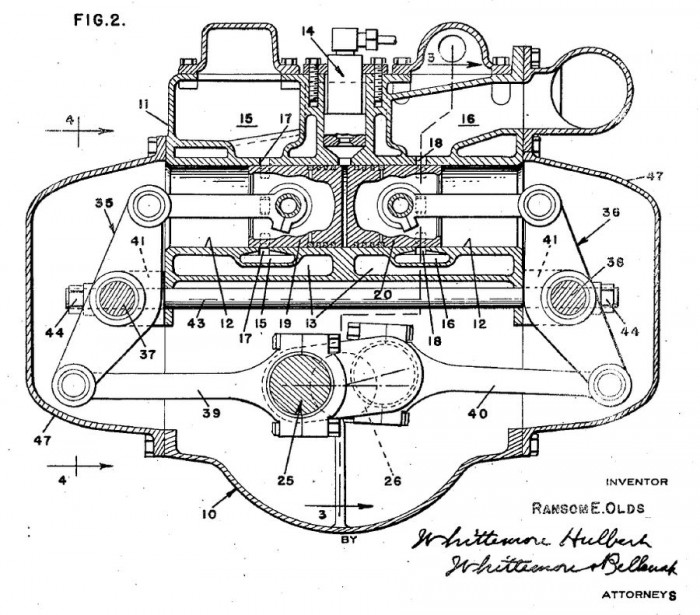
The opposed-piston/single-crankshaft two-stroke engine patented by Ransom E. Olds in 1934.
In each cylinder, a pair of pistons reciprocated toward each other on the compression stroke and away from each other on the power stroke. Each piston was linked to a central crankshaft located below via a rocker arm/con rod assembly.
Being a valveless two-stroke engine, its intake and exhaust were achieved by the pistons’ exposing ports in the cylinder. A blower promoted scavenging, forcing out the spent combustion while encouraging a fresh charge of air into the pistons’ shared combustion chamber. Being a diesel, the injected fuel was then ignited by the extreme temperature of the compressed charge.
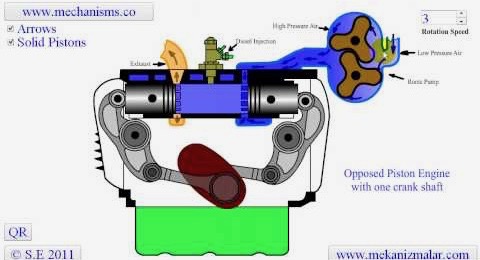
This animation from mechanisms.com shows the engine’s operation.
The Engine’s Swiss Origin. According to Daniel Strohl in Hemmings Daily, January 9, 2014, the idea of an opposed-piston/single-crankshaft diesel “apparently originated with Sulzer Brothers, a Swiss diesel engine manufacturer.” He also notes that Sulzer seems to have licensed its ZG9 engine design to Hill Diesel, a U.S. company bought by Olds in 1929. Strohl writes, “The same Sulzer ZG9 also apparently provided inspiration (whether licensed or not, we have yet to determine) to British firm Tilling-Stevens, which designed its own opposed-piston diesel that Rootes put into production as the TS-3, commonly known as the ‘Knocker,’ powering Commer trucks during the 1950s and 1960s.”
Commer’s TS3. According to Wikipedia, “It is often thought that ‘TS’ in the engine’s name derives from its Tilling-Stevens origin… but this is incorrect. It stands for Two-Stroke. Development of the engine started … some four years before Rootes acquired Tilling-Stevens.”
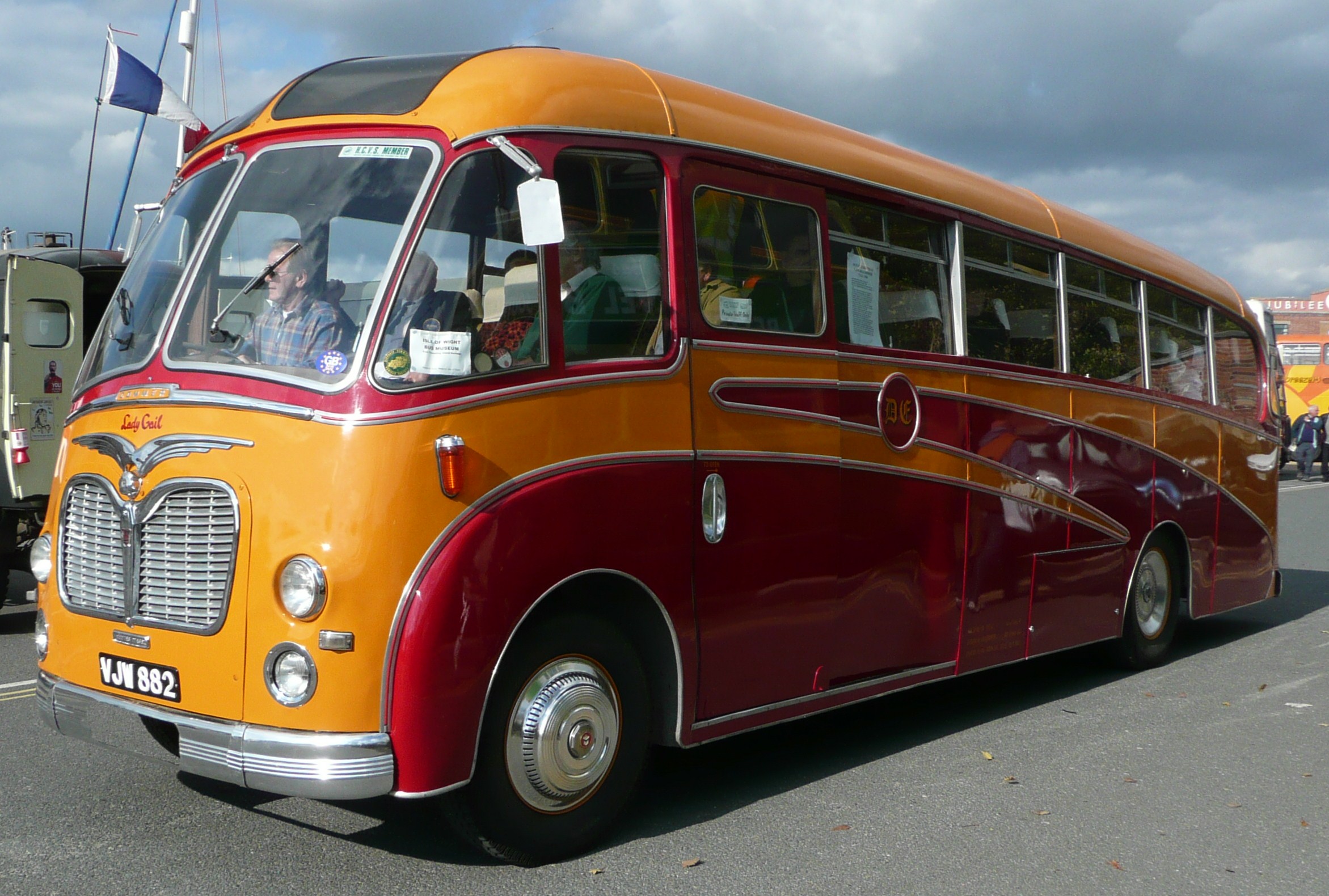
A Commer TS3-engine coach at the Isle of Wight Bus & Coach Museum in 2008. Image by Arriva436.
The TS3 as fitted to Commer trucks and buses produced 105 hp at 2400 rpm and an impressive 270 lb.-ft. of torque at 1200 rpm. The engine’s flat-three configuration permitted its being mounted beneath the floor in a cab-forward layout.
The Knocker nickname came not from diesel combustion nor the exhaust, but rather from timing gear clatter of its scavenging blower in export TS3s. Wikipedia writes “… when the timing gear became worn over time, the export models produced that wonderful ‘knocker, knocker, knocker’ sound at idle that is so well known in New Zealand and Australia but not present in the U.K. models.”
Tomorrow, we’ll see how American Ransom E. Olds, the Swiss Sulzer Brothers, and British Commer Ltd. eventually came to the aid of a Scottish motor sports team with a French name. ds
© Dennis Simanaitis, SimanaitisSays.com, 2019
 Simanaitis Says
Then there was the Fairbanks-Morse OP engine used in subs and other marine service, locomotives, and powerplants. Unlike this one, it had 2 crankshafts geared together at one end of the engine. https://en.wikipedia.org/wiki/Fairbanks_Morse_38_8-1/8_diesel_engine
A more complicated but very successful opposed piston diesel engine was the British Napier Deltic with three crankshafts.
Wikipedia article with a hypnotic animated diagram – https://en.wikipedia.org/wiki/Napier_Deltic
Agreed. The Napier Deltic made an appearance here at SimanaitisSays as well: http://wp.me/p2ETap-32R.
While Ransome Eli Olds may have filed a patent for his engine, in the past I have contacted the R.E.Olds Transportation Museum in Lansing Michigan and they have never heard of it nor any record of it ever being put into production or an example built. It just remains yet another filed patent that went nowhere. I donʻt know that the engines mentioned could be called the ʻinspirationʻ for the TS3. It is very clear, from papers he presented to various important engineering bodies, that Eric Coy, the lead engineer on the TS3 development, was very knowledgeable about opposed piston design (and there are older versions you havenʻt mentioned). As head of the Rootes Engine Division, based at the Humber Stoke Aldermoor plant at Coventry, I believe he decided on the CONCEPT of the opposed piston design to meet the Commer Truck requirements for a diesel engine to fit under the cab of the new QX forward control cab design. It offered a compact motor, lighter in weight than a four stroke design with no cylinder head and fewer parts, and with its high thermal efficiency, greater fuel efficiency. The 2 stroke design could offer similar power output to a 4 stroke 6 cylinder design but with a much more compact space. What I can never understand is why so much is made about the TS3 being a copy of some other motor or was inspired by some other motor. No one ever makes similar comments on an internal combustion engine being a copy of Otto first successful IC engine, , or that Harry Mundy copied the Alfa Romeo / Sunbeam /Peugeot twin cam engine in developing the Lotus Twin Cam unit. It is all about different individuals coming up with a similar concept to problem solve a particular problem. Why, therefore, is the TS3 always regarded as a copy? Lets give Eric Coy and his tiny team of 7 that developed the TS3, the credit they richly deserve. His design, definitely not Tilling Stevens! proved to be a very reliable, fuel efficient engine that, like the trucks they powered, were abused something terribly in the likes of New Zealand and Australia, carrying loads two or three times their intended capacities for applications never dreamed of in its development. And even when sick, with the likes of broken liners, would still do an honest days work. As so many operators of the time used to tell me, the TS3 made them money!