
Simanaitis Says
On cars, old, new and future; science & technology; vintage airplanes, computer flight simulation of them; Sherlockiana; our English language; travel; and other stuff
DOUGLAS DST: WHEN FLYING WAS RESTFUL
THE DOUGLAS SLEEPER TRANSPORT arose through airline competition. Transcontinental Air Transport flights in 1929 were anything but uneventful. For example, TAT passengers interspersed train travel with segments aboard Ford Tri-Motors. The Curtiss-Wright Condor offered transcontinental Sleeper-Plane accommodation in 1932, but the part-fabric/part-metal Condor biplane was hardly a state-of-the-art design.
By 1933, United Airlines had an exclusive on the first 60 advanced all-metal Boeing 247s. It was then that Transcontinental and Western Airlines (TWA) leaned on Douglas Aircraft to produce a competing design. The 1933 DC-1 (as in “Douglas Commercial-1”) filled the bill, followed by an even better DC-2 a year later.
DC-2 Douglas Transport. In 1934, Time magazine wrote, “The compact, conservative, painstaking Douglas Aircraft Company… is coming to be regarded as the equivalent of ‘Sterling’ on silver.”
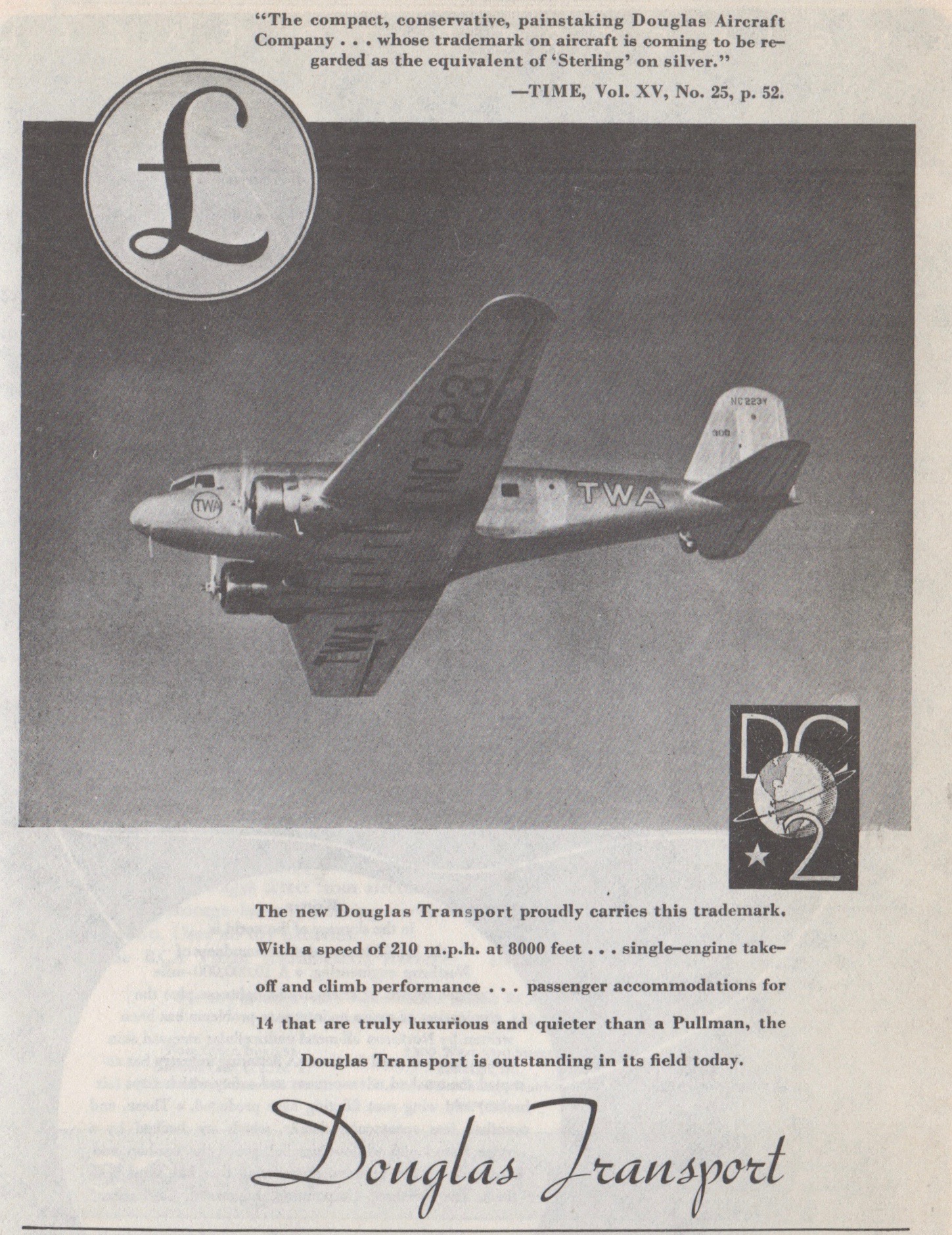
This and images following from Aeroplane (Or Flying Machine) Scrap Book No.3 1911-1941,
Douglas boasted of DC-2 passenger accommodations “that are truly luxurious and quieter than a Pullman…”
But unlike a Pullman railcar, there was no accommodation for overnight travel. The DC-2’s cabin width was 66 in., too narrow for berths on either side of the aisle. This prompted another phone call, and the result was the DST.
Douglas Sleeper Transport. The new design had a considerably wider cabin, 92 in., to accommodate berths. The DST prototype first flew on December 17, 1935, the 32nd anniversary of the Wright Brothers’ Kitty Hawk flight.
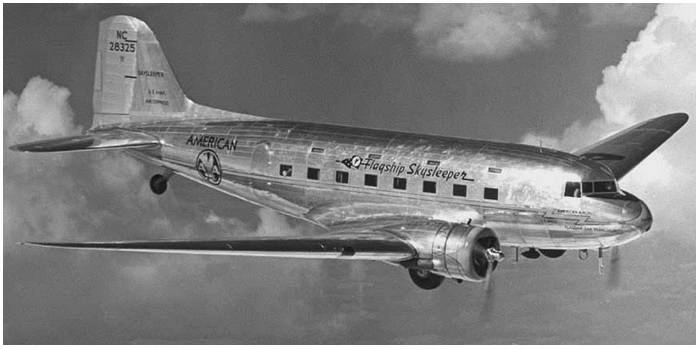
An American Airlines “Flagship Skysleeper” Douglas DST. Image from strijdbewijs.nl.
The DST carried 14-16 sleeping berths, uppers and lowers. In fact, in 1936 Douglas hyped an American Airlines exclusive: “the Sky Room.”
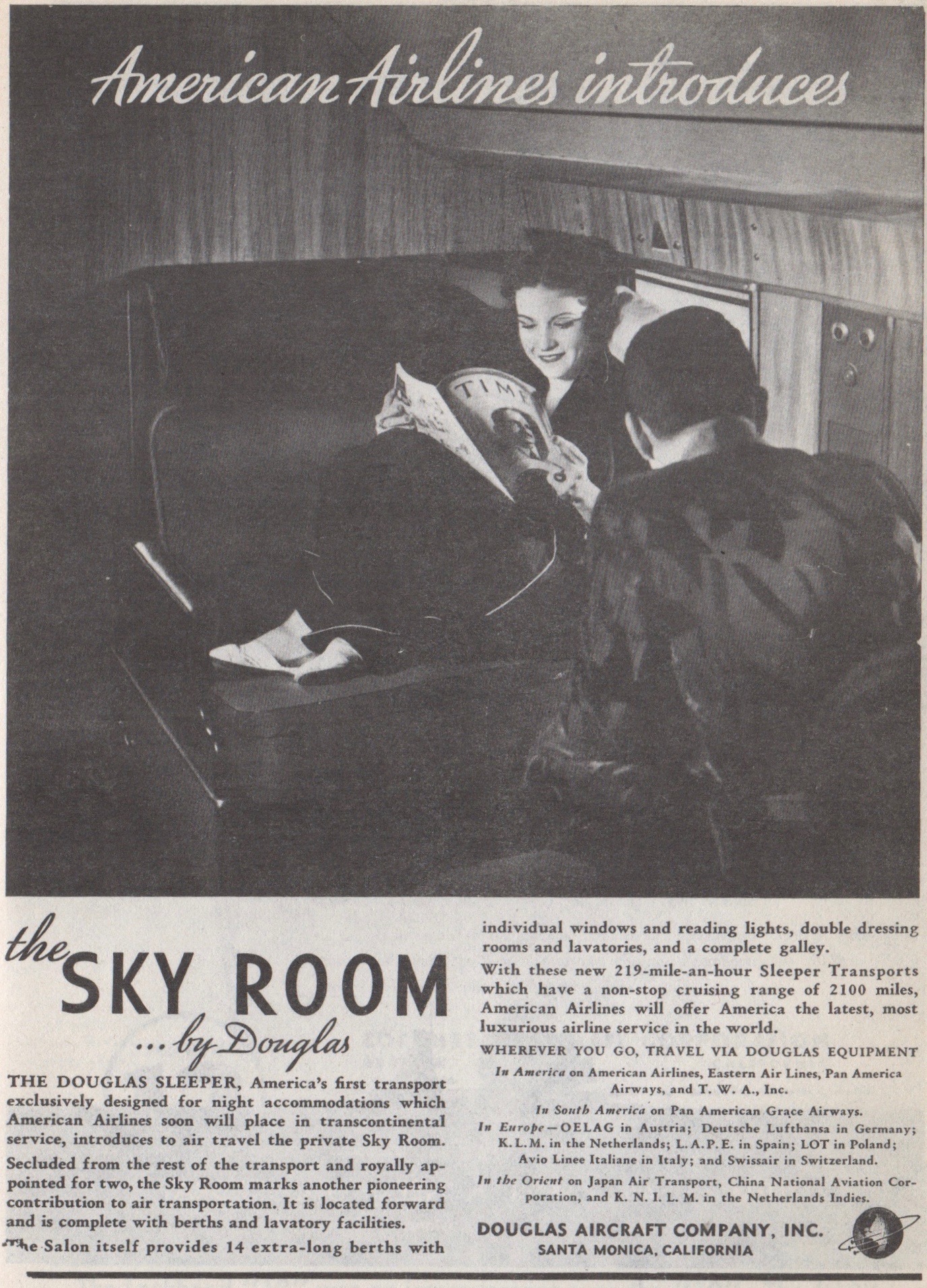
“Secluded from the rest of the transport and royally appointed for two,” Douglas enthused, “the Sky Room marks another pioneering contribution to air transportation. It is located forward and is complete with berths and lavatory facilities.”
Aft of this was the Salon, providing “14 extra-long berths with individual windows and reading lights, double dressing rooms and lavatories, and a complete galley.”
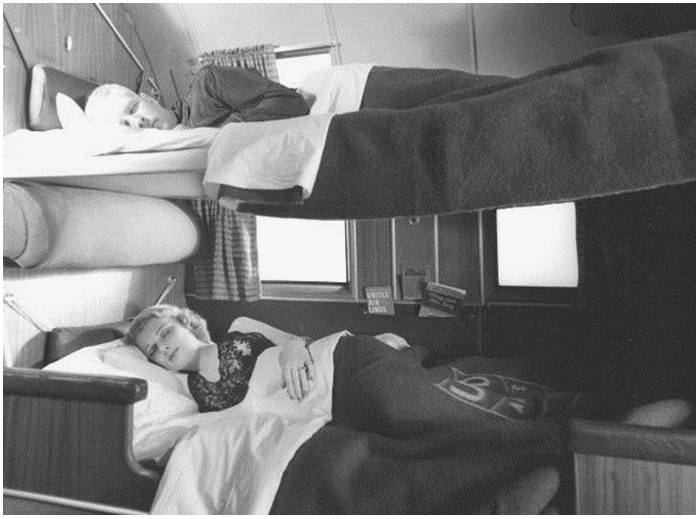
The DST had “down-filled berths—longer than your bed at home.…” Image from strijdbewijs.nl.
The DST traveled at 219 mph with a range of 2100 miles. Not enough for coast-to-coast, but you slept through refuelings anyway.
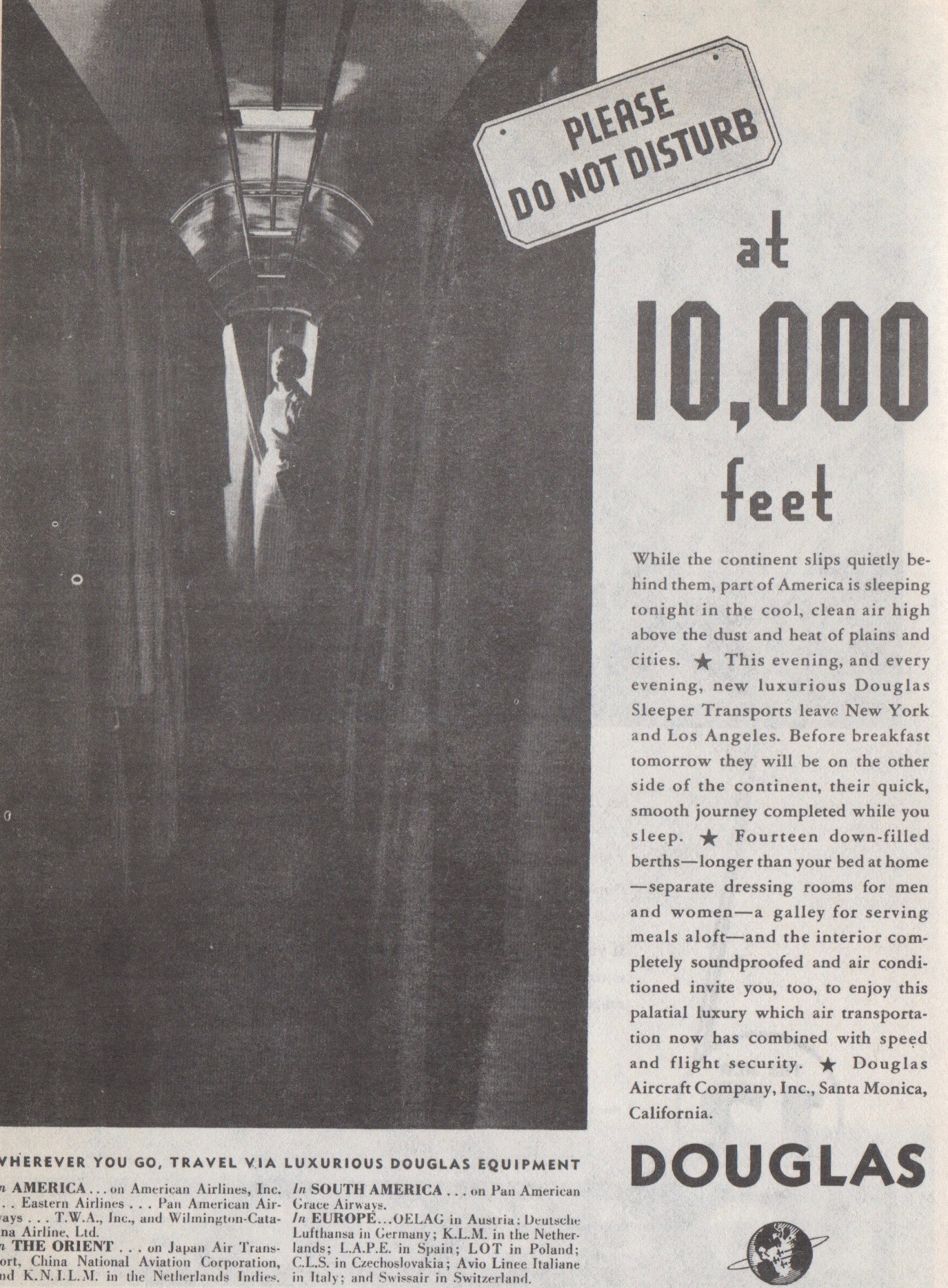
“While the continent slips quietly beneath them,” the Douglas ad read, “part of America is sleeping tonight in the cool, clean air high above the dust and heat of the plains and cities. This evening, and every evening, new luxurious Douglas Sleeper Transports leave New York and Los Angeles. Before breakfast tomorrow they will be on the other side of the continent, their quick, smooth journey completed while you sleep.”
Actually, eastbound flights took about 15 hours, westbound against the prevailing winds took 17 1/2 hours. Three refuelings were part of each trip.
DST to DC-3. It was a practical decision to swap the 14-16 sleeping berths for 21 seats—and call the aircraft the DC-3. This model required no prototypes. It simply followed the first seven DSTs off Douglas’s Santa Monica line and joined the American Airlines fleet.
I suspect that flying First Class in one of today’s giant Airbus 380s is no more pleasant than having one’s own Sky Room. ds
© Dennis Simanaitis, SimanaitisSays.com, 2019
 Simanaitis Says
To me, the genius of the DC-1/2/3 was its performance in the epic and technology stretching 1934 MacRobertson London to Australia air race. Competitors included three DH-88 Comets, speedy Lockheed Vega and even a GeeBee racer stretched for extra fuel. https://en.wikipedia.org/wiki/MacRobertson_Air_Race
The state of the art and specially built DH-88 handily won, but second was a KLM DC-2 (Uiver/Stork) which was even flying a regular route with passengers … and they even got lost, stuck in the mud, losing half a day at least. Third was a special lightened and race prepped (all seats replaced by fuel tanks) Boeing 247 flown by air racing ace Roscoe Turner. Douglas had handily beat its prime competitor! The DC-2 was also the handicap efficiency winner.
Note that the DC-3 became the workhorse C-47 transport of WWII, dropping most of the paratroops in a dozen landings and flying the Himalayan “Hump” to keep China in the fight, as well as the post war Berlin Airlift star. Eisenhower credited “the M1 rifle, the 2 1/2 ton Studebaker truck, and the C-47” as the tools that won WWII.
Cheers, Bob Storck
First of all, I appreciate finally being able to see what the “Sky Room” looked like, I was beginning to wonder if there were such photos. So thank you. Also viewing this, I am reminded that I was born in the wrong period. The aircraft, the cars, the styles of homes, not to mention the mentality of Americans back in those days all call to me. As mentioned the evolutionary train of aircraft and automotive design was on fire. Creativity and imagination were never so married to technical design as in those days. At least as I humbly opine. :-) Thanks for a very fun read. As a side note, just a few hours ago I was looking at the cockpit layout of an Airbus 330 I believe and looking at their first class sleeper accommodations. For just an extra $3.300 USD one could experience that sleeper comfort in a flight from SA to NA. I imagine $3,300 bucks would have likely paid for several pax to fly in a Sky Room!