
Simanaitis Says
On cars, old, new and future; science & technology; vintage airplanes, computer flight simulation of them; Sherlockiana; our English language; travel; and other stuff
AN AEROPLANE FOR EVERYMAN—THE AUSTIN WHIPPET, PART 2
MAYBE A British Great War pilot was contemplating conversion of the back garden potting shed into an aeroplane hangar for his Austin Whippet. Or maybe not.
It was 1919 and Austin Motor Company was three years away from introduction of its fabled Seven motor car. The company had built aircraft under license during World War I, and the Whippet was its proposed entry into a post-war boom in civilian aviation that turned out to be at best a whimper.
As described yesterday at SimanaitisSays, the Whippet was proposed as the ideal single-seat sport plane for the post-war private owner-pilot. Indeed, the Whippet’s folding wings made it easy to tow around or store in one’s back garden shed.
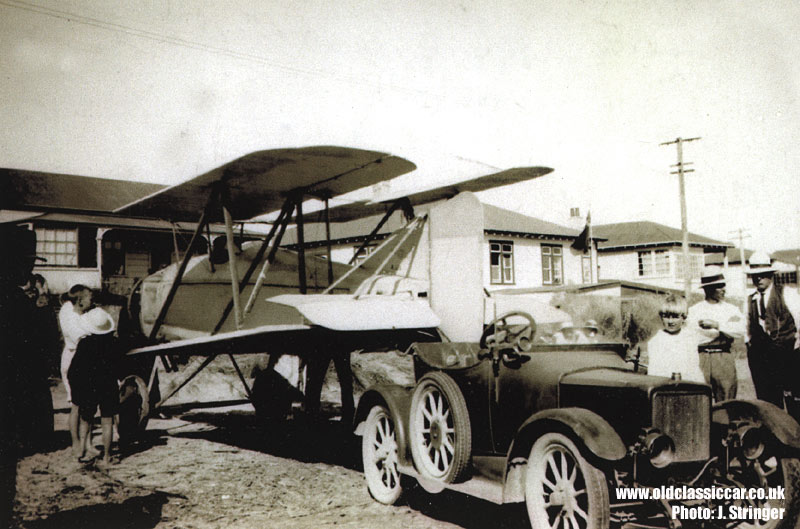
An Austin Whippet, wings folded, towed behind a 1920 8hp Perry motor car. Image from Old Classic Car, which shares other Whippet information.
According to Jane’s All The World’s Aircraft 1919, Austin assured pilots that the wings “are locked in flying position by a special positive locking device.”
Though the wings were traditionally wood-framed and fabric-covered, their streamlined struts of steel eliminated the need for wire bracing. The tailplane, elevators and rudders were also of conventional fabric-over-wood design. A feature noted in Jane’s 1919 was an adjustable tailplane “to correct centre of gravity for different weights of pilots.” We’d call this a trim control today.
Another Whippet innovation was its fuselage constructed throughout of steel tubes, thus eliminating the bracing wires that wood structures required. It too was fabric covered.

Austin Whippet. Image from flyingmachines.ru.
The first Whippet prototype was powered by a two-cylinder horizontally opposed engine producing 45 hp. Four rubber buffers isolated the engine from the rest of the fuselage.
The other four Whippets had six-cylinder Anzani radial power, also cited at 45 hp. A maximum speed of 95 mph was claimed. Cruising at 80 mph, the Whippet’s range was two hours flight.
Like its road-going Seven counterpart, the Whippet was diminutive: Compare the Whippet’s wingspan of 21 ft. 6 in. with a Piper J-3 Cub’s 35 ft. The Whippet’s empty weight was 500 lb.; a Cub’s, 765 lb.
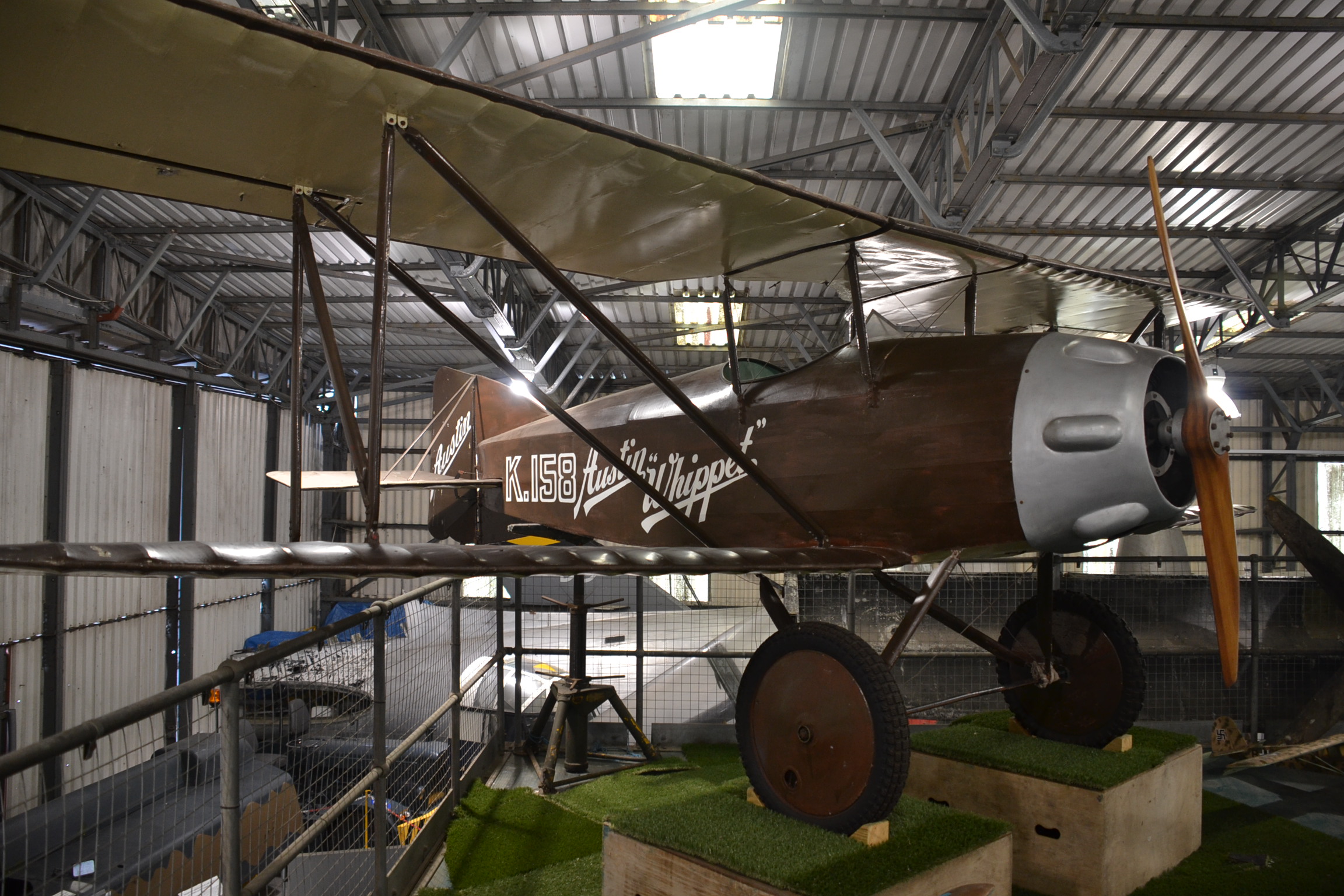
This full-size Whippet model resides in the South Yorkshire Aircraft Museum. Image by Alec Wilson.
Why didn’t the Whippet catch on?
The British post-Great War depression of 1920 didn’t help. The Whippet’s asking price was around £450, $2250 in 1920 dollars, perhaps $28,500 in today’s currency. An Austin Seven motor car cost £155 in 1924; it dropped to £145 two years later, then to £135 in 1927.
Most Brits of the era hadn’t even driven a car, let alone piloted an aeroplane. Thus, the Austin’s “owner-pilot” would have likely served in the Royal Flying Corps (a British Army branch set up in 1912), Royal Naval Air Service (established in 1914), or their combined entity, the Royal Air Force, founded in 1918 and the oldest free-standing air force in the world.
Jane’s 1919 lists a total of 27,906 officers in the RAF in October 1918; this, out of a British population at the time of around 38 million.
The Whippet’s demographics were hardly in its favor.
Last, there was a psychological aspect: Not unlike the mistaken expectation of a private plane boom after World War II, ex-Great War pilots were fine with giving up the cockpit.
Generally, they had had aerial adventures a’plenty to last a lifetime. Let that potential hangar in the back garden remain a potting shed. ds
© Dennis Simanaitis, SimanaitisSays.com, 2017
 Simanaitis Says
The Whippet and the Perry 8HP motorcar pictured in your article were both owned by my great-grandfather Percy Coleman In Wanganui, New Zealand).
Cool! (Indeed, I’ve been to Wanganui during one of my two visits to this beautiful country. Wonderful people too.)
My Grandfather purchased this plane from Percy Coleman. Percy crashed the plane into a cornfield after takeoff in Ashhurst, It was sold to my grandfather Toby Bennett who rebuilt the plane and flew it around for some years. It later crashed again at Kai iwi.
I am currently researching the five whippets that were built, and what happened to them
I have photos from Freelance in 1931 of Toby with the rebuilt Whippet and some of it subsequently flying in Wanganui plus quite a lot of other relevant material.
I live in Wellington NZ and have been researching this for many years.
Please contact me if you wish to share info.
I have an Austin Whippet propeller from an Anzani engined version. There is also the notation “G898” on the prop hub. My parents bought it at an antique shop somewhere in NSW, Australia. It would be interesting to find out which aircraft it is from.
Agreed, Mark. What a neat find.