
Simanaitis Says
On cars, old, new and future; science & technology; vintage airplanes, computer flight simulation of them; Sherlockiana; our English language; travel; and other stuff
EULER’S ELEGANCE
IN A SEARCH for elegance in mathematics, look no further than Euler’s Formula, e i π = -1. This equation takes three perhaps obscure mathematical constants, e, i and π, and arranges them to produce a more familiar number, albeit one with negative value.
It’s a conjurer’s trick: Put three mysterious objects into a top hat—and pull out a dove that gracefully flies off.
What’s more, and a fascinating part, Euler’s Formula can be demonstrated to one and all with no more sleight of hand than appealing to a mathematical concept called a Taylor series.
The basics. We do groundwork first, and then a rigorous mathematical proof.
At one time or another, e, i and π have all appeared here at SimanaitisSays. I celebrated π on π-day a year ago, March 14, 2015, at 53 seconds past 9:26 a.m. (i.e, 3/14/15 9:26:53, 3.141592653). Of the three constants, e, i and π, this last is the most familiar, what with the equation C = πD relating a circle’s circumference C to its diameter D.
The imaginary number i got brief mention in “Computing with Quanta.” By definition, it has the curious property that i2 = -1. This sets it apart from non-imaginary numbers, whose squares are always positive (i.e., -2 x -2 = 4).
Numbers of the form a + bi can be graphed in a mathematical object called the complex plane, with the “a” value measured on the horizontal (real) axis and “b” on the vertical (imaginary) axis. Complex numbers have lots of applications, among them in physics, flow dynamics and electrical engineering.
Last, e is the base for natural logarithms, ln, as opposed to the perhaps more familiar common logarithms, log base 10. In both, a logarithm is the inverse operation of exponentiation. Said another way, logarithms are the opposite of powers: By definition, log 10 = 1 since 101 = 10; similarly, log 1000 = 3 is another way of expressing 103 = 1000. And, by definition, ln e = 1 since e1 = e.
Like π, the number e is transcendental. Loosely, there’s no ordinary polynomial equation for which e is a root. One implication of this is that e has an infinite, non-repeating decimal representation. Approximately, e = 2.718. And, as with π, there’s mathematical interest in extending e’s decimal representation; it has been approximated to more than 800 million places already.
In general, logarithmic representations replace multiplication with addition. (See “What’s a slide rule, Grandpa?” for why logarithms are useful; also, how to promote a snake population.)
Taylor series. The number e can be approximated closer and closer by calculating more and more terms of a particular infinite series, one of a family of mathematic objects known as Taylor series.
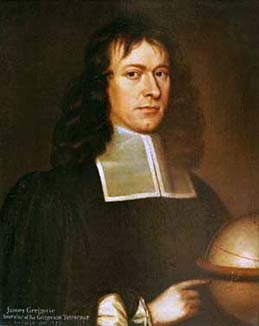
James Gregory, 1638 – 1674, Scottish mathematician and astronomer.
Taylor gets the name, but James Gregory deserves credit as well. Gregory was a Scottish mathematician, a contemporary of Isaac Newton. Newton shares credit with German Gottfried Wilhelm Leibnitz for development of calculus, the mathematics of change.
It was Gregory who gave the first published proof of the Fundamental Theorem of Calculus connecting its two basic concepts, the slope of a curve and the area under it. He also used these fledgling calculus techniques to show that several mathematical expressions could be represented by infinite sums of terms.
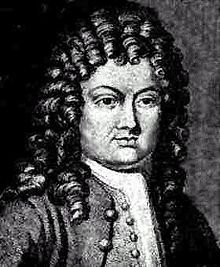
Brook Taylor, 1685 – 1731, English mathematician.
Roughly a generation later in 1715, English mathematician Brook Taylor extended this concept of infinite sums, known today as Taylor series. Here are Taylor series expressions for three mathematical functions, ex and, two from trigonometry, sin x and cos x.
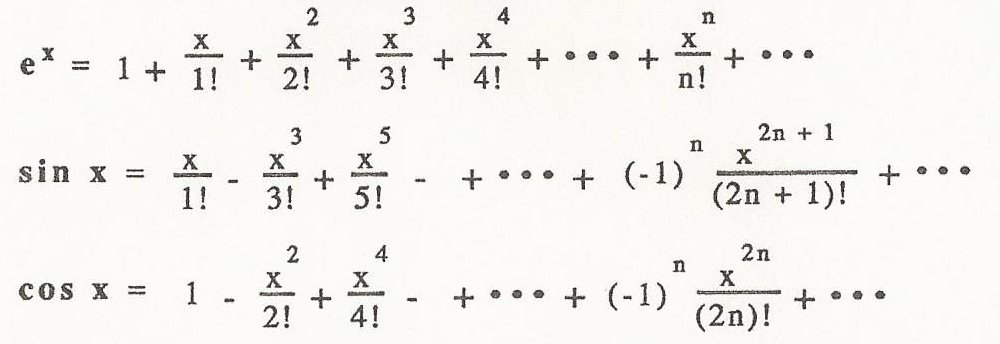
Apart from evens, odds and signs, don’t these three look provocatively similar?
Euler’s Formula. Euler (pronounced “oiler,” as in ë) has made several appearances at SimanaitisSays. He was the star of “Networking Along Königsberg’s Seven Bridges.” I also like his portrait as it appears on the Swiss 10-franc note.

Leonard Euler, 1707 – 1783, Swiss-born mathematician and physicist.
After all this setup, the proof of Euler’s Formula is almost an afterthought. Recall that i2 = -1. Thus, even powers of i are all either -1 or 1. For instance, i x i x i x i = i2 x i2 = -1 x -1 = 1. Similarly, odd powers of i alternate between -i and i.
Hence (you see my hands never leave my wrists…), the Taylor series for e ix is the same as that for cos x + i sin x.
Plug in π for x and we get e iπ = cos π + i sin π.
From trigonometry (or from any but the most basic calculator), cos π = -1 and sin π = 0. And thus, e iπ = -1.
Q.E.D. Latin for quod erat demonstrandum, that which was to be demonstrated. Our proof is completed.
The Birth of Venus, Sandro Botticelli, c. 1486.
What use is Euler’s Formula?
What use is Botticelli’s The Birth of Venus? Its existence is justification enough. ds
© Dennis Simanaitis, SimanaitisSays.com, 2016r
 Simanaitis Says