
Simanaitis Says
On cars, old, new and future; science & technology; vintage airplanes, computer flight simulation of them; Sherlockiana; our English language; travel; and other stuff
CHEETAHS: SPORTS CAR FELINES
YOU’VE PROBABLY heard that the fastest animal in the world, with reported bursts of 70 mph, is the cheetah (Acinonyx jubatus). However, A.M. Wilson et al, reporting in Nature, 12 June 2013, say the cheetah’s outstanding forte isn’t its top speed, it’s the feline’s braking and handling. What’s more, the researchers offer fascinating instrumented data to prove it.
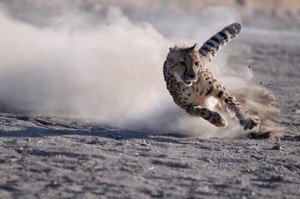
A cheetah is fast, but more important, it’s agile. Image from zmescience.com, which reports earlier work by A.M. Wilson and his colleagues.
An item at zmescience.com (http://goo.gl/4Z6ve) published in 2012 describes earlier work by Wilson and his colleagues at the Royal Veterinary College of the University of London.
This research involved captive cheetahs as well as grayhounds chasing pieces of dragged chicken. Force-measuring plates were planted in their path; cameras shooting at 100 frames/second recorded the chases.
Curiously, the grayhounds proved quicker than the cheetahs, 42.5 mph versus 39.8 mph. But these apparently out-of-shape felines were still exhibiting essentially the same running mechanics as their wild counterparts. In particular, the cheetahs varied their stride frequency with speed: 2.4 strides/sec. at 20 mph; 3.2 strides/sec. at 38 mph, versus a uniform 3.5 strides/sec. for grayhounds at any speed.
In reporting the research in the Journal of Experimental Biology (http://goo.gl/v0zuk), Wilson noted “The next stage is to try to make measurements in wild cheetahs in the hope of seeing higher speeds.”
Five cheetahs in the wilds of Botswana provided the subjects for this later research reported in Nature. To collect data, Wilson and his colleagues fitted the animals with collars that sensed location with GPS and magnometer, lateral and longitudinal accelerations with g-meters and angular motion with a gyro. The miniaturized equipment worked through solar power, with battery backup. All of the data, at 300 updates/sec., was transmitted by radio telemetry in real time.
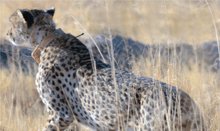
One of the subject cheetahs with instrumented collar. Image from Science magazine, 14 June 2013; Structure & Motion Lab, RVC.
True, the wild cheetahs proved faster than their captive relatives, one recording a top speed of 58 mph. Also noted in the paper’s abstract, “We recorded some of the highest measured values for lateral and forward acceleration, deceleration and body-mass-specific power for any terrestrial mammal.”
A total of 367 runs offered compelling data. The five cheetahs averaged two hunts every three days, with feeding, lounging and sleeping occupying the rest of the time. Though a cheetah might cover nearly 4 miles each day, an average kill came in a chase of less than 600 ft.
Researchers found that the cheetahs didn’t bother with top speed. Rather, the animals loped along at around half-speed, but shifted gears and directions with alacrity as they followed prey.
Their extreme agility gave the cheetahs a higher kill rate in dense foliage than on open ground, 31 percent versus 20 percent. Researchers conjecture that a cheetah’s ridged footpads and claws help in abrupt cornering, acceleration and deceleration.
We can now recognize the cheetah as the super sports car of the animal world, not merely the land speed record holder. ds
© Dennis Simanaitis, SimanaitisSays.com, 2013
 Simanaitis Says
And here I went thinking you were gonna talk about those stubby sports Cars! If you have not already seen this, you HAVE to watch this incredible footage of a Cheetah at speed by National Geographic.. It is truly awesome, both to watch the Cheetah in slow mo, but also the camera work to capture it:
http://video.nationalgeographic.com/video/specials/nat-geo-live-specials/wilson-cheetah-lecture-nglive/
Richard
OMG! I cannot thank you enough for posting that link. I need more Kleenex!
Neat-o! I was going to mention this wonderful link, but the later research about pure agility overwhelmed it. Thanks for providing it.
What? No G-force measurements?