
Simanaitis Says
On cars, old, new and future; science & technology; vintage airplanes, computer flight simulation of them; Sherlockiana; our English language; travel; and other stuff
AERO CLONING
NEWS EARLIER this week reported that an American “small commercial aircraft” was forced to make an emergency landing at Ahvaz International Airport, the busiest airport in Iran. Two subtexts are offered, one purely fictional and the other decidedly non-fiction. Guess which is which.

Ahvaz (also rendered Ahwaz) International Airport is Iran’s busiest airport. The city of Ahvaz, near the Iraq border, is about 350 miles south-southwest of Iran’s capital, Tehran.
One tale: The National Iranian Oil Company wants the American aircraft promptly repaired and out of there, because they’ve discovered scads of oil beneath Ahvaz real estate and plan to relocate the entire airport.
The other tale is quite the opposite: The National Iranian Aircraft Company wants the American aircraft there as long as possible, because Grand Ayatollah Sayyed Ali Hosseini Khamenei, the Supreme Leader of Iran, has instructed them to reverse-engineer the plane so Iran can produce a clone.

In the Islamic Republic of Iran, Grand Ayatollah Khamenei outranks everybody, including president Mahmoud Ahmadinejad. Image from www.kremlin.ru.
It turns out the first tale is true—though the second one is much more plausible. Evidence of the latter comes from a recounting of Josef Stalin’s B-29.
During the latter half of 1944, four U.S. Air Force B-29s on bombing missions to Japan made forced landings in eastern Siberia. The crews were allowed to leave, but the Soviets impounded the four aircraft, one badly damaged.

The Boeing B-29 Superfortress was one of the world’s most advanced aircraft in its era. The Soviets accumulated four of them, so why not….
Josef Stalin (think the Soviets’ Ayatollah, big time) ordered aircraft designer Andrei Tupolev to build duplicates of the B-29. Tupolev studied the idea of reverse-engineering the aircraft and said, yes, it would take a minimum of three years.
Stalin gave him a little more than two—in time for the 1947 National Air Parade.
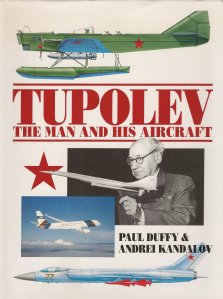
Andrei Nikolaevich Tupolev, 1888-1972, was world-renowned as an aircraft designer. Image from Tupolev: The Man and his Aircraft, by Paul Duffy & Andrei Kandalov, Airlife, 1996. Both Amazon.com and ABEBooks.com list it.
It wasn’t that Tupolev had much choice. Still not quite in Stalin’s favor, at least he was no longer in prison. From 1939, Tupolev and colleagues toiled at a sharashka, a facility devoted to R&D and overseen by the NKVD, the Soviet’s secret police. The reverse-engineering project beginning in late 1944 brought him out of its labor camp atmosphere.
Tupolev’s strategy was to disassemble one B-29 and transform all of its elements into engineering drawings. The second complete aircraft was flight-tested to determine its capabilities; the third, kept for later evaluation.
Measurements of components were non-trivial, as the B-29 was built to units of inches and feet. To expedite matters, Tupolev and his team retained these U.S. measurements rather than converting to metric units and complicating tolerances. Instrumentation and other electrical gear also posed challenges, as did the basic materials. Aluminum grades, elastomers and synthetics were completely different from standard Soviet practice.
The B-29’s Wright Turbo Cyclone engines were duplicated, quite a feat as these were complex turbocharged twin-row 18-cylinder radials.

The Tu-4 was a faithful copy of the Boeing B-29. Image from Tupolev: The Man and his Aircraft.
The Tu-4, as it was named, first flew on 19 May 1947. At the August 1947 National Air Parade, meeting Stalin’s dictum, were a trio of production Tu-4s together with a Tu-70 passenger variant.
The clones were good, though not quite to B-29 standards of performance. Top speed was 354 mph (versus a B-29’s 358). Range was 3045 miles (versus 3107).
A total of 847 Tu-4s were built, with several remaining in Soviet service into the 1960s. Twenty went to the Chinese Air Force in the early 1950s; these remained in use until the 1990s.
Not bad for engineering in (quick) reverse. ds
© Dennis Simanaitis, SimanaitisSays.com, 2013
 Simanaitis Says
You can still see the lineage of the Tu-4 in the TU-95.. in a way the B-29 was taken further by the USSR then the USA.