
Simanaitis Says
On cars, old, new and future; science & technology; vintage airplanes, computer flight simulation of them; Sherlockiana; our English language; travel; and other stuff
“POI TRISTANO,” JOTTED PUCCINI PART 1
CLOSE TO FINISHING HIS OPERA TURANDOT, Giacomo Puccini expressed the intent “poi Tristano,” “then Tristan.” That is, wrap up the complex relationship of the mysterious prince Calaf with ice queen Queen Turandot by having a blissful love death of hers following his.
Been there, done that. See “A Love Potion Gone Awry,” SimanaitisSays, July 17, 2020, for a quick summary of Wagner’s Tristan und Isolde.
We’ll never know precisely what Puccini intended. He died before he could finish the opera, and it has since had several resolutions of the Turandot/Calaf conundrum.
Kevin Ng discusses these in “Is It Possible to Solve the Ending of Puccini’s ‘Turandot’?,” The New York Times, March 24, 2026. Here are tidbits gleaned from his fascinating analysis, together with my usual Internet sleuthing (and recent viewing of Tristan und Isolde).

Olympic Axels—and Video Gaming. Ng relates,“Even if you don’t know Giacomo Puccini, you know his aria ‘Nessun dorma.’” This aria “resurfaced at the Olympics this year in the free skate routine by the Japanese figure skater and silver medalist Yuma Kagiyama. Those who saw him might have noticed that Puccini’s score sounded a little different. That’s because it wasn’t Puccini—or not entirely. It was a new completion of Turandot by Christopher Tin, a Chinese American composer better known for composing music for the Civilization video games.”
Earlier Turandot Endings. Ng recounts, “When Turandot eventually premiered, in 1926 at Teatro alla Scala in Milan, the conductor Arturo Toscanini ended the opera where Puccini’s work stopped, leaving Turandot and Calaf’s fate uncertain. But Puccini’s publisher Ricordi had commissioned his colleague Franco Alfano to complete the score, and subsequent performances, including most today, have used his version.”
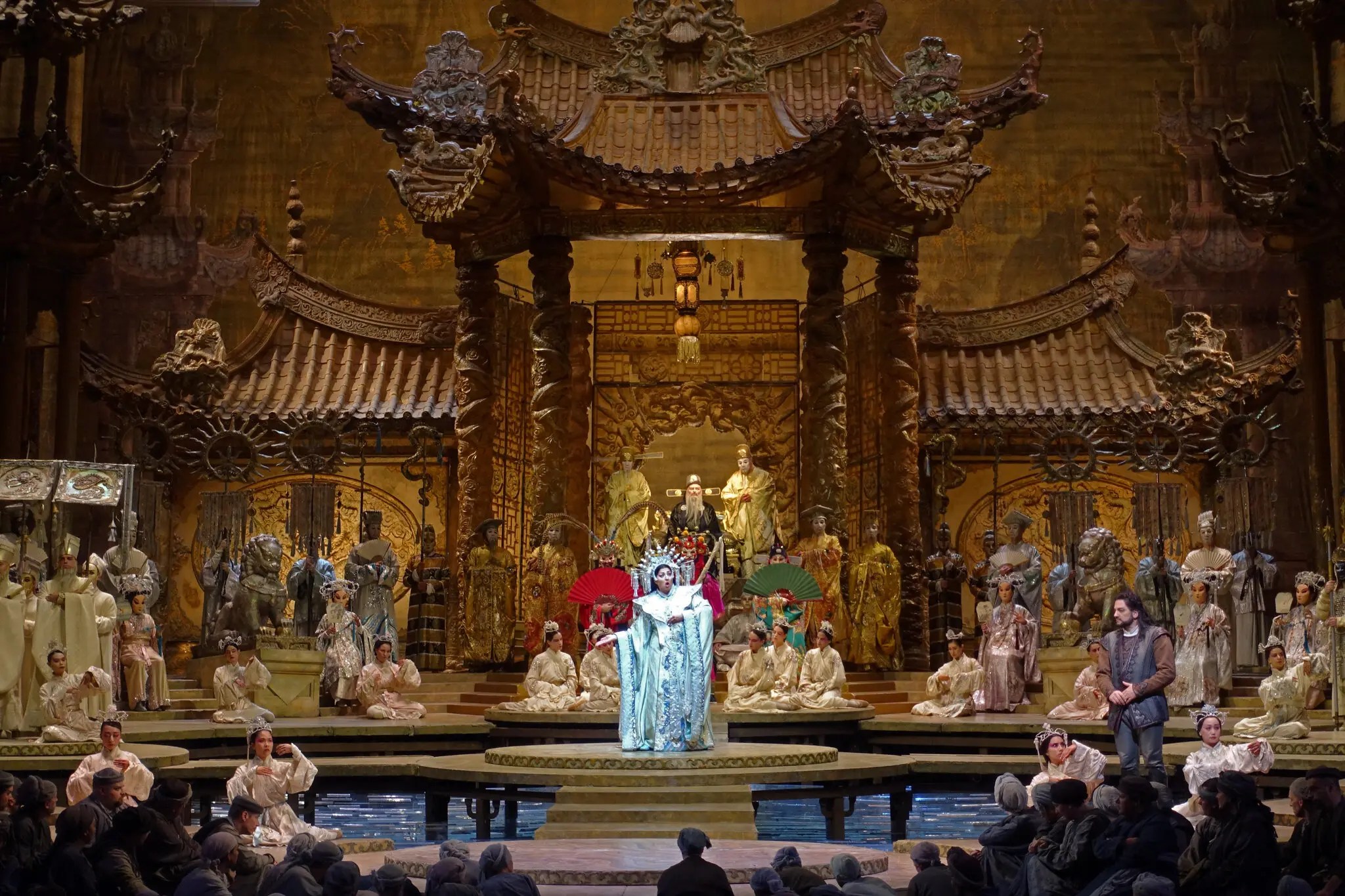
It is at best ambiguous, “musically choppy and deferential,” Ng notes. There’s a potentially deadly name-guessing, Calaf kisses the reluctant ice queen, she’s transformed by love, and “she weds him to a blaring orchestral reprise of ‘Nessun dorma.’ ”
Hardly poi TristanYo.
Pause Here for a Recent Tristan und Isolde. I just saw the Met HD’s new production of Tristan und Isolde, featuring Lise Davidsen as “the Irish princess Isolde in Wagner’s transcendent mediation on love and death,” heroic tenor Michael Spyres as Tristan, and bass-baritone Ryan Speedo Green as King Marke (Trisan’s uncle, whose wedding plans with Isolde generate all the drama of who loves whom and why.
Yuval Sharon is the producer; Es Devlin, the set designer, and Cliny Ramos, the costume designer.
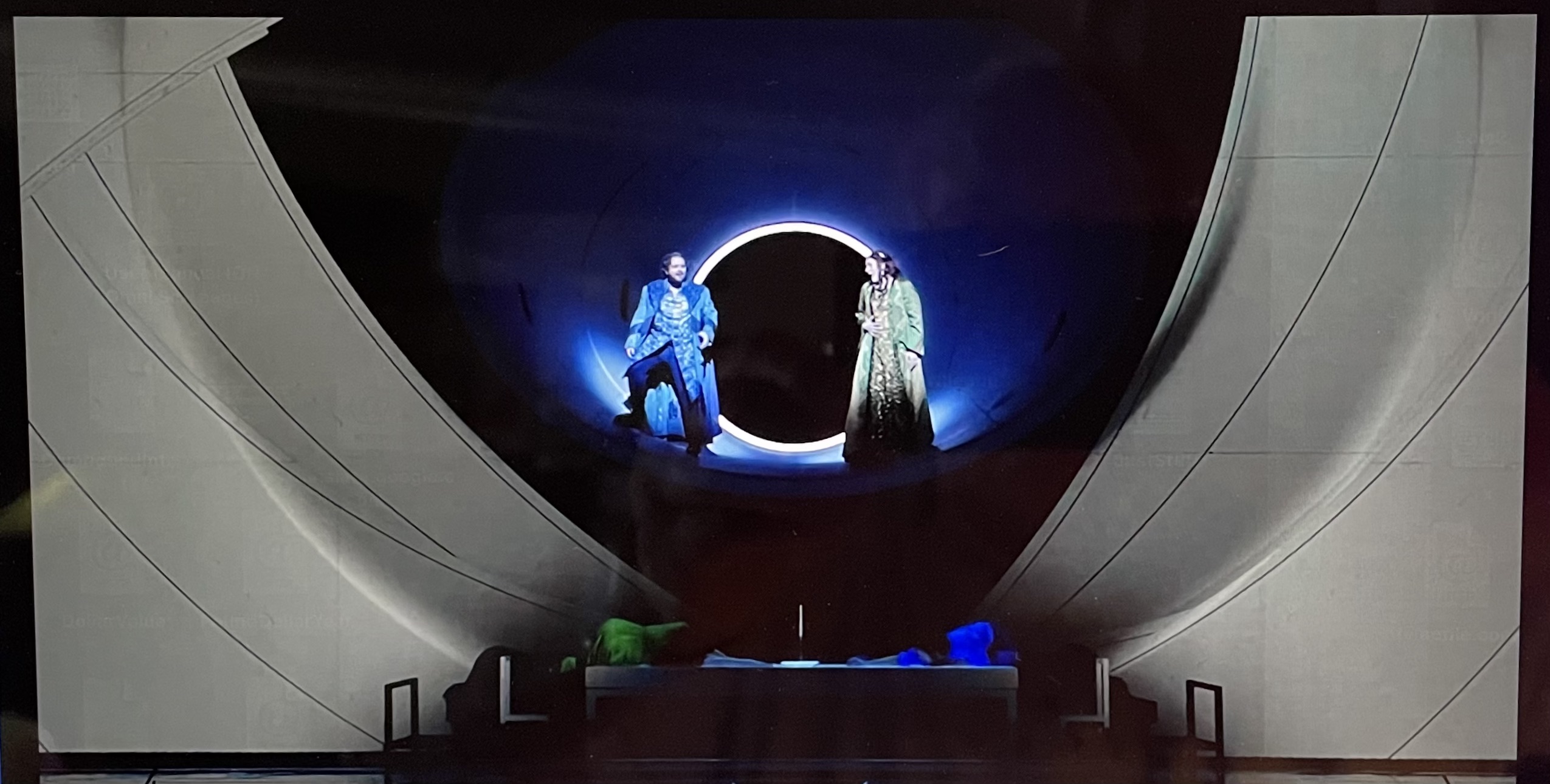
Video from the Metropolitan Opera. A stunning set design, but not without its tradeoffs.
Indeed, Joshua Barnes confirmed something I sensed in my Met HD viewing in his article “A Troubling Problem at the Heart of the Met Opera’s Big Hit,” The New York Times, March 27, 2026: I had thought the orchestra occasionally overpowered the fine singing, but figured it was inherent in the magic of transforming a live performance into an international distribution of movie theater appearances. (Ain’t it technical wizardry?!)
But sound levels are more complex than this. Check out the reader responses to Barnes’ article as well. See also “Will The Real Bayreuth Please Stand Out,” SimanaitisSays, March 27, 2016, for that venue’s idea of a covered orchestra pit, a concept mentioned by one of the readers.
Operatic spoiler: As with previous productions, Tristan dies and Isolde accepts her own death in blissful recognition that it unites them forever. The Sharon production has an enhancement, kinda shocking at first but in a sense dramatically fulfilling: She dies in childbirth, and, as a final note, King Marke lovingly holds the healthy infant.
Tomorrow in Part 2 it’s back to Turandot—with just a dash of “Liebestod” at its conclusion. ds
© Dennis Simanaitis, SimanaitisSays.com, 2026
 Simanaitis Says