
Simanaitis Says
On cars, old, new and future; science & technology; vintage airplanes, computer flight simulation of them; Sherlockiana; our English language; travel; and other stuff
FEELING BARBED AND CRUSTY? PART 1
FORTUNATELY, I HAVE JUST THE BOOK about dishing out barbed and crusty quotes: Indeed, its full title is Barbed Quotes: Mudslinging, Backstabbing, and Celebrity Dirt Dishing. It has already made two appearances here at SimanaitisSays: “Dissing (Merely For Contrast),” October 17, 2022; and “Dissin’ For Fun,” May 14, 2024.
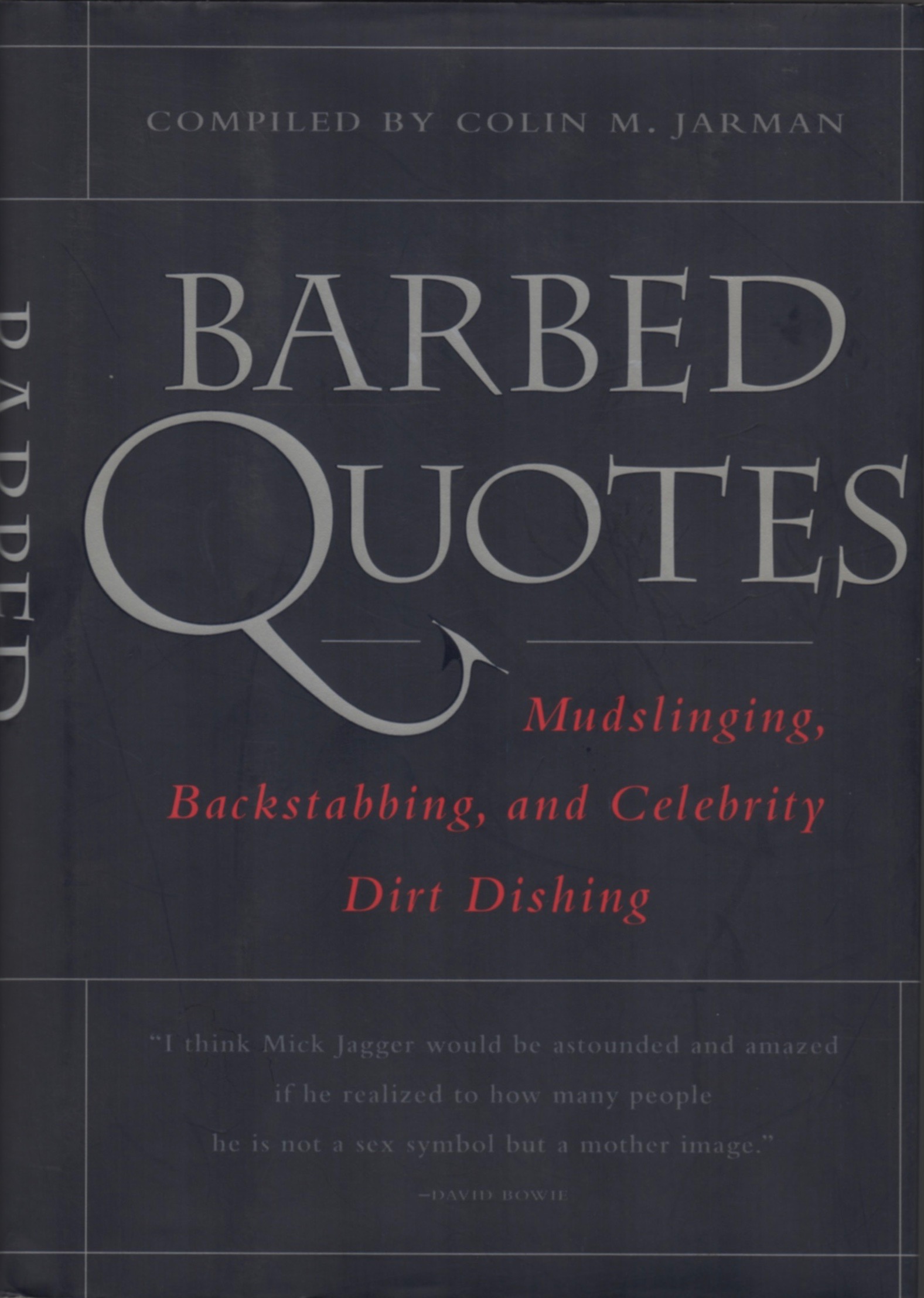
Barbed Quotes: Mudslinging, Backstabbing, and Celebrity Dirt Dishing, compiled by Colin M. Jarman, Contemporary Books, 1999.
The book’s first appearance here gleaned tidbits from all over the celebrity spectrum; the second one focused on politics.
Speaking of politics, I apologize to the world for Trump’s incredibly inappropriate response to a Japanese journalist’s perfectly serious question about allied cooperation; also, his comment following the death of Robert Mueller was particularly tasteless. The less said about our president’s asinine, boorish, utterly despicable behavior, the better.
Instead, here in Parts 1 and 2 today and tomorrow, let’s return to Barbed Quotes and focus on denizens of the theater. As is my custom, I intersperse the gleaned tidbits with Internet sleuthing of my own.
On Easing First-Nighters. “If there’s a spirit world, why don’t the ghosts of dead artists get together and inhibit bad playwrights from tormenting first-nighters?”—Gertrude Atherton Black Oxen (1923)
Gertrude Franklin Horn Atherton wrote Black Oxen in a semi-autobiographical vein. Project Gutenberg writes, “The story is set against the backdrop of New York’s dramatic society and revolves around the enigmatic character Madame Zattiany, who is revealed to have strong connections to the glamorous but troubled past of Mary Ogden, a once-famous beauty.”

Gertrude Atherton—Black Oxen: The Bestseller of 1923, by Gertrude Atherton, Bestseller Publishing, 2020..
It’s something of a precursor to the film Sunset Boulevard (1950), only here Madame Zattiany may well have accompanied stardom with eternal life.
Speaking of Sunset Boulevard. “It is an old joke to say you come out of a show humming the scenery, but this is the first time I have encountered a staircase you could set to music.”—London Today
Ha. I hadn’t heard that “humming the scenery.” A good one. The staircase concerns the Andrew Lloyd Webber musical Sunset Boulevard, a multi-Tony-award winner in 1995.
Strong Openings? Burrito Square—“During the overture you hoped that it would be good. During the first number you hoped that it would be good. After that you just hoped that it would be over.”—Walter Kerr
Three Tall Woman (1962)—“It’s a play that after you’ve been there for a short while, you wonder how long this is going to take.”—Garrison Keillor
Dorothy Parker, Wordsmith and Critic. An anonymous play—“If you don’t knit, bring a book.”—Dorothy Parker
Parker on Tolstoy’s Redemption. “It is not what you might call sunny. I went into the Plymouth Theater a comparatively young woman, and I staggered out of it three hours later, twenty years older, haggard and broken with suffering.—Dorothy Parker
My view? It’s quite enough to note that Google AI Overview begins “Redemption (also known as The Living Corpse….”
On Shakespeare, Then and Now. “There is an upstart crow beautified with feathers. That with a tyger’s heart wrapt in a player’s hide, supposes he is as well able to bombast out a blank verse as the best of you; and being an absolute Johannes Factotum, is, in his own conceit, the only Shakescene in a country.”—Robert Greene (1590)
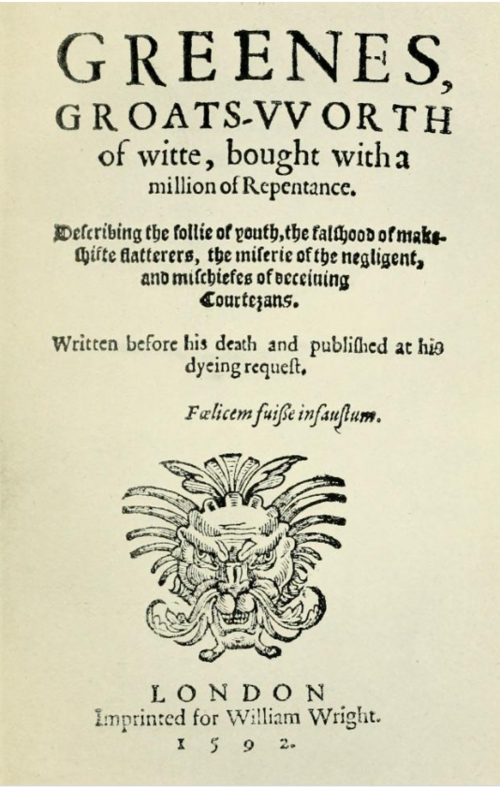
Greene’s Groats-Worth of Witte, Bought With a Million of Repentance. Image from Wikipedia.
Greene’s “upstart crow” and “Shakescene” are remembered today. His Elizabethan career as dramatist and pamphleteer is less well known, but described in Wikipedia.
Carrie performed by The Royal Shakespeare Company (1988). “Nothing can hide the gala kitsch of a gimmicky flashy, and ultimately empty show, set somewhere between Grease and a nightmare by Norman Rockwell.”—Sheridan Morley
Ha. The name “Sheridan” rang a bell: I thought about The Man Who Came To Dinner (1941), starring Bette Davis, Ann Sheridan, and Monty Wooley; he, portraying the rascally Sheridan Whiteside.
And, indeed, the truth is fascinating: Sheridan Morley, English author, biographer, critic, and broadcaster, was the eldest son of actor Robert Morley and grandson, via his mother Joan Buckmaster, of the actress Dame Gladys Cooper. He was named after Sheridan Whiteside, the title role his father was playing in a long-running production of The Man Who Came to Dinner at the Savoy Theatre in London.
So my memory bell was not incorrect, kinda.
One of My Favs is this headline: “Prompter Steals the Show at UCLA Macbeth.”—Los Angeles Times (1919). Whatever do you suppose?
We’ll continue tomorrow in Part 2 with George Bernard Shaw, Winston Churchill, Charlton Heston, Tallulah Bankhead, Bette Davis, and Joan Crawford, not all intermingling, mind. ds
© Dennis Simanaitis, SimanaitisSays.com, 2026
 Simanaitis Says