
Simanaitis Says
On cars, old, new and future; science & technology; vintage airplanes, computer flight simulation of them; Sherlockiana; our English language; travel; and other stuff
MIX: FREEDOM (BUT BE PREPARED TO SKIP THE ADS)
DESPITE BEING SOMETHING OF A LUDDITE, every so often my Internet sleuthing reveals a new fav, in this case, modern composer Richard Einhorn’s piece Freedom. I discovered it and more through a YouTube feature known as “Mix.”
But this is getting ahead of my tale.
A Morning Ritual. As regular readers may know, I’m an early morning person: BBC World Service news on SiriusXM at 6:00 a.m. Pacific, followed by a final proof-reading of the day’s SimanaitisSays at 6:06 a.m. (so much better than running from drugstore to drugstore in the old R&T days with a Magic Marker). Then I get up and around to the rest of my morning activities: feeding the kitties, doing stand-up exercises, and the rest, all the while listening to KUSC, our SoCal classical music station.
A Lovely Sound, Caught in the Middle. The orchestral strings sounded not unlike my favorite Aaron Copland, lush with liturgical overtones. However, unlike just about any Copland, this piece was unfamiliar to me.
Fortunately, KUSC maintains an online playlist, and it identified the piece as Freedom by Richard Einhorn.
The Einhorn Catalogue. Wikipedia describes, “Richard Einhorn (born 1952) is an American composer of contemporary classical music. His best-known work, Voices of Light (1994), is an oratorio scored for soloists, chorus, orchestra, and a bell. It was inspired by Carl Theodor Dreyer‘s silent film The Passion of Joan of Arc (1928), and it has been performed while the film is screened.”
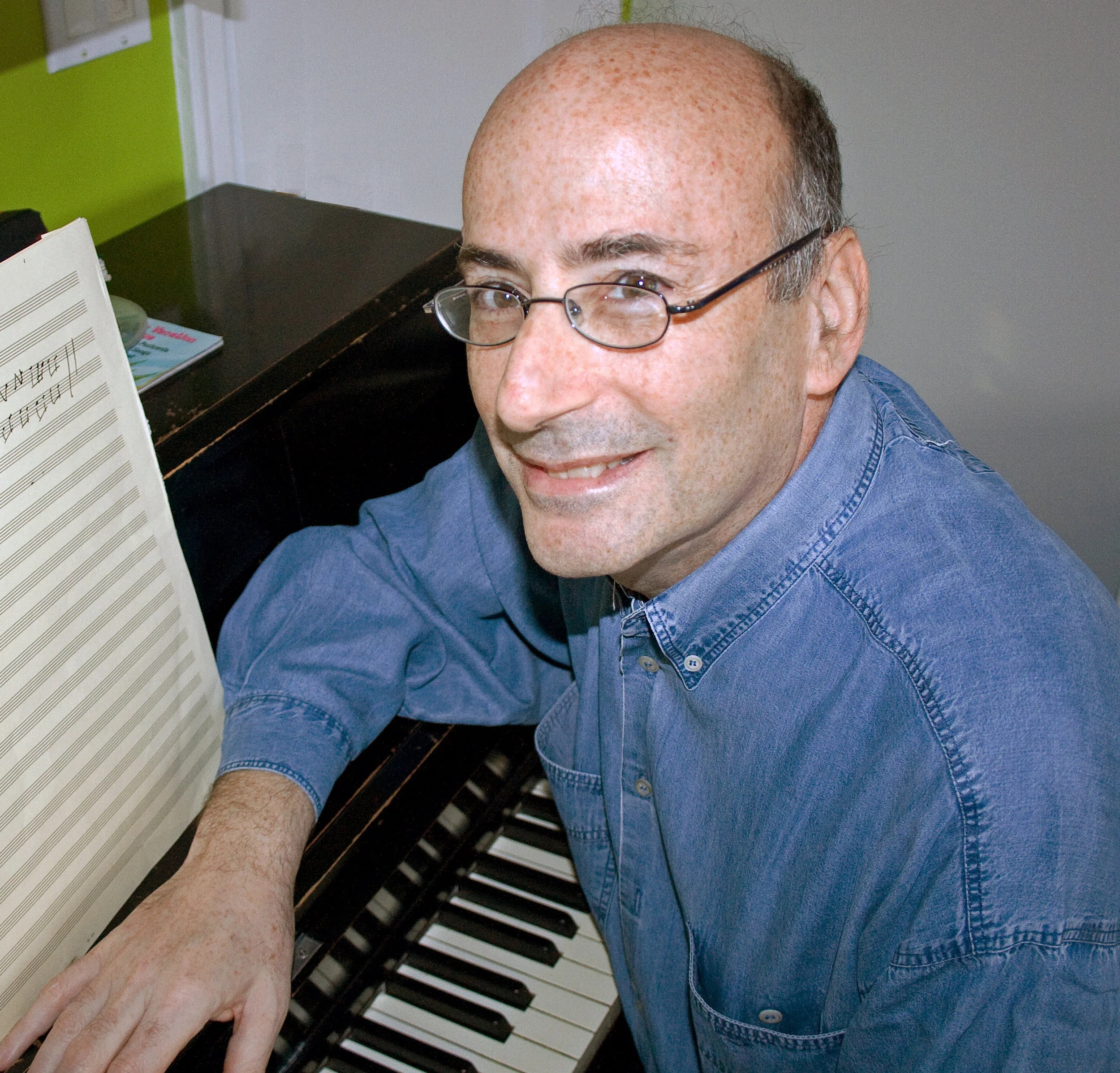
Richard Einhorn. Image from his website, which notes “Einhorn has received numerous awards and grants from Meet the Composer, NYSCA, NEA, the New York State Music Fund, and many others. He is a well-known advocate for persons with serious hearing losses.”
Indeed, Wikipedia recounts, “In his mid-fifties, Einhorn experienced significant hearing loss. In a 2011 New York Times article, he discussed his use of hearing loops to enjoy concerts with his hearing aid.”
Wikipedia continues, “He has also composed many horror and thriller film scores, including Shock Waves (1977), Don’t Go in the House (1979), Eyes of a Stranger (1981), The Prowler (1981), Dead of Winter (1987), Blood Rage (1987), Sister, Sister (1987), and Dark Tower (1989). He also contributed to the soundtrack of Liberty! The American Revolution (1997).”
I confess that horror flicks aren’t my thing (there’s quite enough in real life to keep me a’jitters). But Einhorn’s contribution to the six-part PBS series Liberty! caught my eye. And, sure enough, Freedom (3:40) is one of its pieces.
Recalling Pandora and Rasputina. What happened next in a search for Freedom brought to mind my early experiment with online music: R&T had a deal with XM (back before its merger with Sirius) to fit satellite radio to an R&T Long Term car. I discovered Pandora, back in the days before it had competition from the likes of Spotify and Apple Music.
Wikipedia describes Pandora: “The service carries a focus on recommendations based on the ‘Music Genome Project,’ which is a means of classifying individual songs by musical traits such as genres and shared instrumentation.”
My Rasputina Test. At the time, I was heavy into Rasputina: “And so it was in Paris I bought Thanks for the Ether, my first Rasputina CD. Others were to follow.”
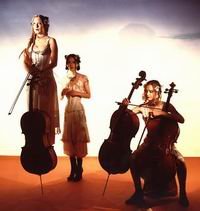
Rasputina, the early years, c. 1992.
My Pandora test would have involved “a trio of young ladies, all three playing cellos, doing something akin to classical/hard rock/performance art.” And, sure enough, Pandora linked me with Rasputina and others of the genre.
History Repeats With a YouTube Mix. Having used the KUSC playlist to identify Einhorn’s Freedom, I promptly Googled it and found Mix—Freedom “Provided to YouTube by Sony Classical.”
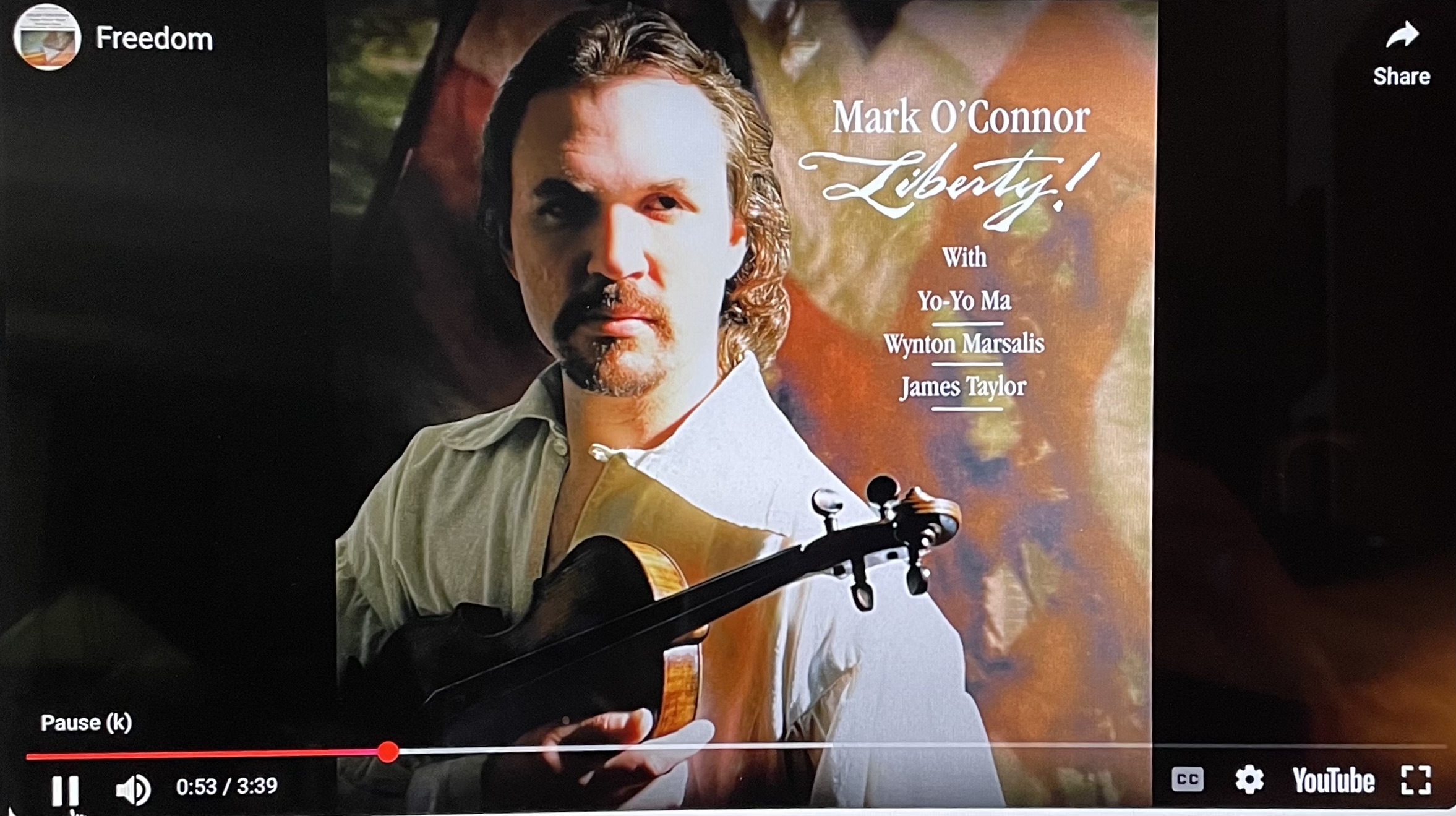
Image and music from YouTube.
And, immediately to its right is a listing of 25 selections, all meeting the Pandoraesque criterion of “music akin to Einhorn’s Freedom.” Indeed, Freedom and Song of the Liberty Bell come from the PBS Liberty! album. Others are from Appalachian Journey by Yo-Yo Ma, Edgar Meyer, and Mark O’Conner and Appalachia Waltz by the same talented trio. Yet other individual pieces include Bach’s Chaconne in D Minor for Two Cellos and Philip Glass’s The Hours.
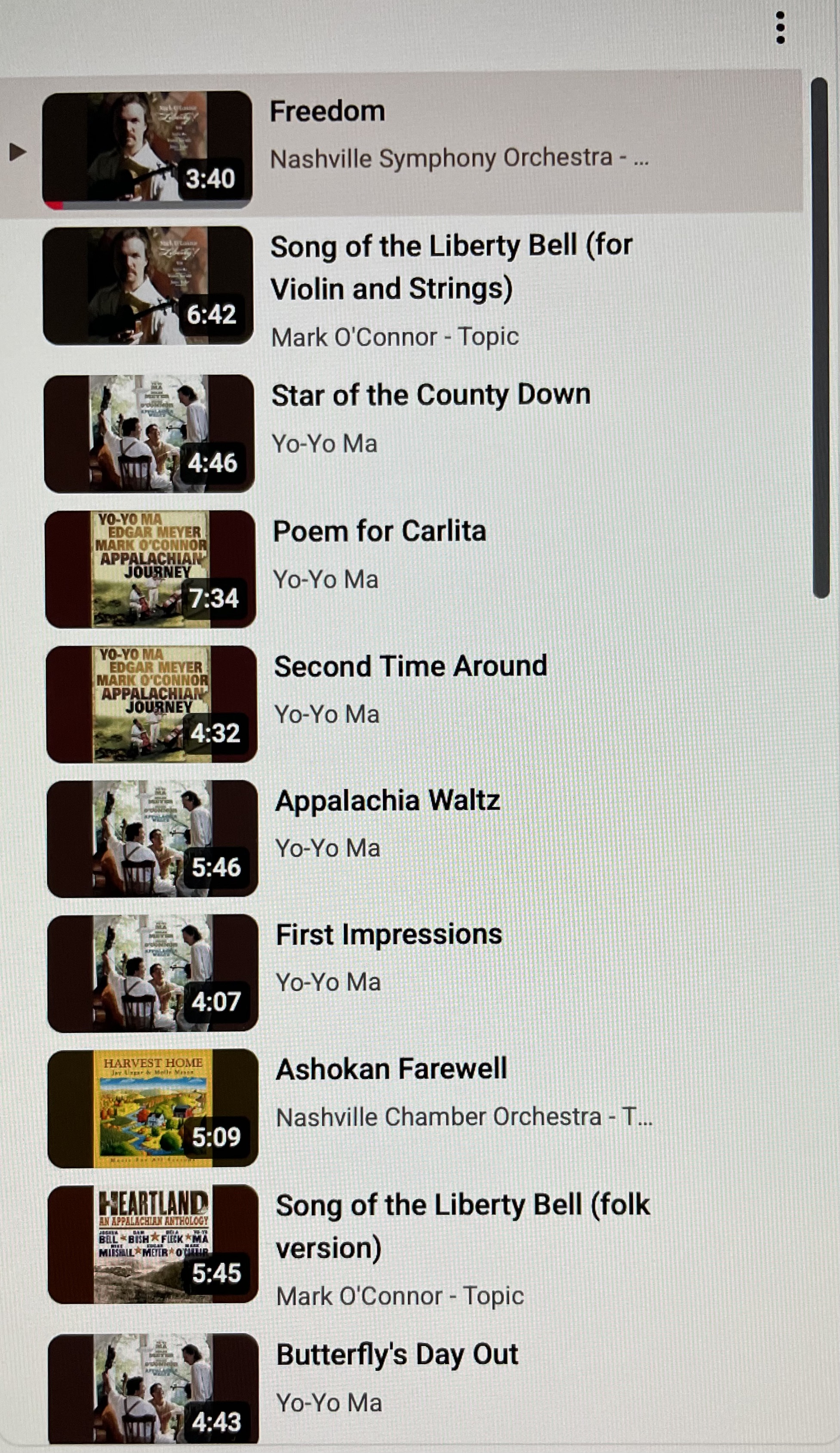
Keep the Cursor Handy. My particular mix played referenced bits continuously from the Nashville Symphony’s Freedom (3:40) to Vivaldi’s Concerto Köln (2:36)—interrupted occasionally by short commercials for everything from cognitive decline to questionable nutritionals, each easily skippable with a cursor click. ds
© Dennis Simanaitis, SimanaitisSays.com, 2026.
 Simanaitis Says
Not sure if this meets your criteria above, but check out Escala a British group of four young ladies playing very modern looking instruments. I first encountered them on a clip on YouTube from the Britain Has Talent or similar type of show.
Thanks, Sabre,
Escala is rather less raw than Rasputina, less performance art. Both are kewl.—d
Mr. Simanaitis,
I am a retired mechanical engineer and life long car nut. I only started
subscribing to R&T in September of 1971, but I believe that covers your
tenure there. Having just recently discovered your blog I’m working my
way back to its beginning and enjoying it tremendously.
SAVE America from the republicans!
Thanks so much,
Alan Christman
Prairie Grove, Ar
Welcome, Alan. Thanks for your kind words. I hope you continue to enjoy the website.