
Simanaitis Says
On cars, old, new and future; science & technology; vintage airplanes, computer flight simulation of them; Sherlockiana; our English language; travel; and other stuff
LOSING A $50 BILLION BET—OR JUST MORE TRUMP CHAOS? PART 1
“IT’S A BILLION HERE, A BILLION THERE, PRETTY SOON IT BEGINS TO ADD UP TO REAL MONEY.” So recounted The New York Times in 1938. And a variation of the quip is often attributed to Senator Everett Dirksen (1896–1969).
But what about $50 billion?? Even today, that’s real money: ten times what Trump is suing JPMorgan Chase for closing his and his business accounts; five times what Trump is suing IRS (i.e., the U.S. government; i.e., us!) over a leak of his tax information.
The Auto Industry’s $50 Billion Debacle. Lindsay VanHulle reports “Automakers Regroup As Market Shifts After $50 Billion EV Debacle,” Automotive News, February 13, 2026.
That is, this $50 billion isn’t some mad king’s scam. It’s money that automakers have burned to meet anticipated American demand for EVs.
How could automakers have got it so wrong? How dissuaded are customers over EV cost, range, or infrastructure? Or is it just concomitant with Trump chaos? Here, in Parts 1 and 2 today and tomorrow, are tidbits gleaned from VanHulle’s Automotive News piece, together with my usual Internet sleuthing.

An Aggressive EV Focus. “The massive price tag,” VanHulle recounts, “is a product of how aggressively automakers focused their capital investments on EVs, said Itay Michaeli, an equity auto analyst at TD Cowen. Yet the charges don’t necessarily reflect ‘a complete about-face’ on EVs, he said, because regulations could change again under future presidential administrations and EV sales are expected to become a larger portion of the market long term.”
Or, as is often the case with TACO, through changes occurring randomly next Thursday.
A Regulation-Driven Industry. VanHulle observes, “The charges follow years of dialing up EV development to keep up with increasingly stringent zero-emission regulations in the U.S. and Europe. Automakers also had to respond to competitive pressures from Tesla and startup EV manufacturers Rivian and Lucid Motors as well as the potential threat posed by up-and-coming Chinese automakers.”
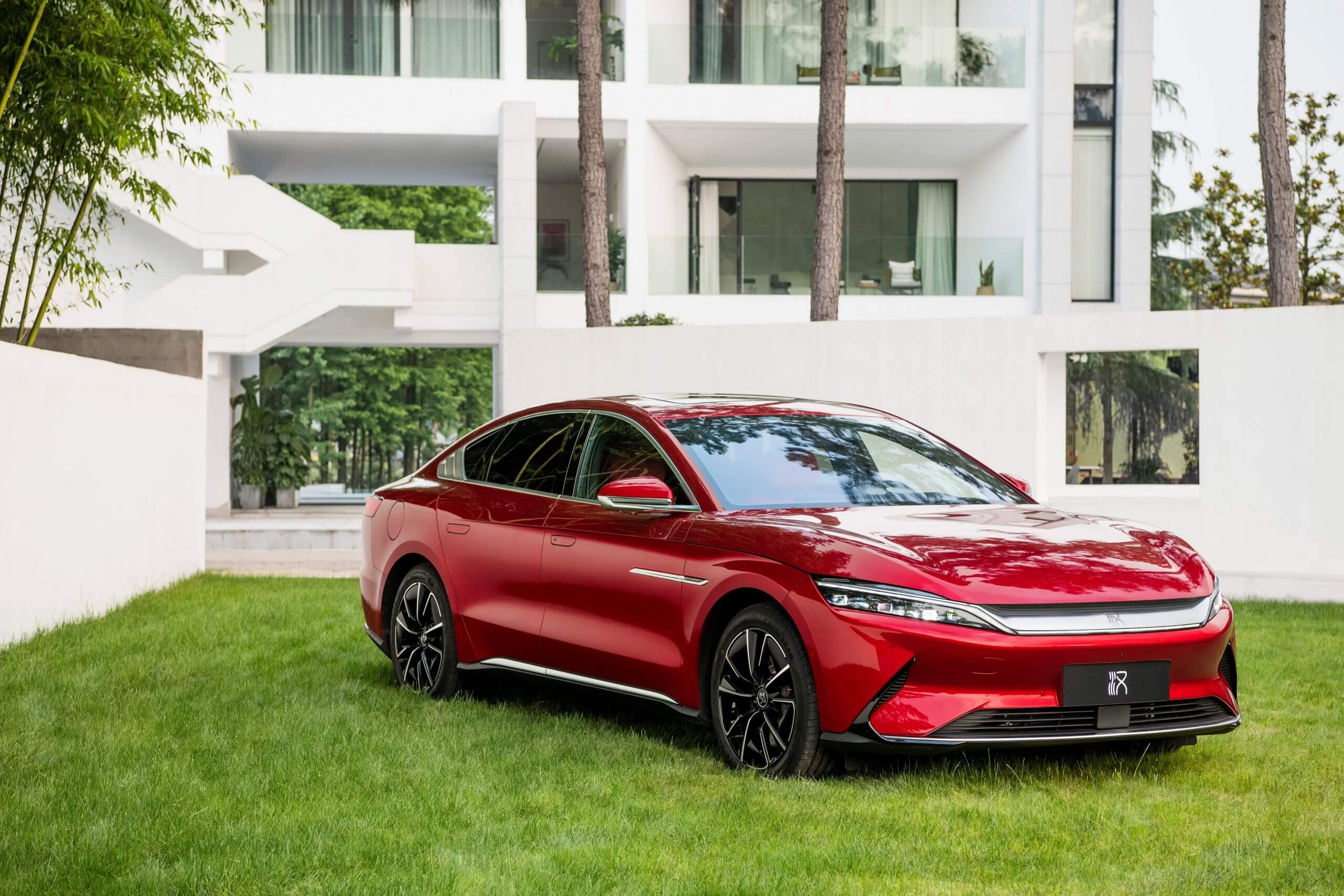
The BYD Han (named after the fabled dynasty). The basic home-market EV model is priced at the equivalent of $27,000 to $30,000.
The standard BYD Han has a range of 605 km (376 miles). Its awd high-performance model goes from 0-100 km/h (0-62 mph) in 3.9 seconds. Image from BYD.

And Then There’s BYD. Note, BYD is the world’s largest producer of (quite possibly the world’s best) EVs. Mauro Orru reports “China’s BYD Opens 2026 With Blockbuster Sales Growth in Europe,” The Wall Street Journal, February 24, 2026.

And Dave McQuilling reports “Canada Just Went ‘Anti-Tariff’ on Chinese EVs—And What BYD Brings Could be Exactly What Americans Start Wanting,” autonocion.com, February 24, 2026.
Tomorrow in Part 2, we’ll continue with more of such tidbits, VanHulle’s analyses, and Trump’s chaos. ds
© Dennis Simanaitis, SimanaitisSays.com, 2026
 Simanaitis Says
The agreement to allow Chinese EVs into Canada is for a maximum 49,000 units a year, 50% of which must be priced below CDN $35,000. These cars would have a tariff rate of 6.1%. Anything over the quota would be at the 100% tariff rate set in 2024.
That would be approximately 2.5% of the approximately 1.9 million vehicle market in Canada (2025 numbers).
According to AI searches we build about 1.35 million units a year, import about 1.1 million units and export about 1.8 million units. That doesn’t add up to 1.9 million units sold in Canada. In fact how could we export 133% of what we produce? Despite the temptation to blame this math confusion on “hallucinations”, I think that a better explanation might be that North American built cars may cross the border more than once due to integrated production processes, thereby confounding the import/export stats.
Looking at the dollars rather than car count might provide a better picture. Sales in 2025 – $63 Billion. Imports in 2025 – $72 Billion including parts (can’t find numbers for completed cars only). Exports in 2024 – $46 Billion including parts. Production in Canada in 2024 – $55 Billion including parts. The issue with parts is that they may be replacement parts, or parts used in the assembly of vehicles. The numbers still don’t really add up, again mainly driven by the integrated production system in North America. The data also sometimes includes both cars and suvs and light trucks, sometimes not, and so it is very confusing.
Another stat that I found shows total value of imports in the auto sector is $142.74 Billion versus exports of $82.21 Billion. Without clear definition about what’s included in all these numbers, it is hard to really understand the dynamic.
But nonetheless it is clear that the erratic behaviour of the Tangerine Nightmare has led to our country looking for alternate trading partners.