
Simanaitis Says
On cars, old, new and future; science & technology; vintage airplanes, computer flight simulation of them; Sherlockiana; our English language; travel; and other stuff
女武者 AND SNAP ELECTIONS PART 2
YESTERDAY WE DISCUSSED JAPANESE PRIME MINISTER SANAE TAKAICHI and her samurai snap election. Today in Part 2, we ponder whether we can snap out of the Trump era.
Our Nearest “Snap Elections,” Sorta. Wikipedia recounts, “Impeachment is a process by which a legislative body or other legally constituted tribunal initiates charges against a public official for misconduct.”
Wikipedia continues, “Most democracies (with the notable exception of the United States) involve the courts (often a national constitutional court) in some way…. Most commonly, an official is considered impeached after the commencement of the charges, and a trial of some kind is required to remove the official from office.”
Several U.S. Impeachments (Sans Convictions). Thus, for example, Andrew Johnson (who succeeded after Lincoln’s assassination) was impeached in 1868, largely for violating the Tenure of Office Act (involving certain presidential powers without Senate approval). However, the Senate failed by one vote to convict him.
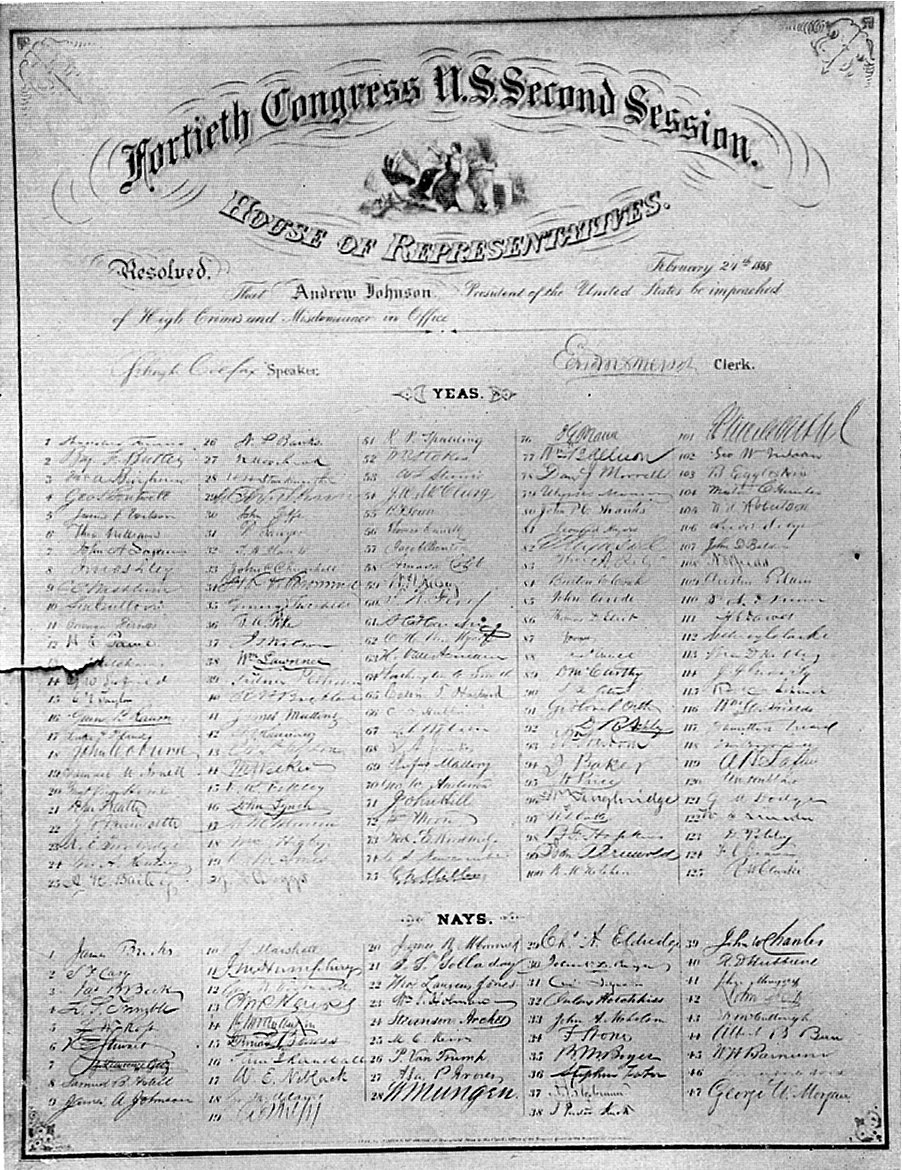
The impeachment resolution against Andrew Johnson, adopted on February 24, 1868. Image from Wikipedia.
Richard M. Nixon beat impeachment after Watergate by resigning before the House vote. Tricky Dick….
Bill Clinton was impeached in 1998 for matters related to the Clinton–Lewinsky scandal. Again, impeachment failed to gain the required super-majority.
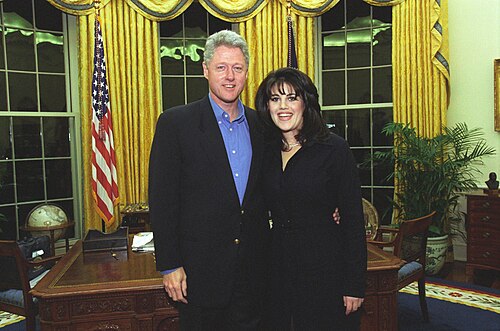
Clinton and Monica Lewinsky, February 1997. Image from Wikipedia.
Trump’s Impeachments. Trump has had several (though he has acted to remove information of these from presidential imagery).

Original plaques cited two impeachments; revised wording eliminates any mention. Image by Rod Lamkey A/P via NPR.
The first Trump impeachment in 2019 concerned the Trump–Ukraine scandal; he beat this rap 48-52. Trump’s second impeachment in 2021 involved his inciting the Capitol riot. This time, he evaded being thrown out of office by 57-43.
Supermajority Required. The required supermajority generally means two-thirds of the senators present, though often it’s 67 votes. As noted at senate.gov, the current count is 53 Republicans, 45 Democrats, and 2 Independents.
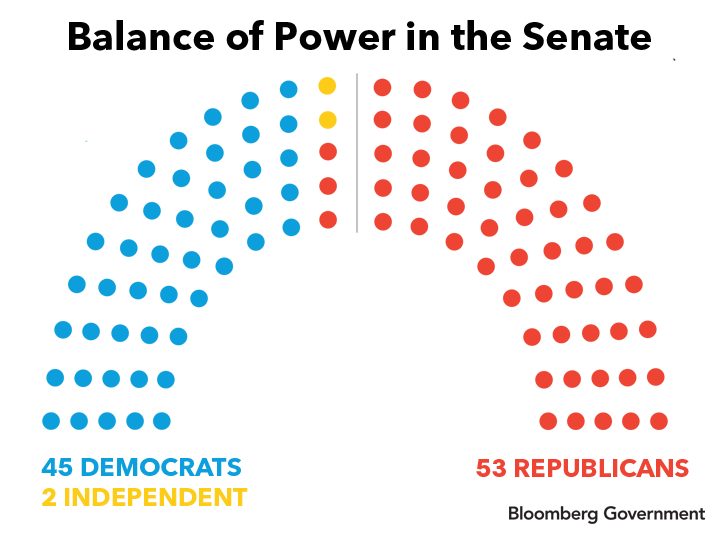
Image from Bloomberg Government.
More recently, H.Res.353, H.Res.415, (each, “for high crimes and misdeamors”), H.Res.537 (ditto, concerning the Maduro kidnapping) and H.Res.939 (another “crimes and misdemeanors,” 12/11/2025) have been introduced in the House of Representatives.
With the Senate count, is Teflon Don likely to slide by again?

On the Other Hand. The two Minnesota killings by ICE have aroused Americans. So too should be The Guardian’s “Eight People Have Died in Dealings with ICE So Far in 2026. These Are Their Stories,” January 28, 2026.

There’s also NBC News’ “Trump’s DHS Has Shot 13 People During Immigration Enforcement Operations Since September. Here’s What We Know,” January 28, 2026. One aspect identified: Many of the victims were Hispanic or Black.

Nor should we overlook The New York Times’ “ ‘I Didn’t Make a Mistake’: Trump Declines to Apologize for Racist Video of Obamas,” February 7, 2026. How much racist evil must we endure from our country’s president??
And, Petty Though It May Seem.… Let’s not forget the narcissistic mobster extortion of “Trump Wanted Dulles Airport, Penn Station Named After Him—In Exchange for Releasing Federal Funds,” NBC News, February 5, 2026.
Republicans: Have you had enough yet?? Isn’t it time for our own version of a snap vote? ds
© Dennis Simanaitis, SimanaitisSays.com, 2026
 Simanaitis Says
Snap elections can be a way to game the system.
Constitutionally, Canadian federal and provincial governments can only sit for a maximum of five years, except if there is a state or war, invasion or insurrection. With the exception of Ontario and Nova Scotia, the federal and provincial governments currently have fixed election dates based on 4 years after the last election. Most of the provincial fixed date laws have a provision to move the date if there is a federal election occurring at the same time.
But an election can be called earlier than the fixed date if a government loses a non-confidence vote, or if a sitting premier (provincial) or prime minister (federal) requests the Lieutenant Governor (provincial) or Governor General (federal) to dissolve parliament and call an election (snap election). I’m not sure how the fixed date rules apply in this case, but most probably would require a regular election within 4 years after the early election on the “fixed” date established in each jurisdiction’s law.
Both non-confidence and snap elections occur when the sitting government does not have a majority. As just about all our jurisdictions have at least 3 parties, you could have party 1 with 46% of the seats, party 2 with 44% and party 3 with 10%. The government could be party 1 as they have a plurality of seats, or party 2 in coalition with party 3. If party 2 and 3 effectively gang up on a governing party 1 on a non-confidence vote (say the budget) the government would fall.
On the other hand a governing party 1 could call a snap election if their polling shows them with a significant lead, hoping to capitalize on this short term advantage to gain a majority. Say if that snap election happens two years into a four year mandate and they succeed in getting a majority, they have effectively extended their mandate to six years. But snap elections have sometimes backfired too.
A majority government could also try to call a snap election if it foresees their fortunes dropping in the future and wants to taking advantage of their current polling. But the lieutenant governor or Governor General could deny the request to dissolve the government if it is seen as a cynical attempt at gaming the system.
Usually if party 3 supports party 2 to form a government, it will frequently take a big hit in the next election as voting polarizes around parties 1 and 2.
Thanks for this. It seems to work effectively with more than two parties.
Depends which side you support. If your party improves its situation, all is good. If the “bad” guys further entrench themselves, not so good.
Probably the closest we have to a snap election here in the US is the recall process. It’s only available in some states in the present day, and is most notoriously used in places where it can be triggered by initiative as in California. In CA also, a recall election usually includes a slate of people running for the office as a replacement should the recall be successful; that’s how we got Arnold Schwarzenegger replacing Gray Davis, and it’s been used in many lower-level cases to replace chunks of a county board of supervisors or city council.
Fairly early in my career, I was laid off after a majority of the county board of supervisors was recalled and replaced with hard-line conservative (not quite modern MAGAts, but certainly a couple of them were open John Birchers) individuals. They decided that land use planning and regulation, while required by state law, was not something they wanted to do, and zeroed the budget. I worked in the Planning Department…