
Simanaitis Says
On cars, old, new and future; science & technology; vintage airplanes, computer flight simulation of them; Sherlockiana; our English language; travel; and other stuff
A QUITE PROPER MEDITERRANEAN CRUISE—1923 PART 2
YESTERDAY, WE EMBARKED ON A CRUISE around the Mediterranean Sea with Rolland Jenkins’ 1923 guidebook. Today, we continue in Part 2, first with the “sparkling city of Algiers.”
Algiers. “The present city,” Jenkins recounted, “was founded in 944, and in 1530, after the expulsion of the Moors from Spain, it became the chief stronghold of the Barbary pirates.”
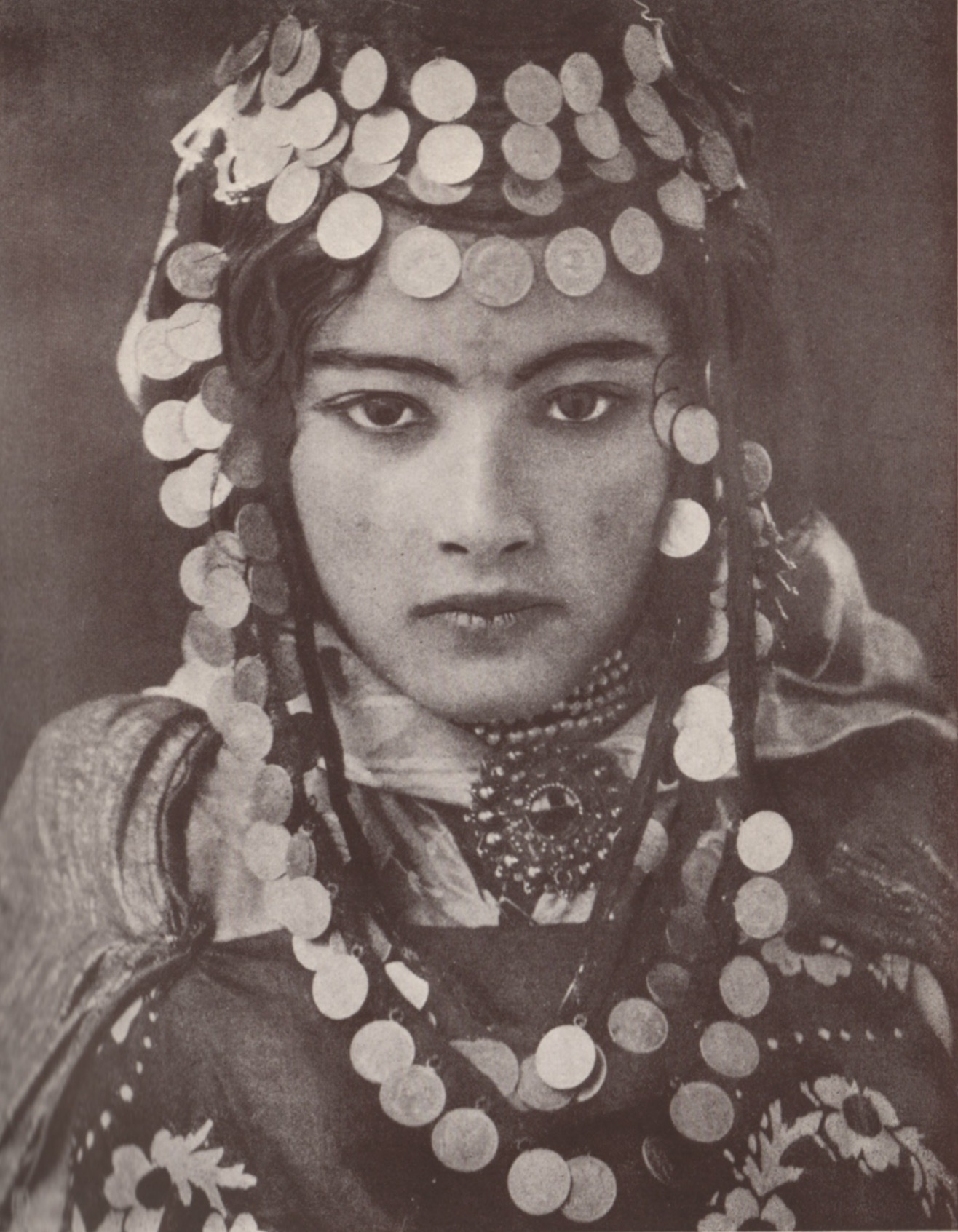
A pirate’s moll? As promised in Part 1, “A wild, impetuous daughter of the desert. Tattooed ‘beauty marks,’ eyebrows and fingers deeply stained with henna, and dowry-coins festooned about the face….” This and the following images and captions from The Mediterranean Cruise.
A President Washington Tale. “Pirates continued unabated…,” Jenkins related, “Even America, then a new republic, suffered. President Washington protested at the high ransom demanded for captured American subjects, which averaged $3000 per person. In 1795 this country paid over the sum of $721,000 to these pirates, and as late as 1812 a large sum was paid annually in stores and munitions.”
Jenkins Opined: “It is hard to realize, from observation of the lazy and ignorant Arab which one sees in great numbers today, that a hundred years ago they held the civilized world in constant terror, and kept the entire Mediterranean region under complete domination.”
Hmm….
Decatur to the Rescue. Jenkins continued, “Commodore Decatur first succeeded in breaking the hold of Algerian piracy, and in June, 1815, he arrived before Algiers and demanded the immediate and unconditional release of all American captives.”
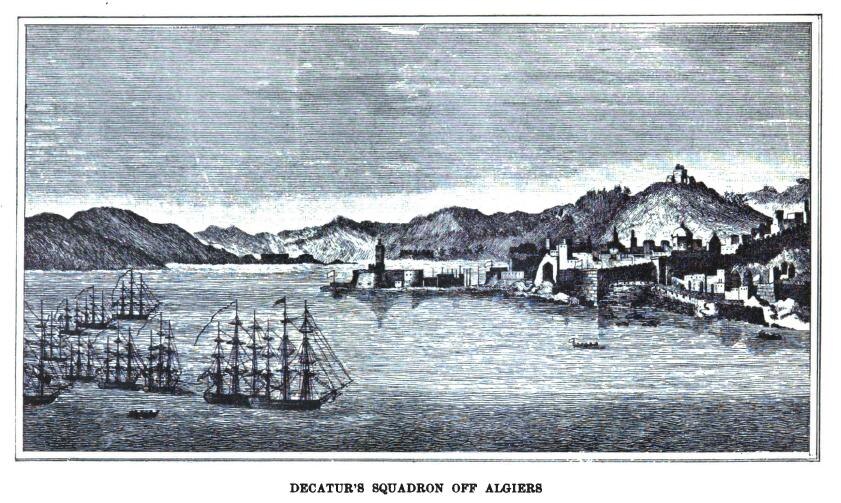
“The dey,” Jenkins recounted, “asked a nominal tribute in the shape of gunpowder; but Decatur replied that if the dey accepted the powder, he must take the balls with it, and won his point.”
This particular guidebook, you’ll note, isn’t just a bunch of pretty pictures.
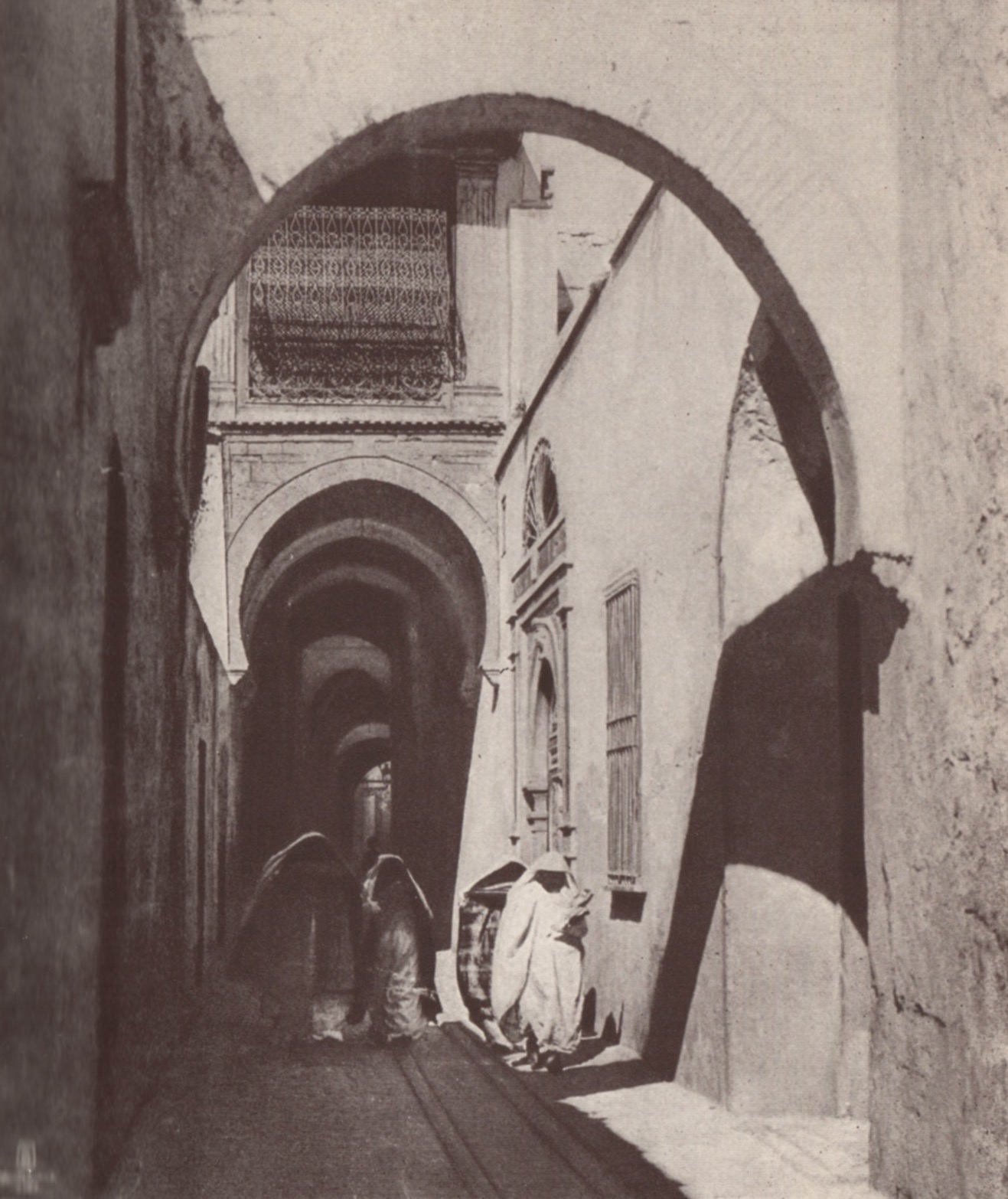
On the other hand, “Up and down the streets comes an endless variety of figures—town and country Arabs, Spahis in their gay uniforms, French soldiers, Italian workmen, children in vivid colors, Jewesses with heads and chins swathed in dark wrappings, and interesting beyond all these, the Arab women flitting like ghosts from one corner to another.”— Frances E. Nesbit.
And Who, You Ask, is Frances E. Nesbit? Ain’t research fun: Sulis Fine Art describes, “Frances E. Nesbitt (c.1864-1934) was a painter, mainly in watercolours, born in Wolverhampton, Staffordshire…. Nearly every year with her widowed mother, she travelled abroad, visiting France, Germany, Italy, Norway and the Netherlands, studying the history and architecture of these countries.”
“An excellent linguist,” Sulis Fine Art continues, “she took the opportunity to capture the local colour and atmosphere in her numerous watercolours. Venturing further afield, the pair visited North Africa. This trip resulted in Frances’ travel book ‘Algiers and Tunis’ illustrated with many of her watercolours.”
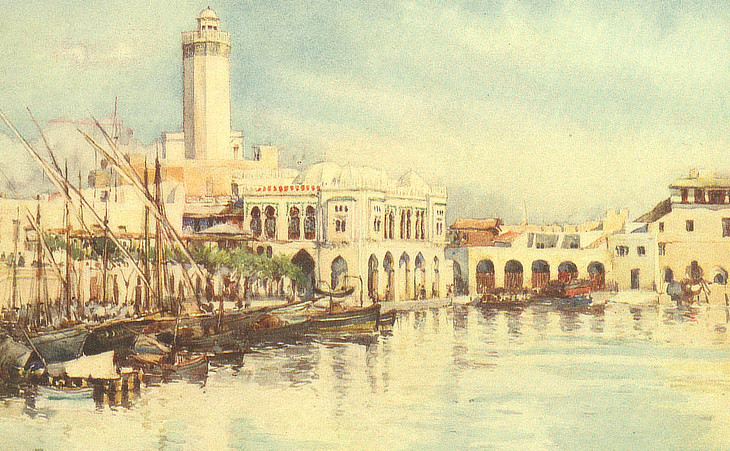
Algiers: The Penon, watercolor by Frances E. Nesbit. Image from Roman Art Lover.
Monaco—A Gaming Heritage. Jenkins offered another historical note: “In 1860, the noted M. [François] Blanc was driven from Homburg with his gambling tables. He came to Monaco, built his gambling palace a short distance to the eastward of Monaco, and converted the section into a veritable paradise.”
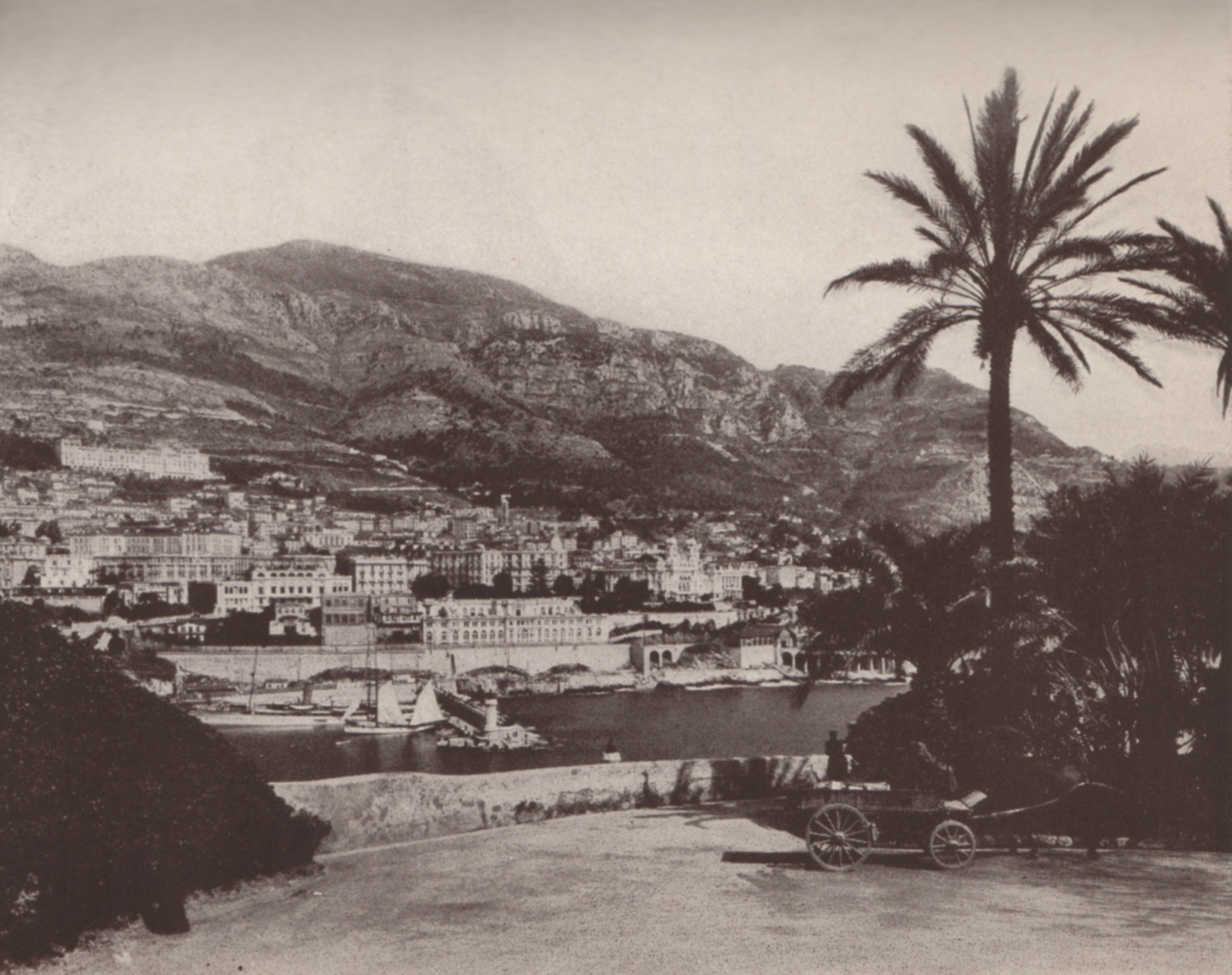
“Desiring the concession,” Jenkins continued, “Blanc agreed to lend financial support to the Prince of Monaco and his Government. With the revenue from this source, the Prince restored the palace, built the cathedral and other sumptuous structures, until today the city is a continuous succession of magnificent hotels, restaurants, clubs, and entrancing villas.”
The Corniche Road. “Perhaps the most beautiful drive in Europe,” Jenkins observed, “is that along the Corniche Road between Monte Carlo and Nice. There are two roads;—the Upper Corniche, which climbs rapidly to a great height along the steep cliffs lining the shore in this region—and the Lower Corniche, which keeps near the level of the sea, and which passes through most of the towns bordering on the coast.”
Not to nitpick, but there are actually three: Grande, Moyenne (“Average,” i.e, Middle), and Basse.
“Passing La Turbie,” Jenkins recounted, “Monte Carlo lies far below, looking for all the world like a toy city on the edge of the blue sea. Cap d’Ail or ‘Garlic Point,’ where many pleasant villas are located, is the next village passed. Then comes Èze, where there is a ruined fort said to be a Saracenic origin.”
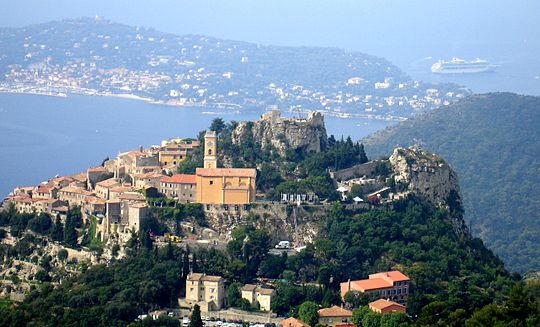
The village of Èze, as seen from the Grande Corniche. Image by Jimi magic at English Wikipedia.
My Èze. As described in “Cook’s Traveller’s Handbook Health Resorts,” pal/fellow journalist Rich Homan and I visited the Jardin Exotique d’Èze, “a wonderful collection of succulent plants and xerophytes (those requiring very little water).”
With a Lasting Regret. Of that same visit, I recounted, “One of the few regrets of my international adventures came in an Èze giftshop: It offered a folk-crafted mustached aviator in goggles, leather helmet and garb—and wearing Icarus-like wings.”
“Admittedly, he was larger than my backpack, but perhaps suitcase-sized if I ditched some clothes and shoes. He was priced at the French equivalent of around $375, not exactly souvenir change back then.”
“I shoulda brung him home.” ds
© Dennis Simanaitis, SimanaitisSays.com, 2026
 Simanaitis Says
Marvelous memories, Dennis! Thank you,
Thanks, Tom. It’s much appreciated.—ds
Of course the usage of the word “gay” in the 1920s had quite a different meaning from current usage. I would always cringe when my mother used that term in the 1920s meaning when referring to contemporary friends of my brothers and me. I don’t think that she ever understood the more modern usage of the word.
Indeed, it wasn’t until the ‘60s that “gay” took on its current primary sense. Remember Digger O’Dell, the friendly undertaker, who spoke of “gay” in the earlier (now noted as second) sense. —ds