
Simanaitis Says
On cars, old, new and future; science & technology; vintage airplanes, computer flight simulation of them; Sherlockiana; our English language; travel; and other stuff
WILLIAM DAVENANT—SHAKESPEARE’S SON?? PART 2
YESTERDAY WE INTRODUCED WILLIAM DAVENANT, English playwright spanning a particularly complex period of that country’s history encompassing regicide, civil war, and a real piece of work in Lord Protector Cromwell. What’s more, Davenant might have been—let’s emphasize “might have been”—an illegitimate son of William Shakespeare. Today in Part 2, Ralph and Ed Goldswain’s No Sweat Shakespeare website continues sifting through 400-year-old commentary.
Davenant’s Tween Tribute. “Davenant was ten years old when Shakespeare died,” the Goldswains note. “He clearly had an emotional or spiritual connection with the famous visitor, because two years later, he wrote a poem—a pretentious, precocious poem—titled ‘In Remembrance of Master William Shakespeare’ that showed little talent.”
In time, Davenant was to rise considerably in literary stature as Poet Laureate appointed by King Charles I.
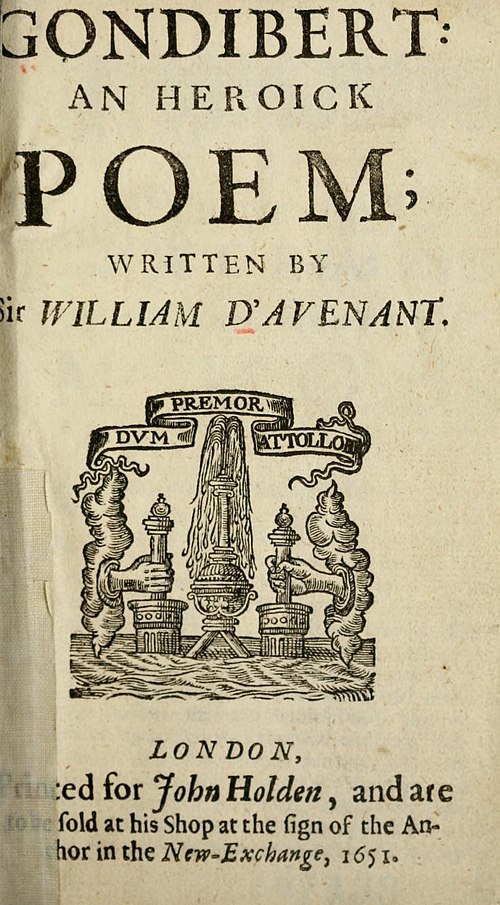
The title page of the 1651 edition of Gondibert, one of Davenant’s more memorable works.
Later, Wikipedia notes, “He headed the Duke of York’s Men and produced highly successful theatrical seasons at Lincoln’s Inn Fields from 1660 until his death in 1668.”
The Goldswains continue, “We don’t have any reminiscences regarding interactions he may have had with the Bard as a boy, but his brother Tom, who became a bishop, told people that he remembered being bounced on Shakespeare’s knee when he was a child.”
Enter John Aubrey. The Goldswains’ narrative continues: “Years later, John Aubrey, man about town, popular philosopher, and gatherer of tittle-tattle, was the seventeenth-century version of a gossip columnist. [Think Walter Winchell.] He wrote a book of biographical sketches, Brief Lives, and William Davenant is one of his subjects. Like all of Aubrey’s sketches, it’s highly entertaining.”
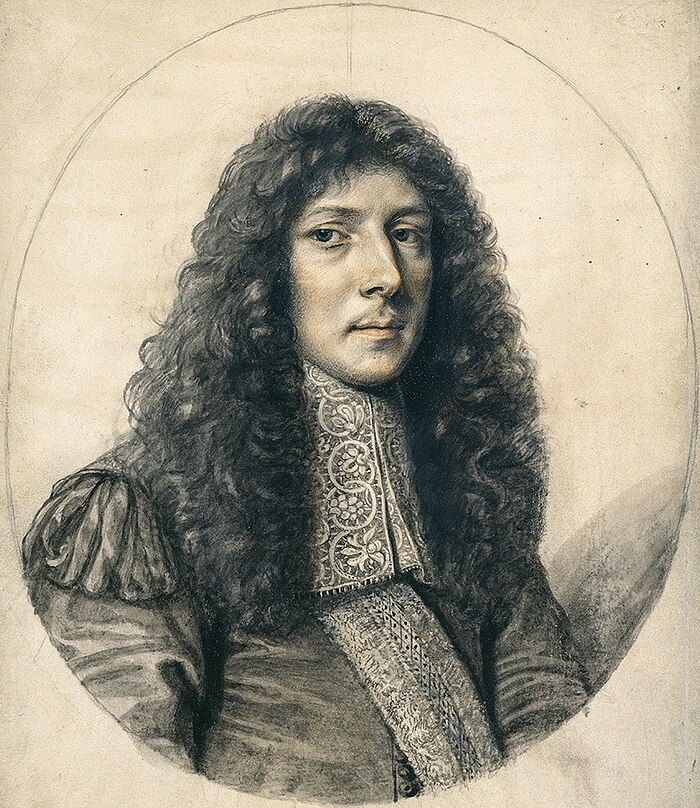
John Aubrey, 1626–1697, English antiquarian and biographer, known for his vivid, intimate, and sometimes acid sketches of contemporaries. Image from Wikipedia.
“Aubrey claims that the poet, Samuel Butler, who was a close friend and dining companion of Davenant, told him that when Davenant had had a few drinks, he would joke that he was Shakespeare’s illegitimate son, even saying that his mother was morally loose.”
Agg!
The Goldswains note cogently, “Not very nice, is it? That claim by Aubrey, gained at second hand, is the only source of the story. But is it likely that, having borne fourteen children, she must have been far too busy being pregnant and raising her children to be sneaking off to romp with her husband’s friend, having one-off encounters right under his nose? Surely common sense forbids?”
Another Shakespeare Hassle. The Goldswains relate as well, “Given that so little is known about Shakespeare, it’s not surprising that he has become the victim of conspiracy theories. For example, there is a serious debate among conspiracy theorists regarding the authorship of the plays.”
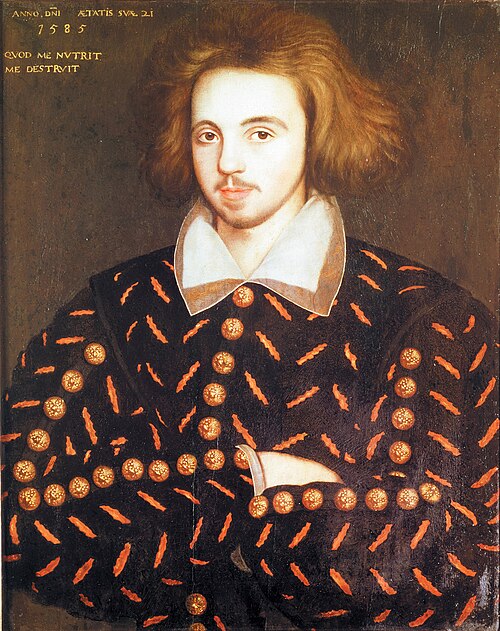
Christopher Marlowe, 1564–1593, English playwright, poet, and translator. His life was complicated by conjectures of blasphemy against the church, homosexual intrigue, and espionage of the highest level. Anonymous portrait, possibly of Marlowe, from Wikipedia.
I sorta like the Marlovian theory of Shakespeare authorship: It’s based kinda on Shakepeare’s “small Latine lesse Greeke” and the coincidence of his fame coming not long after Marlowe’s (faked?) death in 1593.
Failing that, there’s always “William Shakespeare didn’t write the plays; they were written by another guy with the same name.” And, come to think of it, “Who’s your daddy?” ds
© Dennis Simanaitis, SimanaitisSays.com, 2025
 Simanaitis Says
See also, “ Sweet Swan of Avon” by Robin Williams. Arguing that at least many of the works attributed to Wm Shakespeare were written by Mary Sidney. Interesting read at the very least.