
Simanaitis Says
On cars, old, new and future; science & technology; vintage airplanes, computer flight simulation of them; Sherlockiana; our English language; travel; and other stuff
THE BIG LIFT AND TRUMP’S DEMOCRACY
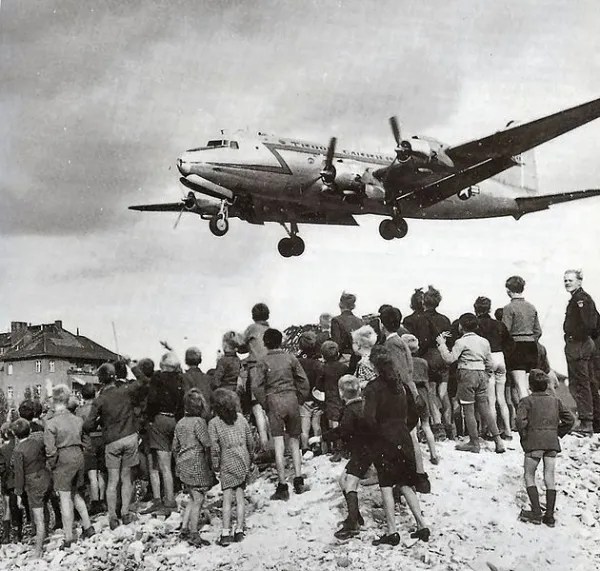
TURNER CLASSIC MOVIES RECENTLY SHOWED THE BIG LIFT, a 1950 Hollywood drama centered around the Soviet blockage of Berlin and the allies subsequently successful support of the city by air transport. An early SimanaitisSays tale “Berlin Airlift,” December 7, 2012, gave details of this heroic 1948 response to Russian oppression: “On June 26,” SimanaitisSays recounted, “what came to be called Operation Vittles began. Thirty-two flights of American twin-engine C-47s (military designation for the Douglas DC-3) flew from Wiesbaden Air Force Base to Tempelhof with 80 tons of supplies. In another two days, 35 four-engine C-54s (Douglas DC-4s/Navy R-5Ds) left Alaska, Hawaii and the Caribbean to join them.”
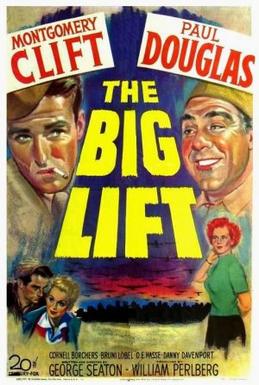
Montgomery Clift portrays Tech Sgt./C-54 flight engineer Danny MacCullough. Paul Douglas plays his pal Master Sgt./ground controlled approach operator Hank Kowalski. The fetching redhead is Cornell Borchers portraying Frederica Burkhardt, Danny’s love interest/war widow with a past. The blonde is Bruni Löbel, Hank’s “Schatzi” Gerda (and destined to be related to my “Trump’s Democracy” title).

Other Cast Members. Indeed, The Big Lift, written and directed by George Seaton, was filmed on location in Berlin less than one year after the Soviets ceased the blockage. Wikipedia notes, “All military roles except those of Clift and Douglas were portrayed by actual military personnel stationed in Germany as themselves.”
“The 19th Troop Carrier Squadron,” Wikipedia recounts, “was an actual Air Force unit based in Hawaii and was one of the first to deploy for Operation Vittles in July 1948. However it participated only until August 26, when it was inactivated and its personnel and equipment absorbed into the 53rd Troop Carrier Squadron at Rhein-Main Air Base as depicted in The Big Lift.”
In a note of authenticity, Wikipedia observes “The copilot of Der Schwarze Hibiscus, 1st Lt. Alfred L. Freiburger, was a C-54 pilot with the 14th Troop Carrier Squadron who had participated in the final months of Operation Vittles.”
Seaton must have been quite the director, as there’s nary a sign of non-professionalism in any of the acting.
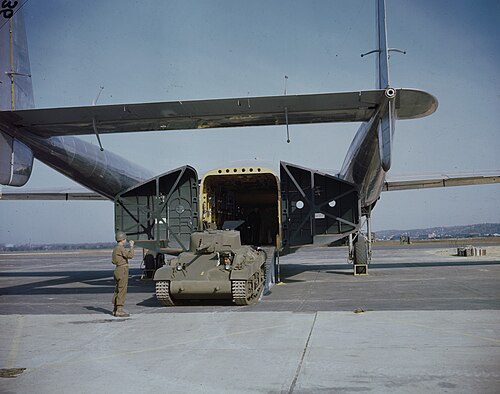
A C-82 Packet As Camera Plane. Wikipedia describes, “Aerial sequences were accomplished, often in bad weather to demonstrate conditions under which the airlift was flown, using a Fairchild C-82 Packet as a camera platform, taking advantage of its removable rear fuselage to take panoramic shots of up to 170 degrees.”
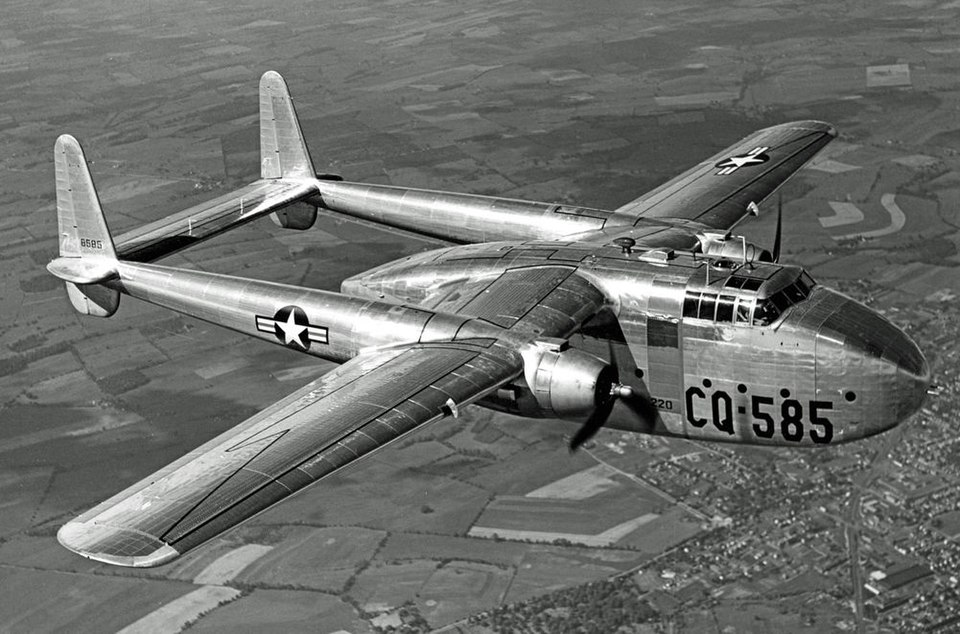
Above, a C-82; below, an M22 Locust light tank being loaded onto a C-82. Images from Wikipedia, which notes, “During the Berlin Blockade, five C-82 aircraft carried large disassembled earthmoving equipment into the city to enable the construction of Berlin Tegel Airport in the fall of 1948.”
Ruskie Interference. Berlin, isolated from West Germany, was divided into four zones: American, British, French, and Russian. Wikipedia recounts, “Seaton reported that he finally overcame political complications with Soviet authorities to complete location shooting inside the Brandenburg Gate, which was in the Soviet zone, but that on the day of the shooting the Soviets set up loudspeakers to harass the set with propaganda. The scene was shot without sound and dialogue was later added by dubbing.”
Once again, the dastardly Ruskies were outmaneuvered.
Reality Mirroring Fiction. Wikipedia recounts, “German actress Hildegard Knef had been cast in the role of Frederica Burkhardt, her first lead role in an American film, and arrived in Berlin on June 16. However director George Seaton and producer William Perlberg had in the meantime been made aware of the circumstances of her wartime relationship with Ewald von Demandowsky, Nazi head of Tobis Film. Knef had posed as a Nazi soldier to remain near him when he became an officer in the SS near the end of the war.”
“After their capture in Poland and subsequent release,” Wikipedia relates, “he told US investigators that they had in fact wedded during their period as prisoners of war, trying unsuccessfully to avoid being turned over to the Soviets for prosecution. Because of the possibility of her negative impact on the film due to its theme of fraternization, which was still a volatile issue—and a general coolness towards her by the Hollywood community as a result of the revelation—Knef was fired and replaced by relative newcomer Cornell Borchers.”
Schatzi’s Civics Education. A recurring theme is Gerda’s wanting to learn more about the United States. Hank’s descriptions are often off-the-mark, but she finally gets the point of “democracy” and “free speech.”
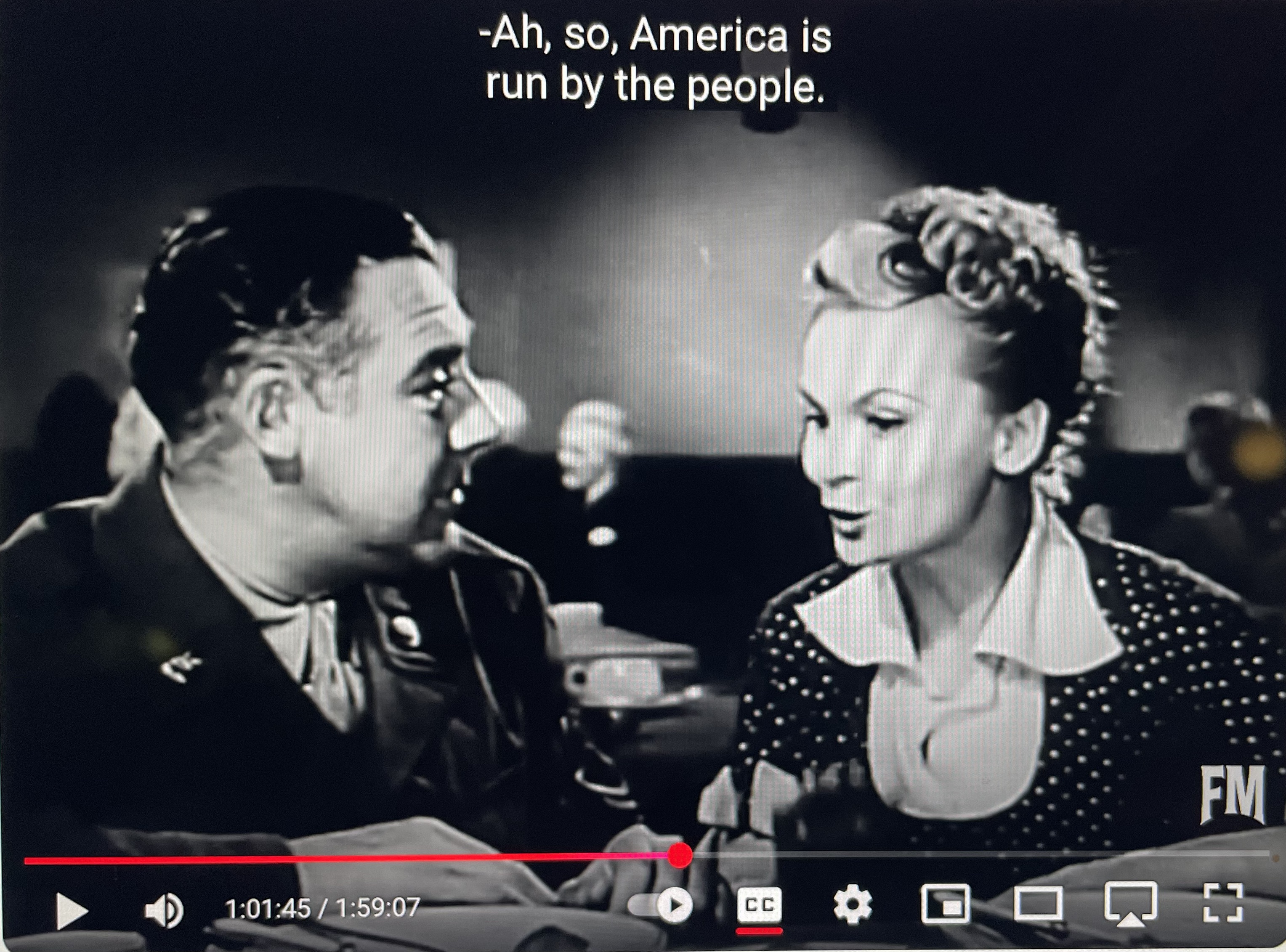
Hank and Gerda discuss who’s in charge and what can be said about whom in a democracy.
Fortunately, the entire flick can be viewed online. In particular, see 1:01:45–1:02.
And ponder Trump’s recent comments about free speech in a democracy. ds
© Dennis Simanaitis, SimanaitisSays.com, 2025
 Simanaitis Says
Cor Blimey! A worthwhile movie i’ve never seen. Many thanks. Often hard, these days, to remember our nation once showed the world the loftiest bar of magnanimity with the Marshall Plan.
Thanks, Mike. I admit my initial reason for watching it was my admiration for the Berlin Airlift. It was after viewing Gerda’s understanding of democracy that I sensed the movie’s other important—and immensely timely—message. ds