
Simanaitis Says
On cars, old, new and future; science & technology; vintage airplanes, computer flight simulation of them; Sherlockiana; our English language; travel; and other stuff
MARS—AS TIMELY AS TODAY’S HEADLINES, OR THOSE OF THE LATE 19TH CENTURY, OR THOSE OF MAR’S ORIGIN PART 1
I PLANNED THIS AS A BOOK REVIEW of David Baron’s The Martians, with tidbits gleaned from Dov Greenbaum’s “Mars Mania and the Making of Scientific Authority,” AAAS Science, August 28, 2025.

Then—surprise—when Googling this review, up pops Derek Lowe’s “Life, Maybe, On Mars, Unless We Change Our Minds,” AAAS Science, September 10, 2025. What’s more, in the August 28, 2025, issue of Science, there’s a research paper “Seismic Evidence for a Highly Heterogeneous Martian Mantle,” by Constantinos Charalambous et. al. And wait, there’s more: Paul Voosen reports “Data from Defunct Mars Lander Paint a Radical New Picture of Mars’ Interior,” Science, September 3, 2025.
Tidbits galore about Mars! (Agg. I had it positioned between Venus and Earth…. Thanks, reader Jack M.) In Parts 1 and 2 today and tomorrow, let’s take matters more or less in chronological order.
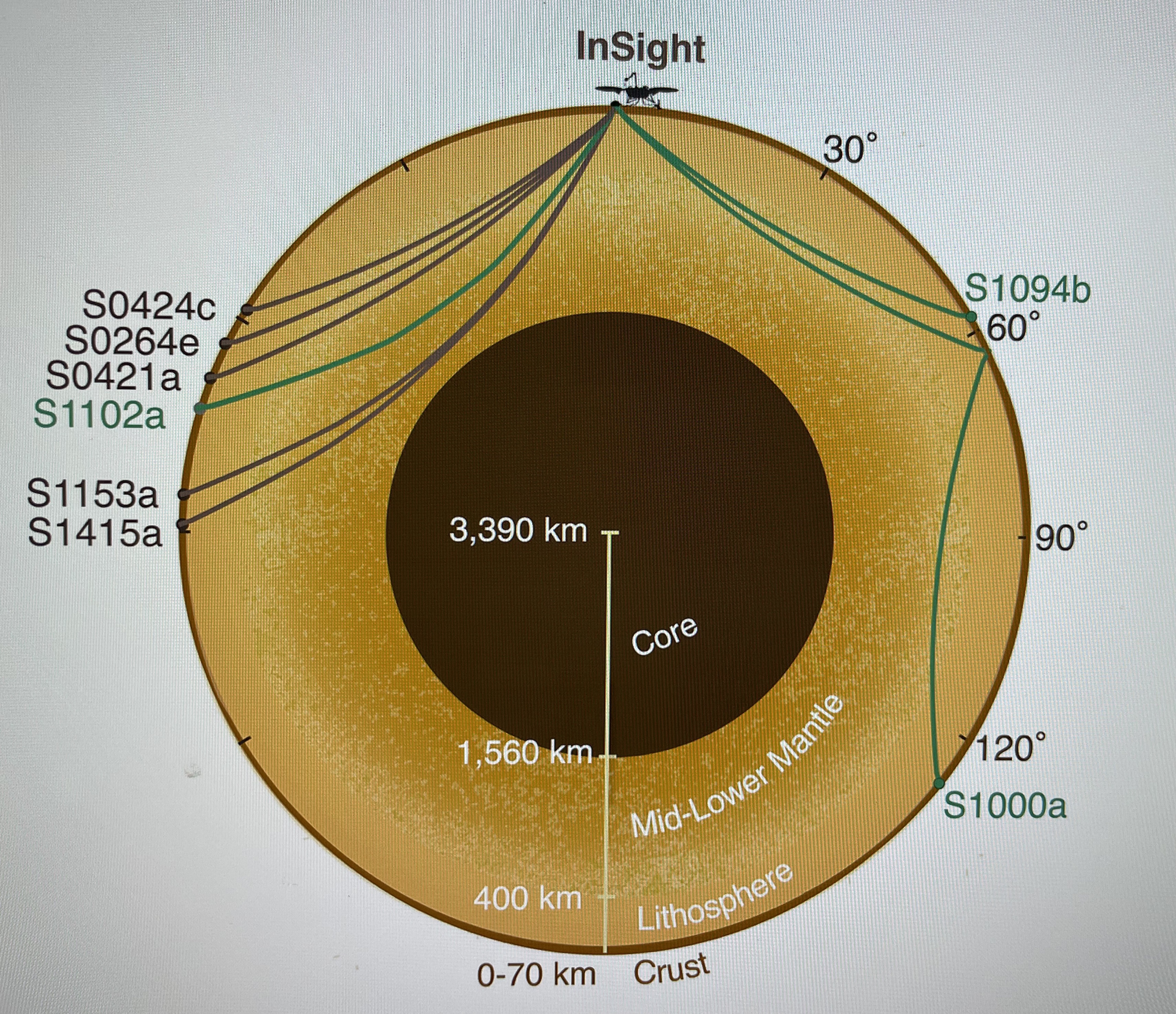
Mars’ Origin and Evolution. From Angela Hessler’s Editor’s Summary of Charalambous et al.: “Mars is a single-plate planet. In contrast to Earth, where subducting plates have churned the mantle for billions of years, the interior of Mars may preserve characteristics of its early evolution. Charalambous et al. detected marsquake waveforms arriving at NASA’s InSight lander and saw an apparent delay in the high-frequency arrivals that increased with travel distance through Mars’ mantle. They attribute these delays to very fine-scale heterogeneities, the result of chaotic mantle convection during Mars’ impact-filled early history. This widespread heterogeneity was then frozen in place as the planet’s crust cooled and mantle convection slowed to a creep.”
What About Those Martian Canals? Dov Greenbaum writes, “In The Martians, David Baron offers a detailed account of how socialites, inventors, and respectable astronomers became convinced that intelligent life thrived on Mars at the turn of the 20th century. Baron’s engaging narrative examines science put on public trial and litigated through personalities, persuasion, and press rather than peer review. The result: public fascination that outpaced scientific fact, revealing more about earthlings than martians.”
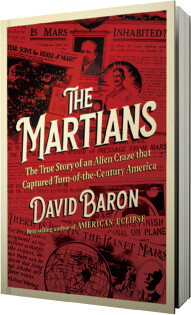
The Martians: The True Story of an Alien Craze That Captured Turn-of-the-Century America, by David Baron, Liveright Publishing, 2025.
Greenbaum continues, “The martian ‘canals’—optical illusions widely mistaken for infrastructure on the distant planet—became the foundation for an elaborate but inaccurate vision of an advanced civilization. Amplified by mass media, this idea fed a cultural feedback loop where entertainment, belief, and speculation blurred into perceived scientific fact.”
“But,” Greenbaum recounts, “society’s fascination with Mars also reflected deeper cultural needs, argues Baron. Amid rapid industrialization, global tensions, and spiritual uncertainty, the red planet came to symbolize humanity’s hopes for technological progress and the possibility of peaceful, intelligent life beyond Earth.”
Hype, Not Science. “Science became spectacle in the Gilded Age, shaped by outsized personalities rather than cautious deliberation,” notes Greenbaum. “Baron shows how the era’s nascent scientific institutions lacked the mechanisms to counter charismatic advocacy—a dynamic he illustrates through compelling portraits of the very personalities who exploited this institutional vulnerability.”
Alas, recounts Greenbaum, “Chief among these figures was Percival Lowell, the wealthy ‘poet astronomer’ whose resources, eloquence, and unwavering conviction made him especially influential. His telescopic observations, distorted by both atmospheric conditions and personal ambition, helped entrench the myth of canal-building martians in the public imagination. What set Lowell apart was his stubborn certainty, which turned a scientific hypothesis into an unyielding belief.”
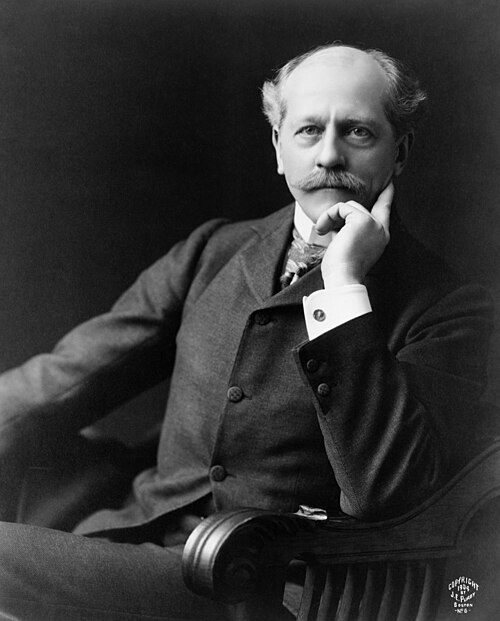
Percival Lowell, 1855–1916, American businessman, author, mathematician, and astronomer. Image by James E. Purdy/Library of Congress collection.
Greenbaum notes, “The scientific establishment eventually responded decisively. When Mount Wilson Observatory astronomers deployed the era’s most advanced telescope, they found no evidence of Lowell’s canals—delivering the empirical refutation that passive responses had failed to provide. Yet, confronted with contradictory evidence, Lowell ‘stubbornly refused to update his thinking when new evidence came in.’ ”
Greenbaum’s review concludes: “To his credit, Baron avoids caricature. Figures such as Lowell are not painted as charlatans but as complex characters—brilliant, flawed, and caught in the zeitgeist.… Baron wisely resists drawing heavy-handed lessons from his historical narrative, instead allowing the Mars episode to illuminate enduring patterns in how scientific authority is constructed and contested.”
Tomorrow in Part 2 we’ll continue with pictures of Mars, sans canals but still compelling. ds
© Dennis Simanaitis, SimanaitisSays.com, 2025
 Simanaitis Says
Are you sure you’re not talking about tidbits from the fourth planet from the sun?
Agg! I had Mars between Venus and us. Corrected now. Thanks, Jack.