
Simanaitis Says
On cars, old, new and future; science & technology; vintage airplanes, computer flight simulation of them; Sherlockiana; our English language; travel; and other stuff
RETHINKING A.I. PART 1
A.I. SPECIALIST GARY MARCUS WRITES IN THE NEW YORK TIMES, SEPTEMBER 3, 2025, “The Fever Dream of Imminent ‘Superintelligence’ Is Finally Breaking.” Here, in Parts 1 and 2 today and tomorrow, are tidbits gleaned from his Guest Essay, together with my own comments here and there.

Gary Marcus is Professor Emeritus at New York University. He was founder and chief executive of Geometric Intelligence. Professor Marcus publishes Marcus on AI.
GPT-5 = A.G.I.? Marcus recounts, “GPT-5, OpenAI’s latest artificial intelligence system, was supposed to be a game-changer, the culmination of billions of dollars of investment and nearly three years of work. Sam Altman, the company’s chief executive, implied that GPT-5 could be tantamount to artificial general intelligence, or A.G.I. — A.I. that is as smart and as flexible as any human expert.”

“Instead,” Marcus says, “as I have written, the model fell short. Within hours of its release, critics found all kinds of baffling errors: It failed some simple math questions, couldn’t count reliably and sometimes provided absurd answers to old riddles. Like its predecessors, the A.I. model still hallucinates (though at a lower rate) and is plagued by questions around its reliability. Although some people have been impressed, few saw it as a quantum leap, and nobody believed it was A.G.I.”
The Problem: Scaling Isn’t Enough. In his 2022 essay “Deep Learning Is Hitting a Wall,” Marcus argued that “scaling,” that is, upsizing Large Language Models with more and ever more data, isn’t enough to achieve A.G.I.
Marcus writes, “Large language models, which power systems like GPT-5, are nothing more than souped-up statistical regurgitation machines, so they will continue to stumble into problems around truth, hallucinations and reasoning.… Even significantly scaled, they still don’t fully understand the concepts they are exposed to—which is why they sometimes botch answers or generate ridiculously incorrect drawings.”
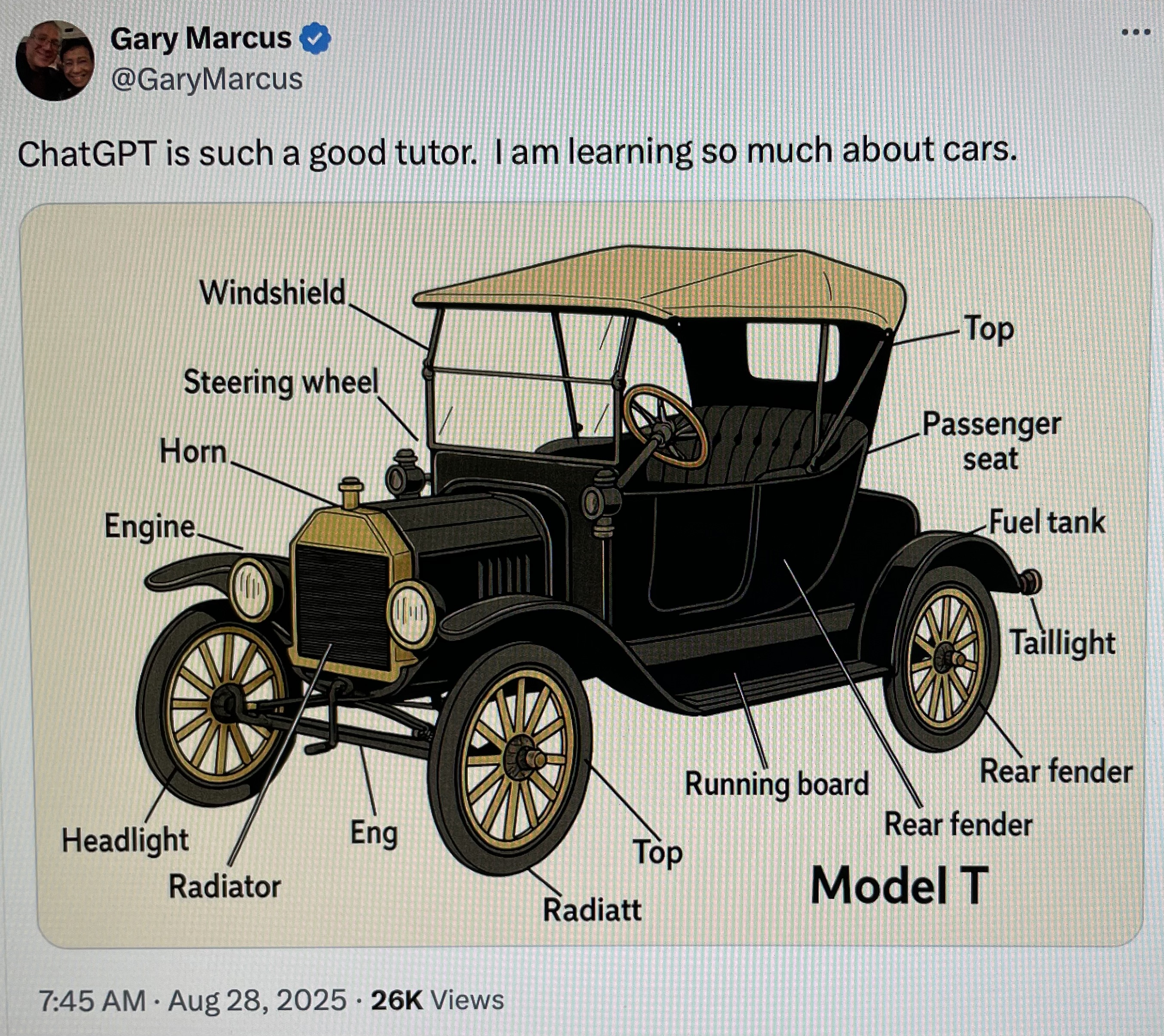
“ChatGPT is such a good tutor,” Marcus says. “I am learning so much about cars.” Image by Gary Marcus from The New York Times.
A.G.I. by 2027?? “The chances of A.G.I.’s arrival by 2027,” notes Marcus, “now seem remote. The government has let A.I. companies lead a charmed life with almost zero regulation. It now ought to enact legislation that addresses costs and harms unfairly offloaded onto the public — from misinformation to deepfakes, “A.I. slop” content, cybercrime, copyright infringement, mental health and energy usage.”
“Moreover,” Marcus stresses, “governments and investors should strongly support research investments outside of scaling. The cognitive sciences (including psychology, child development, philosophy of mind and linguistics) teach us that intelligence is about more than mere statistical mimicry and suggest three promising ideas for developing A.I. that is reliable enough to be trustworthy, with a much richer intelligence.”
Tomorrow in Part 2, Professor Marcus gives details of these three promising ideas. ds
© Dennis Simanaitis, SimanaitisSays.com, 2025
 Simanaitis Says
Dennis,
I recently used “AI” (Microsoft Pilot) – which I learned is basically ChatGPT from Open AI – after taking a series of classes at the local, ahem, “senior center” (I prefer the term “survivor”). I was going to get out the old slide rule, a spreadsheet, and a long cord of number 2 pencils to help my daughter calculate a budget (she works very complicated 24-hour shifts as an EMT). After attending the last class, I thought I’ve give AI a try instead, and, dang, it did pretty good. I had to refine my question a few times (but as a hip and with-it oldster, I now know how to do dat) but, after I uploaded her pay stubs (which had no identifying info) and gave a few details about the scheduling process it gave a better answer that old non-AI me could. The guy at the class (a local IT manager) said they’re as secure as anything on the internet (which means be careful!) and that Open AI is one of the best since they don’t take ad money. His assessment of the changes resulting from AI: it will (has!) become utterly pervasive and will affect everything! Specialized versions are already is use (for things such as medicine and law) are more are coming everyday. The user interface is simple (he did several things just by speaking to it casually) and the results were impressive.
Mark W, http://www.mark-fiction.com
Thanks, Mark, for this input. It sounds promising. ds