
Simanaitis Says
On cars, old, new and future; science & technology; vintage airplanes, computer flight simulation of them; Sherlockiana; our English language; travel; and other stuff
MERRIAM-WEBSTER NEW ENTRIES
I ENJOY TWO EXTREMES IN DETERMINING WORD DEFINITIONS: the online Merriam-Webster and the microprinted Compact Edition of the Oxford English Dictionary, 1971. The M-W is only a click away; but the OED is more entertaining—provided the word or phrase is no newer than 1971.

Today let’s take a look at “200 New Words and Definitions Added to Merriam-Webster.com.” I’m adding a few into my own vocabulary. I’m surprised to find a couple that are considered “new.” And there’s one about which IDGAF.

Shadow Ban. As a transitive verb, “to shadow ban” is “to cause (a user or their content) to be hidden from some or all other users usually without the user’s knowledge.” That is, its origin and typical use are online phenomena (but not soley).
As a noun, Adi Robertson says, “The shadowban is useful in that rather than someone immediately being locked out and possibly retaliating by, for example, making a new account, the user fades away gradually due to the lack of interaction from other users.” That is, shadow banning is short of an outright shunning, regardless of the environment.
M-W notes that its first known use was in 2007. The phrase recently appeared in The New Yorker, June 2, 2025, when Lauren Collins recounted, “Some observers say that Algeria has enacted a shadow ban on French wheat—as of January, a single shipment had entered the country in the past year, compared with the usual millions of tons.”

Indeed, I remember Lauren Collins’ article “How A Hazelnut Spread Became A Sticking Point in Franco-Algerian Relations.” It caught my eye because it talked about El Mordjene, an Algerian competitor to Nutella (and I include Randy’s Donuts Nutella Raised among my favs).

Funny how words link to one another.
Touch Grass. M-W describes the idiomatic phrase “to touch grass” as “to participate in normal activities in the real world especially as opposed to online experiences and interactions.”
Again, an online origin. It cites Catriona Morton: “To be told to touch grass is intended as an insult for people who spend too much time online, disconnected from the reality outside their pixelated screens.”
“Touch grass,” I might say to a pal who prefers iPhone intimacy in lieu of my sterling dinner conversation. Universalist that I am, my first thought about the phrase “touch grass” had to do with marijuana: I recall a vibrant St. Thomas experience when I laughed like crazy over a Donna Reed flick (though we didn’t have a TV; it was our stereo I was staring at).
Snog. Having English friends, I’ve long known that “to snog” was “to kiss and caress (someone) passionately,” just as M-W recounts. Apparently, the parenthetical limitation implies one does not snog one’s car (because the best snogging calls for reciprocity).
M-W quotes Neil Gaiman: “It’ll be the same as it always is. After an hour you’ll be off somewhere snogging the prettiest girl at the party, and I’ll be in the kitchen listening to somebody’s mum going on about politics or poetry or something.”
Yes, been there, done that.
Street Corn. Being a born-again Californian, I know this as two separate delicacies: Esquites and Elote. M-W describes them both: Elote is “grilled corn on the cob that is coated with a creamy spread (such as mayonnaise, sour cream, or crema) and garnished with toppings (such as lime juice, cotija cheese, and chili powder).” Esquites is “boiled, grilled, or sautéed corn kernels mixed with assorted ingredients (such as lime juice, mayonnaise, cotija cheese, and chili powder).”
That is, M-W quotes Lucas Peterson: “Once you’ve chosen your corn, you decide whether you want it on the cob, in elote form, or in a bowl, which is known as esquite.”

Above, elotes. Image (and recipe) from loveandlemons. Below, esquites, also known as elote en vaso. Image from isabeleats.com

Indeed, during temperate weather a guy pushes a cart through our neighborhood with elotes/esquites. In the hot weather, he switches to raspados, Mexican snow cones. Either way, muy delicioso!

Image from isabeleats.com.
Burrata. This word has M-W catching up with the familiar (at least to my California existence): “Burrata” is “mozzarella formed into a ball-shaped casing that contains curds and cream,” agrees M-W.
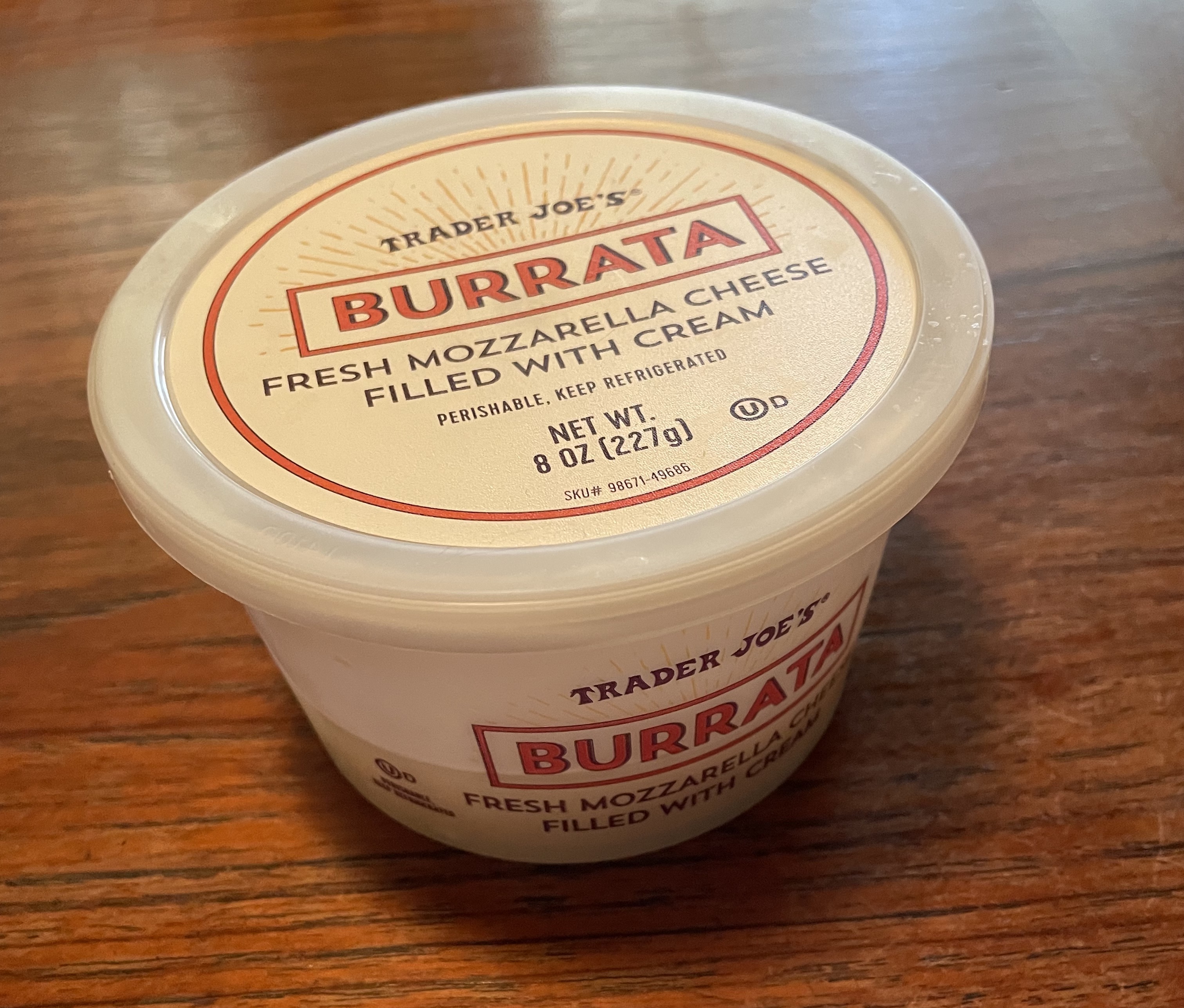
My locale Trader Joe’s and Vons have had Burrata as long as I can remember.
IDGAF. Ask your mom or dad. Grandparents aren’t supposed to know words like this. ds
© Dennis Simanaitis, SimanaitisSays.com, 2025
 Simanaitis Says