
Simanaitis Says
On cars, old, new and future; science & technology; vintage airplanes, computer flight simulation of them; Sherlockiana; our English language; travel; and other stuff
“A SILENT AND ABSOLUTELY TRACTABLE” BUGATTI
PERHAPS THIS TITLE BRINGS TO MIND THE ROYALE, the 12,760-cc straight-eight Golden Bug only six of which left Molsheim. No, actually these tidbits are gleaned from the British Autocar Road Test No. 645 of a Type 46 Bugatti Saloon dating from May 31, 1931, via John Dowdeswell (aka Brooklands Books’ R. M. Clarke) and his fine Bugatti Type 10 to Type 251.

Autocar described, “Few names have the power to suggest speed as does that of Bugatti; but not all are well aware that to-day Bugatti makes cars which are silent and absolutely tractable. To anyone not acquainted with the latest products of the famous Molsheim factory, the 5-litre straight eight touring type machine comes as a veritable revelation.”
A 1931 Time Machine. This Autocar article can also be a time machine for readers familiar with traditional R&T Road Tests, their side view drawings (many from the multi-talented Bill Dobson), and data panels (assembled for years by your SimanaitisSays proprietor).

This and the following images from The Autocar via Bugatti Type 10 to Type 251.
Autocar wrote, “Imagine a big, but in no sense unwieldy, car which can run on top gear as slowly as a man walks and then accelerate straight away, cleanly and without hesitation, up to something closely approaching 90 miles per hour, and you have an idea of this Bugatti.”
Its 5-Liter Engine. Autocar’s Data For The Driver cites “32.5 [English Taxable] h.p., eight cylinders, 81 x 130 mm. (5,350 c.c.). Tax £33.”
Of this straight eight, the magazine described, “On the off side [i.e. Brit “furthest from the kerb,” to the right] are sixteen sparking plugs, all accessible, and fed from two coils and a common distributer, each cylinder having two plugs, of course. Also, a Bugatti feature is three valves for each cylinder—two inlet and one exhaust inclined and operated from an overhead camshaft.”
Though the Autocar article is sans under-bonnet photography, I offer this image showing the architectural elegance of a 5-liter Bugatti powerplant.
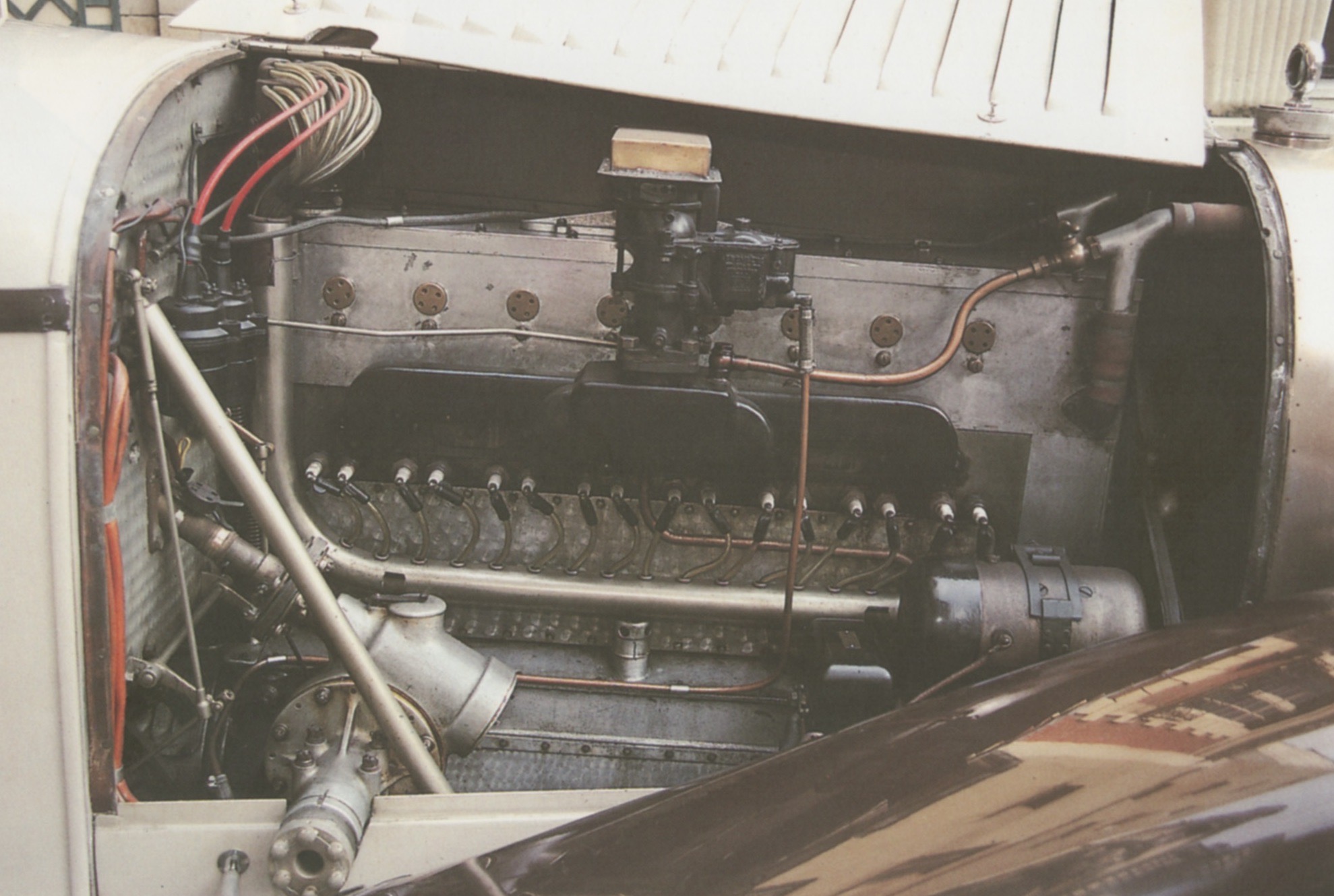
A Bugatti Type 46 engine with its 16-lead distributor. Image from Bugatti Magnum.
Shifting (If Desired). Autocar recounted, “Immediately a driver strange to the car realises that the gears are changed both up and down by moving the lever from position to position just about as quickly as it can be moved, the change is delightful and equivalent in speed to a racing change.”
Just as R&T did for awhile in its Data Panels, Autocar’s equivalent displayed Gear Lever Positions. The Bugatti’s, you’ll note, mirrors our traditional three-speed (and agrees with a Morgan Trike’s).

Other Data Curiosities. The Autocar panel included identification of controls (“strangler,” of course, being our “choke”), a layout of instruments sans identification, and location of the accelerator pedal. (Many vintage cars, among the several I’ve driven, had the accelerator in between clutch and brake; this, for supposed ease of heel-and-toe downshifts.)
Notice that acceleration is “from steady 10 to 30 mph.” Standing starts to 60 were yet to have relevance. “Turning circle” for the Bugatti differentiated between right (44 ft. 5 in.) and left (53 ft. 6 in.). These days, specifications typically cite “minimums” only. And isn’t Autocar’s illo for braking data a charming one.
Accommodations. “With this chassis,” the magazine observed, “the coachwork can be a matter of taste, but the body fitted on the car tested is a metal-panelled Weymann, with two wide doors that make getting in and out genuinely convenient for both front ahd back compartments.”

“Both the separate front seats,” Autocar reported, “are easily adjustable while occupied, which enables different drivers to find an excellent driving position, and are extremely comfortable, giving support high in the back.”
“At the back,” Autocar continued, “there is good leg-room and the seat is very comfortable, with nicely sprung side arm rests and a folding arm at the centre, and the upholstery is first class.”
Traveling. “On a very long journey,” Autocar recounted, “a wonderful average is possible without tiring the driver at all, for the car so quickly gets up to a good cruising speed, though actually the cruising speed can be anywhere in the range, picks up rapidly after the normal sort of traffic check, and, of course, climbs very fast indeed.”

Summing Up. “Altogether,” Autocar concluded, “a most remarkable motor car, highly satisfying in the easy, purposeful manner of its performance, and with a charm and individuality it is impossible to appreciate adequately without actually going out on the car.”
No doubt this was Autocar’s way of saying, “You really gotta drive one!” ds
© Dennis Simanaitis, SimanaitisSays.com, 2025
 Simanaitis Says
Dennis thanks for this. Perhaps of interest regarding “dual” ignition systems. 50 years ago my Cad V8 powered ’40 Ford had a “W. H. Ducoil” distributor. This featured a 4 lobe cam with two sets of points and two coils. The claimed advantage was twice the time for each coil to saturate, making a hotter spark.
True to form, if I removed a plug wire nearest a distributor cap clip the spark would come out of that plug wire hole and find the clip.
Another Autocar, the Autocar truck, an old name is still seen on the roads today. Wikipedia:
The company was originally called the Pittsburgh Motor Vehicle Company when started in Pittsburgh, Pennsylvania, in October 1897 but was renamed two years later in 1899 as The Autocar Company[3] when it moved east across the “Keystone State” to Ardmore, Pennsylvania, outside Philadelphia.
Though more often it would be twelve liters.
Also related, also from Wikipedia:
Autocar founder Louis Semple Clarke (1867–1957) was a successful mechanical engineer. Among Clarke’s innovations were the porcelain-insulated spark plug for gasoline engines.