
Simanaitis Says
On cars, old, new and future; science & technology; vintage airplanes, computer flight simulation of them; Sherlockiana; our English language; travel; and other stuff
SAID CORRECTLY
THERE ARE SOME WORDS THAT I MISPRONOUNCE; others that I say correctly but misspell. Conveniently enough, Merriam-Webster discusses both sorts.

Our Mongrel Language. “English is famously difficult to spell,” M-W observes. “It asks us to accept the inconsistencies of has and was, do and go, and to resign ourselves to the logic-defying set of “ough” words, like bough, bought, tough, though, and through.”
“The state of English spelling,” M-W continues, “is partly due to the mongrel nature of the language (it’s essentially a product of Anglo-Saxon aka Old English, Latin, Old Norse, and Anglo-French), and partly a consequence of longevity; English is more than a thousand years old and languages are inherently vulnerable to the vagaries of time.”
Immigrant Words. Words, like people, move from place to place and are accepted. (Or, alas, they generally usta be.) M-W offers an interesting collection of words that came here as tasty menu Items.
Beignet \bayn-YAY, ben-YAY\. 1 : fritter 2 : a light square doughnut usually sprinkled with powdered sugar. “Anyone who’s had a beignet,” M-W says, “can thank the French Acadians: It’s believed that they introduced the pastry in Louisiana in the 18th century.”
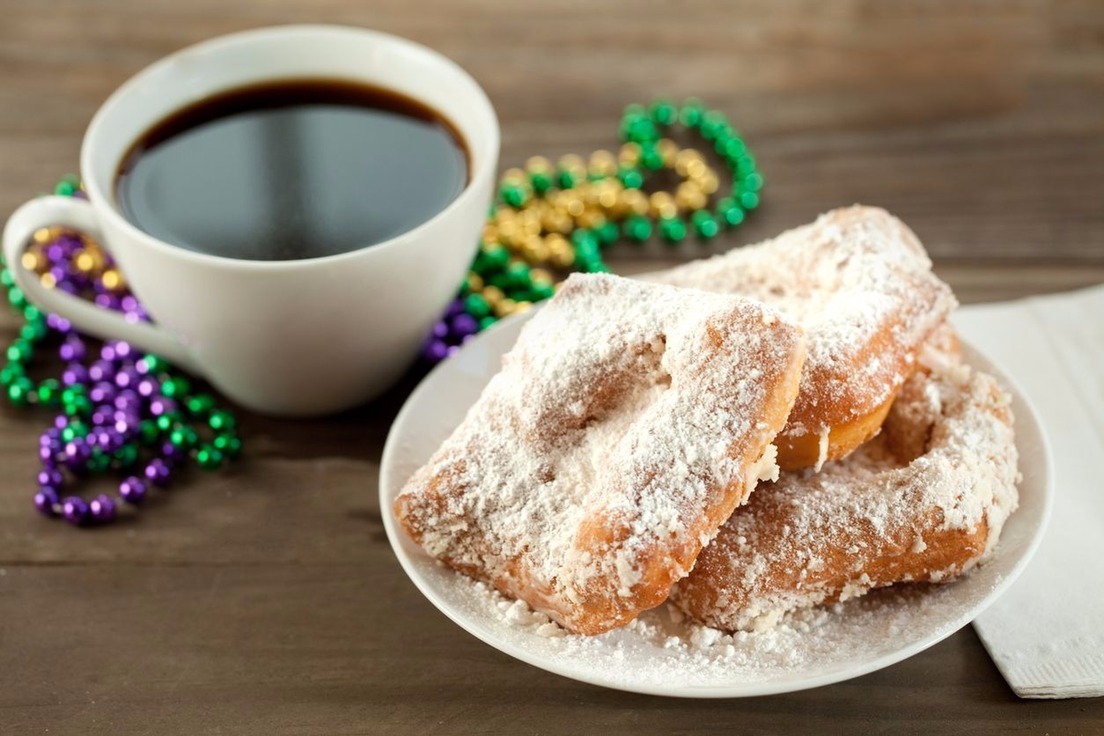
Thanks to the Cleveland Board of Education, I learned how to pronounce “beignet” the same time I learned about this powdery treat: My Fourth-, Fifth-, and Sixth-Grade had daily total immersion in French. “To this day, when I attempt speaking le français, I do so thinking en français, not just translating.”
Our total immersion back then started with oral only, the written exercises coming later. Thus, no one mangled monsieur (‘mon-sewer”) or the like. We learned about tasty ragots and beignets, though to this day I have to remember ei not ie in the latter’s spelling.
Which Reminds Me, For No Particular Reason…. When learning German, I devised a memory aid for the two German words, jener (“each”) and jeder (‘that”). Why not use the English word “yonder,” i.e., “that”?
Ha. But “yonder” has an “n” which reminds me of jener and a “d” which reminds me of jeder. So much for self-generated memory aids.
Gyro \YEE-roh, ZHEER-oh\. I had my first pita-bread sandwich long after elementary school, yet their pronunciation still baffles me. M-W recounts, “The name of the sandwich is pronounced differently than the gyro that refers to a gyrocompass or a gyroscope, but it too is etymologically about turning: It comes from the Greek gyros, meaning ‘turn,’ from the rotation of the meat on a spit.”

Maybe I should study some ελληνικά?
Gnocchi \NAW-kee, NYAW-kee, NAH-kee. I enjoy these Italian dumplings, usually made with potato or semolina and served with sauce. M-W describes, “It’s completely understandable that an English speaker would be a bit flummoxed by gnocchi: it starts with gn (not unheard of for an English word, but not common) and ends in cchi.”
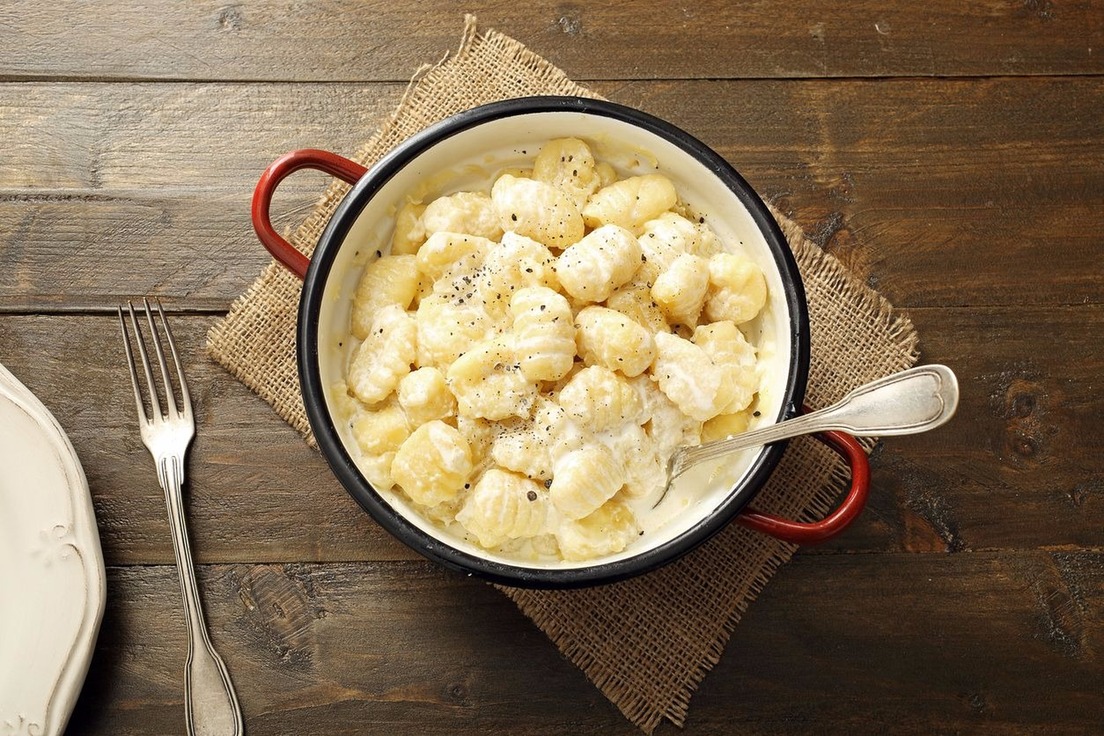
“The g is silent,” M-W notes, “as it is in gnat and gnarl. Listen to the audio [alas, which doesn’t reproduce here], and then remember that second syllable is always pronounced like the word ‘key,’ and the first syllable (which always gets the emphasis) can be pronounced like \NAW\, \NYAW\, or \NAH\.”
Thus, a familiar word for motor sports fans: machine, macchina \MA-key-naw. As in “Questa macchina è un porco!”
Pho \FUH, FOH\. M-W recounts, “The Vietnamese name for this soup is spelled phở. The English alphabet lacks that particular o-like vowel, so we replaced it with a plain old o in the borrowed word. The dominant English pronunciation \FUH\, however, mirrors the Vietnamese one, though the Anglicized \FOH\ is accepted too.”

I asked Daughter Suz, who introduced me to this tasty noodle stew, the pronunciation she prefers. She says “FUH,” just like the audible included in the M-W entry. To hear the audibles for these and others, visit Merriam-Webster.
Thanks, M-W, for the language enhancements. ds
© Dennis Simanaitis, SimanaitisSays.com, 2025
 Simanaitis Says
>Gryo
Transposition? The pronunciation guide is consistent with the Greek root quoted as “gyro.”
No problem though. My figners do that all the time. Occasionally the spillchukker will catch it😂.
Tpyo? Which toyp? Thanks, Mike. Corrected.