
Simanaitis Says
On cars, old, new and future; science & technology; vintage airplanes, computer flight simulation of them; Sherlockiana; our English language; travel; and other stuff
BIG, BEAUTIFUL AND BRUTISH—DEFINITELY NOT FOR THE IMPECUNIOUS NOR THE FAINT OF HEART
“FERRARI,” R&T RECOUNTED IN DECEMBER 1962, “IS A MAGIC NAME, epitomized by automotive writers as a sort of 4-wheeled Holy Grail, to be sought after with fervor, worshipped in blind faith and cherished as a possession second only to wife (and even there the Ferrari sometimes comes first).”
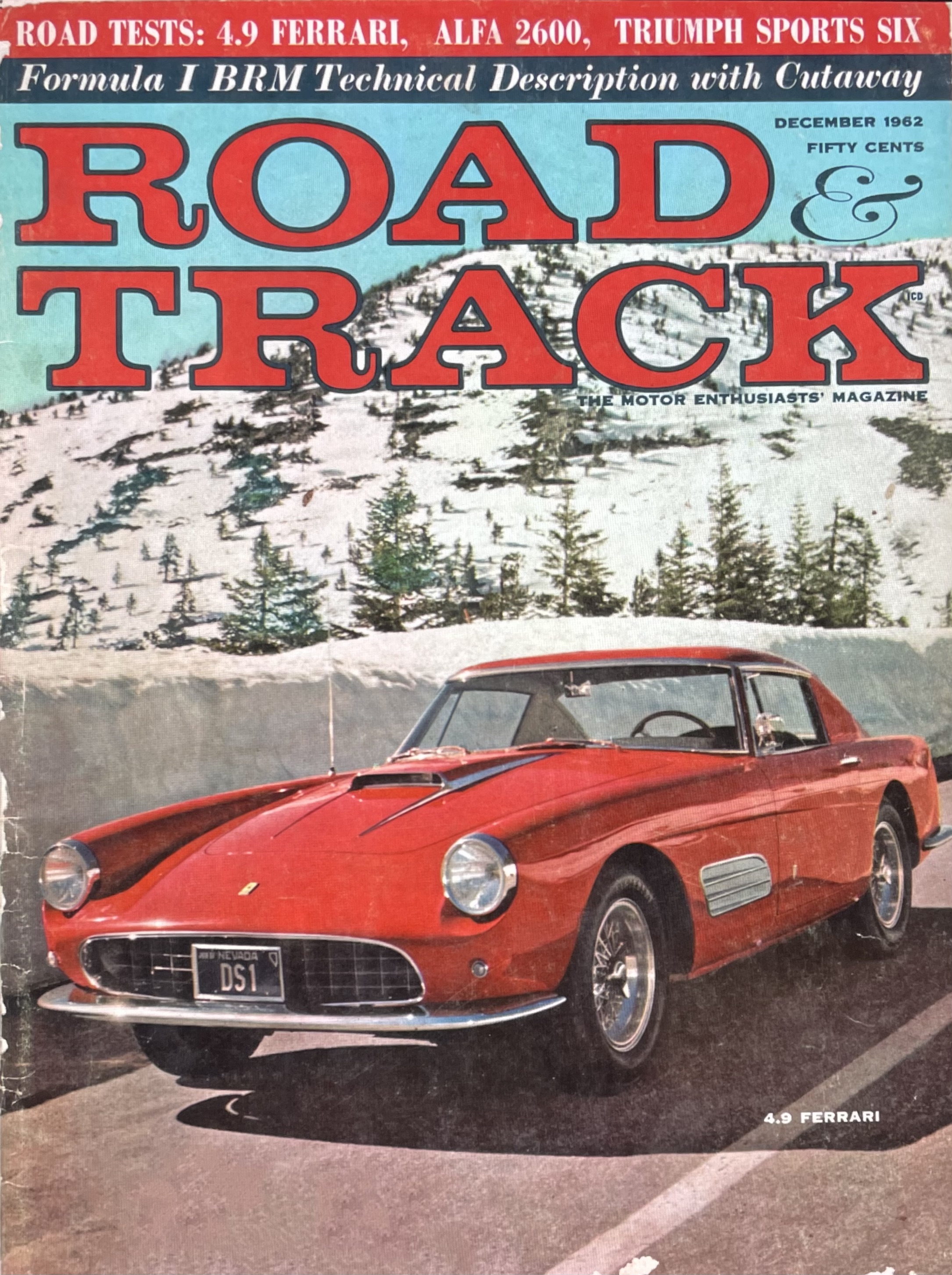
Geez. What about Bugattis? Morgans? Dellows? Well, anyway, here are tidbits gleaned from this R&T December 1962 road test of the 4.9 Ferrari.
Its Owner: Bill Harrah. “The model tested for this report,” R&T wrote, “is the property of Bill Harrah, of Reno, Nev., and is a 1959 model (registered as a 1960)—one of about six built.” Perhaps to jog your memory, William Fisk Harrah (1911–1978) was the founder of Harrah’s Hotel and Casino, now part of Caesars Entertainment. And, unlike today’s typical gaming moguls, Bill was a knowledgable automotive enthusiast.

This and other images from R&T, December 1962.
Engine Evolution. R&T recounts, “Historically, Ferrari started with a 1.5-liter V-12, designed by engineer Columbo, in 1947. This engine, a single overhead camshaft (on each bank of six) design, operating inclined valves through rocker arms, was subsequently enlarged to 2 liters, then to 2.3, 2.6, 2.7, and, finally, to 3 liters in 1952.”
“In 1949,” R&T continues, “Ferrari commissioned Aurelio Lampredi to design a new engine and the ‘second generation’ V-12 was introduced in a Formula 1 car as a 3.3-liter…. The Lampredi design grew from 3.3 liters to 4.1, 4.5, and, finally, the 4.9.”

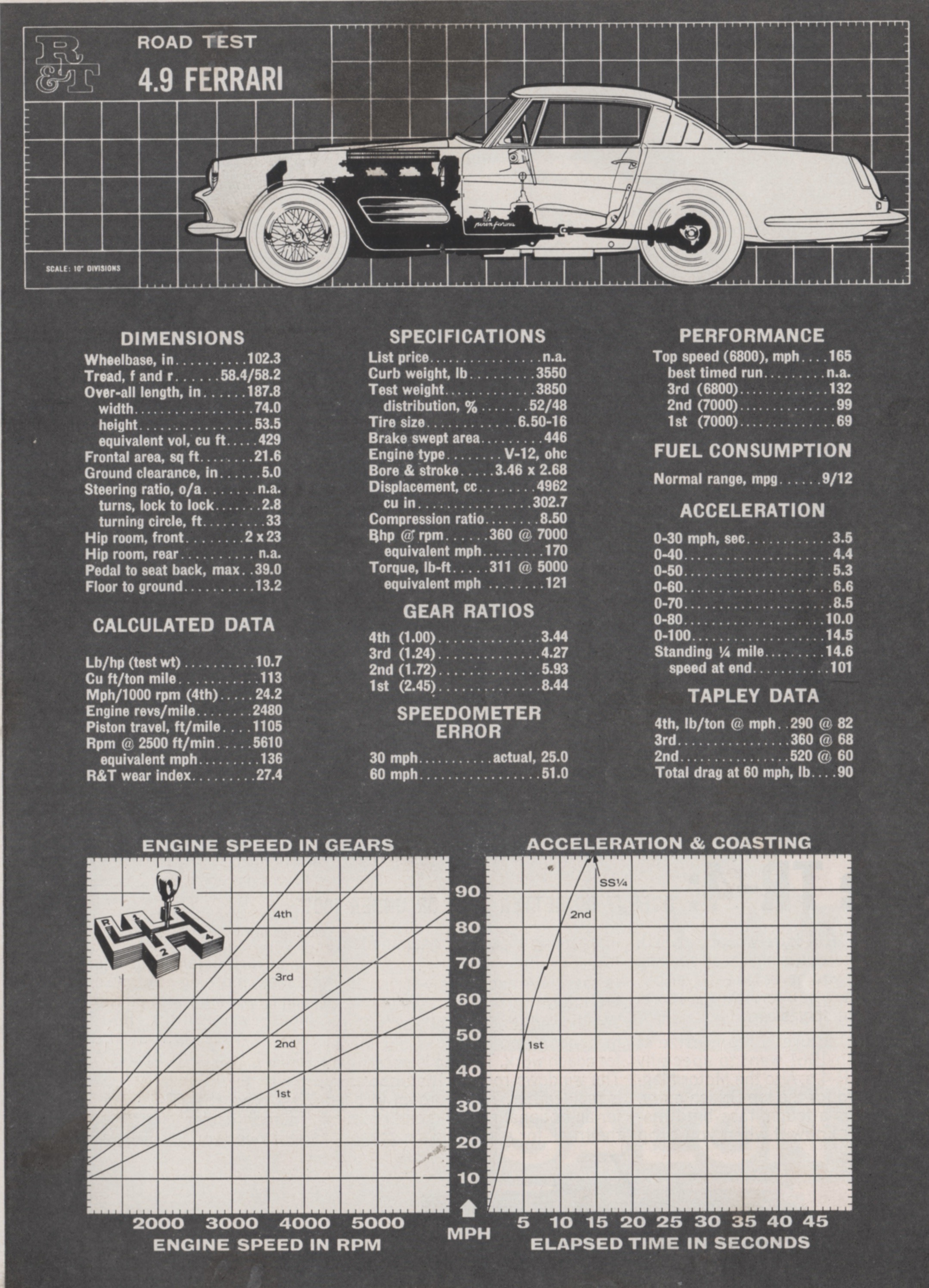
Ferrari Super America. R&T described, “The Super America 4.9-liter coupe, body by Pininfarina, has the same wheelbase as the 250-GT at 102 in. but carries a wider track (57.5 front, 57.2 rear) to accommodate the larger engine…. To most people there would be no awareness of its being a larger vehicle at all. Credit for this must go to the excellent design and proportions achieved by the well-known house of Farina.”

Getting In. “Climbing into the driver’s seat, we find, in addition to a very comfortable driving position, plenty of room and good visibility; a safety belt, shoulder harness, and a fire extinguisher mounted on the passenger’s side at the front; all reflecting Mr. Harrah’s desire for safe high-speed motoring.” Remember, this is 1962 and mandatary belts are some 20 years away.

“On each side of the almost horizontal steering column are the speedometer and tachometer, with large, legible dials. In the center is a smaller oil pressure gauge; on the left, the oil and water temperature gauges; and on the right, fuel and ammeter gauges.”
Firing It Up. “The instant the engine starts,” R&T reported, “the unmistakable sound of power lets you know this is not a toy, and a small inner voice warns you to be careful.”
Having driven several private-owner test cars during my R&T days, I’ll bet knowing the 4.9 was borrowed—and one of only six of priceless value—amplified that inner voice.
A Driver-Friendly Clutch. Originally Harrah’s 4.9 had a finicky racing-type multi-disc clutch, but for normal day-to-day use Bill had it replaced with a single-disc dry-plate clutch normally fitted to a 250-GT.
“However,” R&T noted, “we discovered later that it also is unable to absorb the enormous torque transmitted in racing-type starts. This has been no problem to Harrah, as he never indulges in drag racing, though, as already noted, he does drive the car often and when on the road (there’s no speed limit in Nevada other than that posted in built-up areas), he likes to move.… Once out of city limits, there’s nothing to hold one back but traffic and fear.”
And, I suspect, that “inner voice.”
All This—And Drum Brakes. R&T observed, “Performance like this must be matched by an ability to stop. This is taken care of by just about the largest diameter drums to be seen off the race track—in fact, these are the same units formerly used by Ferrari on his racing cars before changing to Dunlop discs.” Like other safety features, discs didn’t become common (initially up front only) for another 15-20 years.
Hmm… Back in ’62, I was doing my undergraduate work at Worcester Poly and driving a ’58 English Ford Consul convertible. Sorta like R&T at the time, I could only dream of having a favorite Ferrari. ds
© Dennis Simanaitis, SimanaitisSays.com, 2025
 Simanaitis Says
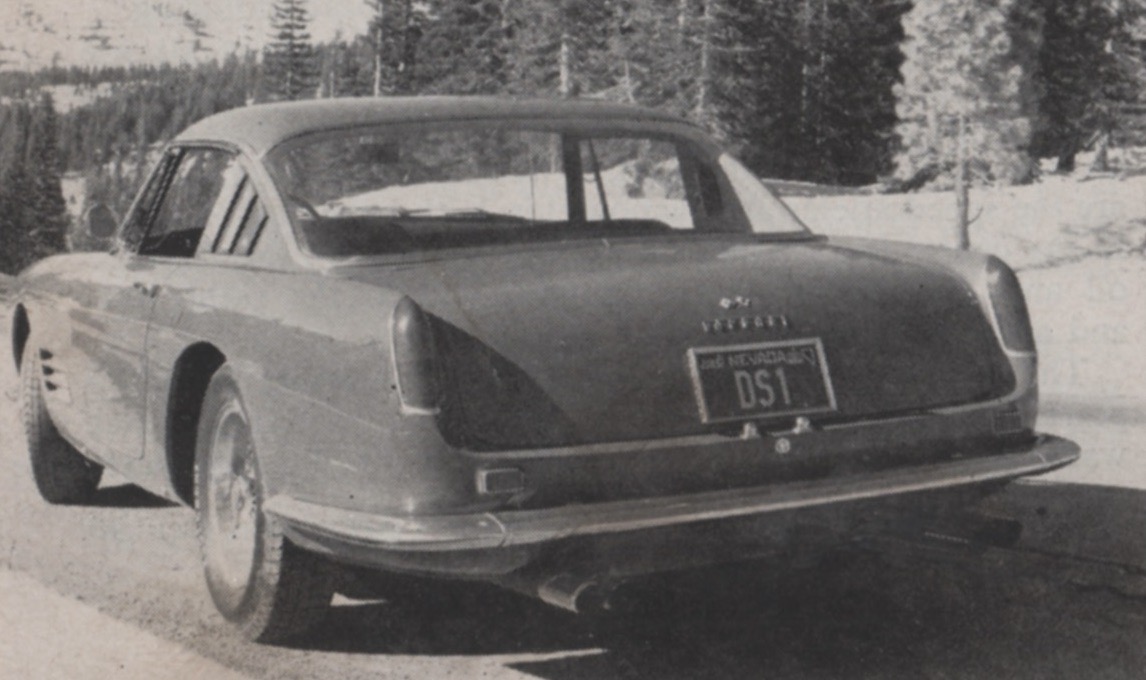
Did you edit in the license plate number?
No. I do not know its origin. —ds
Dennis, I am 80 years old now. Each time you put up an old R&T, I think of my collection of over 1K of different ones, including R&T. What are you going to do with yours. I am having trouble finding some one to take them.I did move 500 Brit car mags, and now ready to dump all the Comp Press & Auto Weeks.John
You might try a museum or library. Or a local car club. My collection is focused on R&T until the Ann Arbor move. And the Brit “Classic and Sports Car” since.
I would lean toward a car club. At least, they might hold a fundraising auction of them to distribute them to interested collectors. I’ve tried to flog off old ACM Communications volumes on a library and nobody wants them; print magazine archives are just not a thing any more.
Disc brakes … were unusual (though available by the early ’70s as an expensive option) in American cars until the mid-1970s, but were fairly common in European cars, even fairly small economy models like my Opel 1900 (Ascona) wagon, by 1970. My wife’s AMC Hornet when we got married that had a nasty combination of light, overpowered steering and unassisted brakes, with discs in front; good workout for the leg muscles, and very difficult to lock up. So I might amend your “15-20 years later” timeframe for them to, perhaps, “10-15 years.” That said, the Ferrari here must have been nearly their last model without discs at least on the front; the British were starting to do it by 1960 weren’t they?
Thanks, Mike, for your examples. My point was general adoption here in the U.S., not any attempt at an historical survey (i.e., the 1950 Crosley, etc.).