
Simanaitis Says
On cars, old, new and future; science & technology; vintage airplanes, computer flight simulation of them; Sherlockiana; our English language; travel; and other stuff
WANNA AIM FOR AN F1 CAREER?
AS EARLY AS THE ALAIN PROST/AYRTON SENNA GENERATION, you’d wanna drive a go-kart as a kid. (Senna’s dad built his first one). Michael Schumacher is a later example of early go-karters; he started at age 4. Lewis Hamilton was 6 when he started karting; he had already made a name for himself in British Radio Car Association (i.e. RC-controlled) competition.
Duncan Hamilton. On the other hand, Duncan Hamilton (a different Hamilton entirely) flew Westland Lysanders during World War II. Like many of the demobbed, he raced sports cars after the war as he figured it was a helluva lot safer than being exposed to enemy fire.
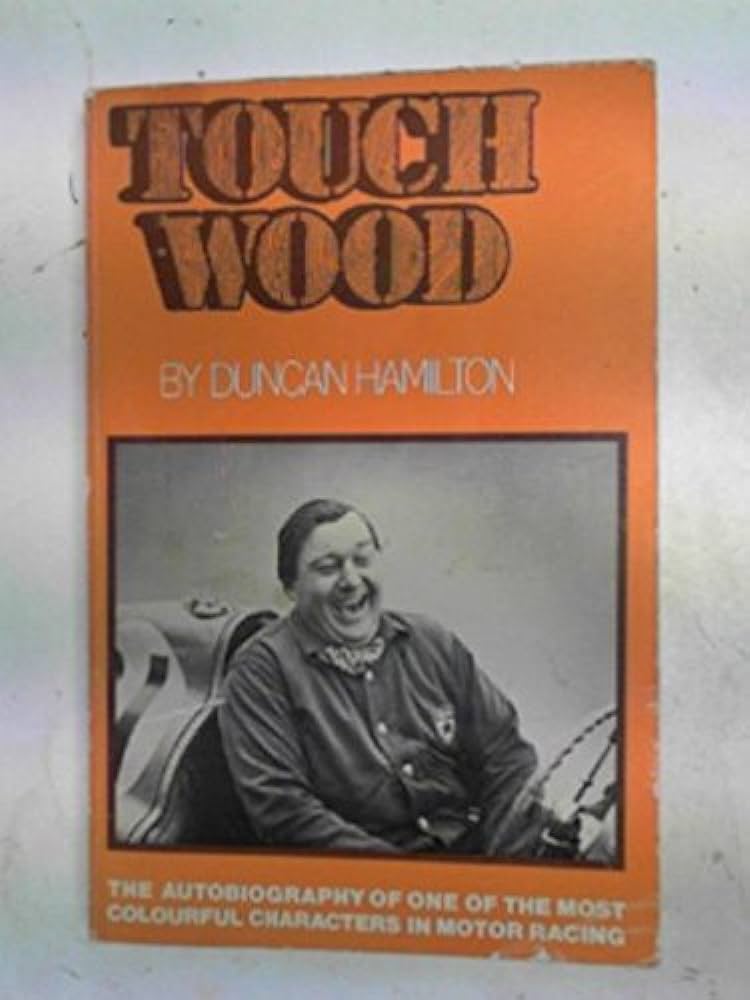
Duncan’s autobiography Touch Wood is a hoot (and inspired more than a couple of my motorsports journalist highjinks).
Wikipedia cites an example of Duncan’s adventures: “On one occasion in 1947, he was transporting his MG R-type to the Brighton Speed Trials. While going down a hill near Guildford, he ‘saw the splendid honeycomb radiator of a Bugatti in the outside rear-view mirror”’, so he moved over and waved it past. However, the car hung back. Further down the hill, the Bugatti drew level with Hamilton, at which point he saw there was no one in it and realised it was his own car which he had forgotten he was towing.”
John Surtees’s Heroes. John Surtees, like a goodly number of F1 drivers of his generation, came to the sport through Grand Prix motorcycle racing. John was first in the latter championships in 1956, 1958, 1959, and 1960. Racing in F1 from 1960 through 1972, he earned the 1964 Drivers World Championship in a Ferrari.
In 1992, Surtess was commissioned by Pirelli to assemble with Sydney Higgins an Album of Motor Racing Heroes.

Pirelli Album of Motor Racing Heroes, by John Surtese
Heroes include those appearing here in SimanaitisSays, Tazio Nuvolari, Juan Manuel Fangio, and Stirling Moss. Here are tidbits about these and others gleaned from Surtess’s book and from other Internet sleuthing.

Tazio Nuvolari. This and following images from Pirelli Album of Motor Racing Heroes.
Tazio Nuvolari. One of five Heroes coming into four-wheeled grands prix through two-wheeled variants, Nuvolari is renowned for the 1935 German Grand Prix: Surtees describes, “At the end of 1934, at the insistence of Mussolini, no less, Nuvolari rejoined Scuderia Ferrari. It was the dawn of the era that was to be dominated by the astonishing silver cars of Mercedes-Benz and Auto Union.”
“In his outdated, underpowered Alfa Romeo,” Surtees writes, “he battled for over four hours against the might of the Silver Arrows…. Midway round the final lap, the left rear tyre of the [first-place] Mercedes exploded and Nuvolari swept past.”
“So confident,” Surtees recounts, “had the officials been of a German win that they hadn’t provided a recording of the Italian national anthem. But it was played: Nuvolari had brought along a copy of his own just in case there would be a need of it!”
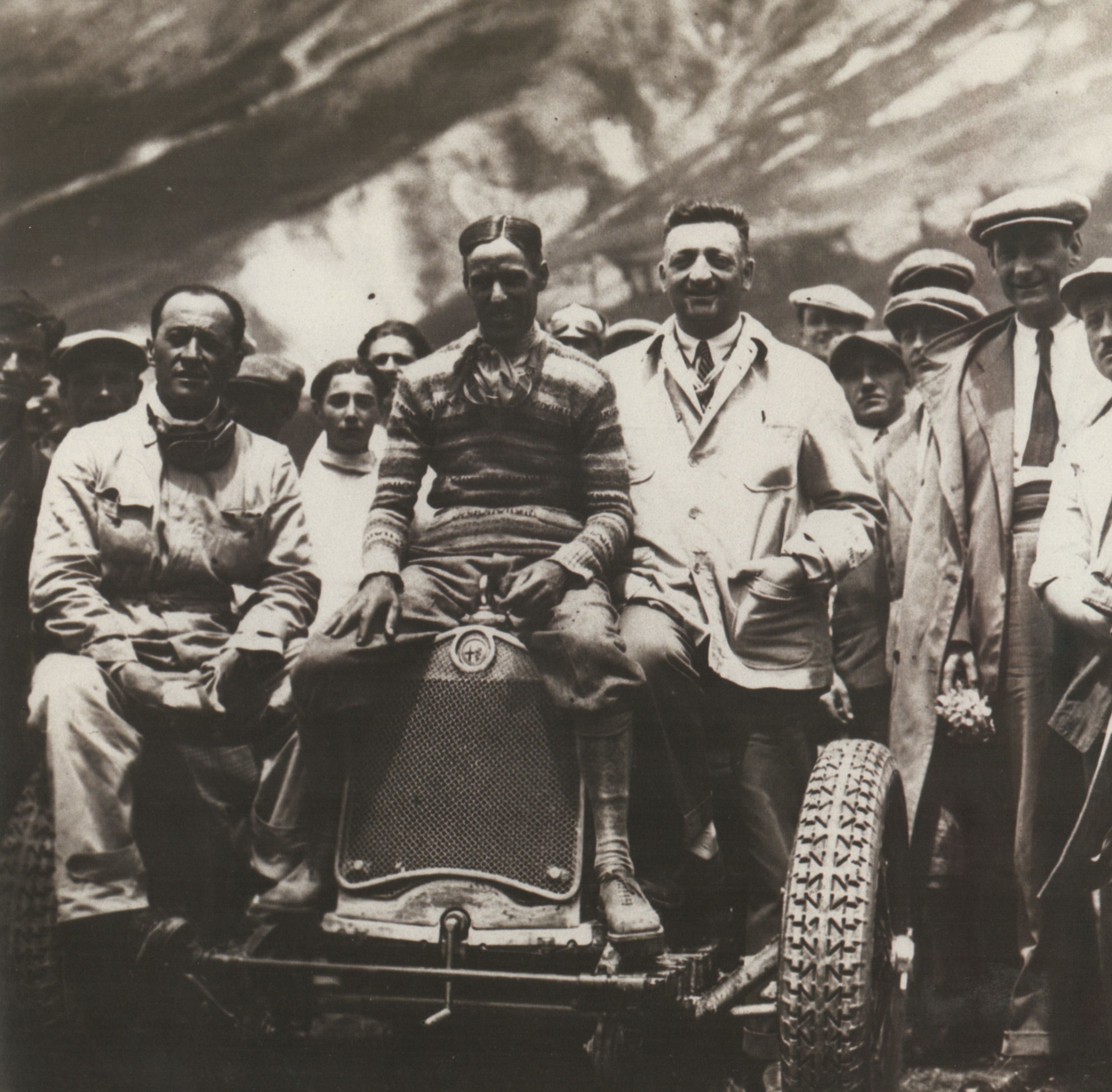
1930, Cuneo mountain climb. Nuvolari straddles the radiator of his Alfa Romeo. Team manager to his left had yet to build his own cars.
Graham Hill. Surtees describes, “Graham Hill decided, at an early age, that he wanted to be an engineer. As a child, he loved tinkering with machinery bought from local secondhand shops. His National Service was spent as an engine-room artificer in the Royal Navy. Afterwards, he became an engineering apprentice with an instrument and accessories firm.”
Surtees continues, “He began to take part in motorcycle scrambles and races. This came to an end when he was involved in a road accident which resulted in his being left with recurrent backache and a twisted leg which settled an inch shorter than the right.”
“Not at all deterred by these injuries,” Surtees recounts, “Graham took up rowing. ‘I was looking,’ he later remarked jokingly, ‘for a sport that I could do sitting down.’ In 1952, he competed in the London Rowing Club’s second eleven at Henley and, in 1953, he stroked their first eight to victory in the Grand Challenge Cup.”
“That same year,” Surtees notes, “Graham, who was then 24, bought his first car (a 1934 Morris 8), taught himself to drive and scraped through his driving test.” Then came five years of unpaid wrenching in exchange for race rides. And then things improved considerably.
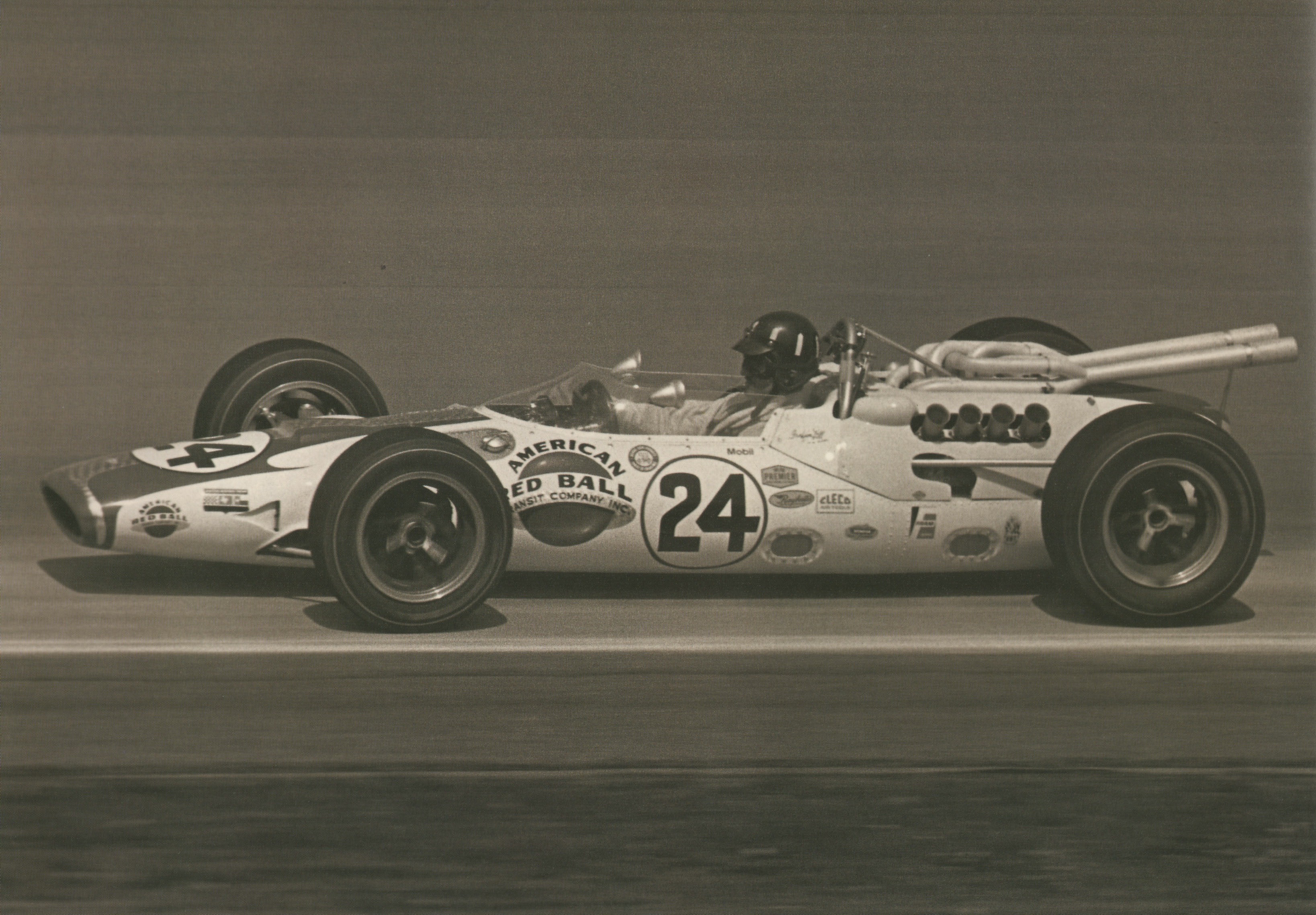
This particular race ride came in 1966 at a place called Indy. Hill finished first.
In time, Graham had earned two Drivers World Championships, 1962 with BRM and 1968 with Lotus, the Indy 500 in 1966, Le Mans in 1972, and the title “Mr. Monaco” having won there in 1963, 1964, 1965, 1968, and 1969.
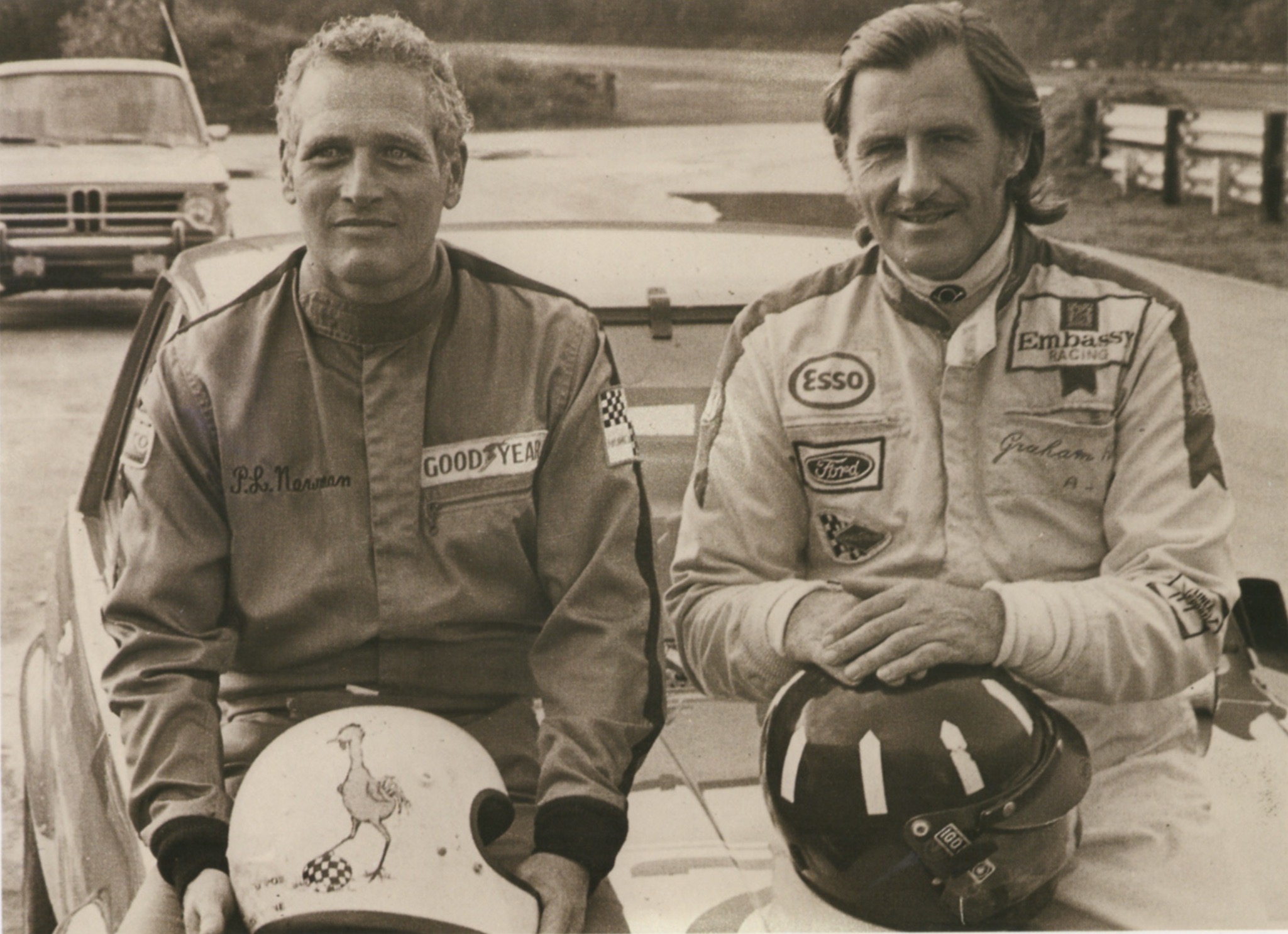
Graham Hill with a race driver/friend (who got his racing start in the movies).
And now you know the origin of Graham Hill’s helmet design: dark blue with its eight vertical white flashes, representing the blades of the London Rowing Club’s first eight.
Motorcycles, go-karts, wrenching for rides, the movies. It’ll be good fun recurring to Pirelli Album of Motor Racing Heroes. ds
© Dennis Simanaitis, SimanaitisSays.com, 2025
 Simanaitis Says
Terrific and new to me story of Graham Hill’s coming to motorsport.
We perhaps forget that most of these famed racers were, like many pro ball players, blessed with superlative vision. Ted Williams was not alone in having 30/20, better than 20/20, and Sir Stirling Moss could supposedly read newsprint at 10 feet.
Among an increasing number of world-class athletes, Sir Lewis Hamilton extols veganism.