
Simanaitis Says
On cars, old, new and future; science & technology; vintage airplanes, computer flight simulation of them; Sherlockiana; our English language; travel; and other stuff
OTHELLOS AND IAGOS WE’VE LOVED AND HATED PART 2
YESTERDAY, BEN BRANTLEY’S PIECE IN THE NEW YORK TIMES got us started in Othellos and Iagos through time. Here in Part 2 we pick up with a complex relationship of people in a 1943 Broadway production of Othello.
Paul Robeson and José Ferrer, Broadway, 1943. Ben Brantley notes, “It took 13 years for Robeson’s singular, boundary-shattering brand of Shakespearean lightning to strike in Manhattan. But this production, astutely directed by Margaret Webster, was a more unconditional triumph. It helped that Ferrer’s Iago was, as Lewis Nichols put it in The Times, ‘a half dancing, half strutting Mephistopheles.’ (Desdemona was, if you please, Uta Hagen, Ferrer’s wife, who became Robeson’s lover.)”

Paul Robeson (Othello) and Uta Hagen (Desdemona) in the 1943 Broadway production. Image from the U.S. Library of Congress.
“At a time when anti-miscegenation laws were still on the books in the States,” Brantley writes, “there were worries that the interracial love affair might alienate audiences. But the opening-night ovations were again thunderous, and reviews were largely ecstatic. (The Herald Tribune described it as a ‘tribute to the art that transcends racial boundaries.’) The production broke records for a Shakespeare play on Broadway, clocking 296 performances.”
Laurence Olivier and Frank Finlay, London, 1964. Brantley recounts, “Those who saw Olivier’s Calypso-cadenced Moor onstage swear he was mesmerizing. His ‘power, passion and verisimilitude,’ wrote the critic in The Sunday Times of London, ‘will be spoken of with wonder for a long time to come.’ ”

The theatrical poster. Image from Wikipedia.
However, Brantley noted, “But captured on film the next year, Olivier’s blackface makeup and exaggerated mannerisms registered as grotesque and, to many, deeply offensive. A university professor recently discovered it was not a film to show latter-day students.”

Jake Gyllenhaal and Denzel Washington in the play’s latest revival, on Broadway through June 8, 2025. Image by Sara Krulwich/The New York Times.
Orson Welles and Others “Making Down.” Plenty of Othellos were played in blackface. Not cited by Brantley was Orson Welles’ Federal Theatre Project and its “Voodoo Macbeth.” Staged as part of the New York City Negro Theater Unit in 1936, an all-Black cast set the Shakespeare classic in Haiti.
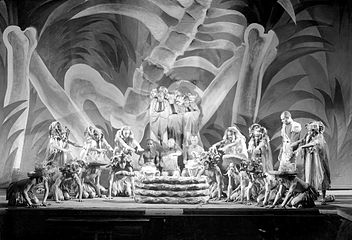
Macbeth with the Three Witches, Orson Welles’ “Voodoo Macbeth.” Image from Wikipedia.
In Barbara Leeming’s Orson Welles: A Biography, she recounts lighter-skinned Black actors “making down” (i.e., darkening their complexions). Indeed, they joked with Welles in doing so when he stood in for an ailing cast member.
Later, by the way, Welles portrayed Othello in his 1951 film, an adaption of the play. Wikipedia notes this was one of Welles’s more complicated shoots, filmed erratically over three years. His original producer went broke. Pouring his own money into the project, Welles would suspend production while he raised cash taking part in others’ films.
A good tale in this: “When Welles acted in the 1950 film The Black Rose, he insisted that the coat his character, Bayan, wore be lined with mink, even though it would not be visible. Despite the expense, the producers agreed to his request. At the end of filming, the coat disappeared, but could subsequently be seen in Othello with the fur lining exposed.” ds
© Dennis Simanaitis, SimanaitisSays.com, 2025
 Simanaitis Says
I just realized that it’s been thirty years since I last saw Othello, in this case, the film starring Laurence Fishburne and Kenneth Branagh. The overwhelming tragedy of it all left me feeling disturbed.