
Simanaitis Says
On cars, old, new and future; science & technology; vintage airplanes, computer flight simulation of them; Sherlockiana; our English language; travel; and other stuff
LEST WE FORGET
BBC HISTORY MAGAZINE, FEBRUARY 2025, OFFERS AN INTERVIEW with historian Laurence Rees; his topic, “the history of the Nazi regime yields warnings—but that frighteningly few people are interested in learning from the past.”

Laurence Rees, BAFTA-winning historical documentary filmmaker and British Book Award-winning author, headed up BBC TV History Programmes. This and following images from BBC History.
Today’s news is filled with madness: People whisked away sans due process. Others afraid to speak out for fear of retribution. Law firms shut out of federal facilities. Elimination of anything vaguely linked to D.E.I, even Black war heroes and Enola Gay (a WWII bomber named for its pilot’s mother). Untold numbers of federal workers arbitrarily forced out. Scores of lies utterly without evidence (a recent example: the abject ass-covering of Signalgate).
It’s hard to believe that 77,303,568 of my fellow Americans voted for this chaos. Or even worse, that they agree now with its taking place.
Sad to say, I find some understanding in historian Rees’s comment that “frighteningly few people are interested in learning from the past.” Here are tidbits gleaned from his book and BBC History interview for the benefit of those who wish to learn.
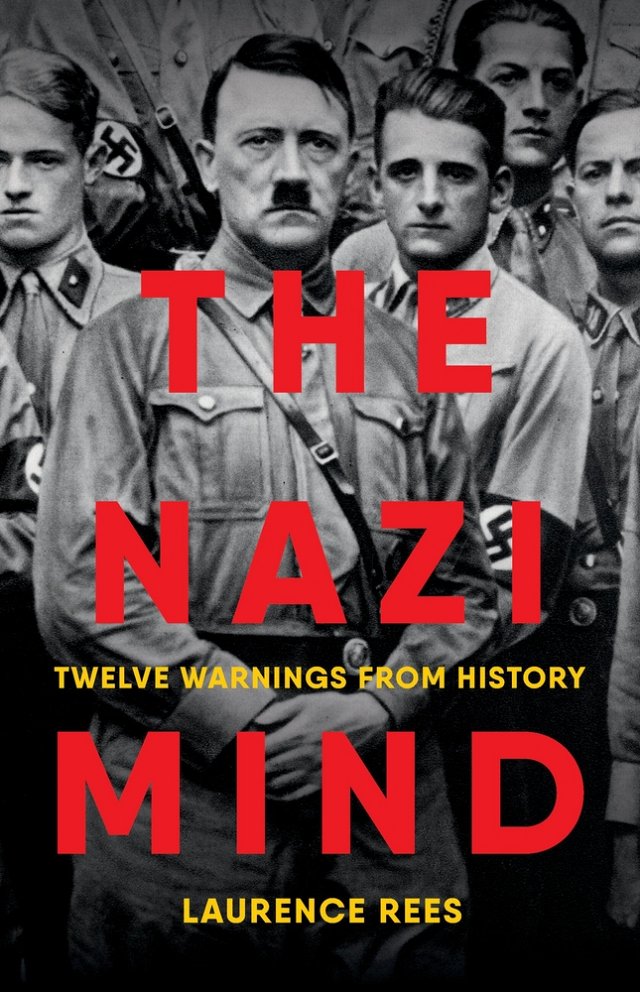
The Nazi Mind: Twelve Warnings from History, by Laurence Rees, PublicAffairs, 2025.
IndieBound writes, “From an award-winning historian comes a fresh analysis of the rise of Nazi extremism, how such thinking gained popularity, and why it is vital to fight burgeoning extremist movements today…. Using previously unpublished testimony from former Nazis and those who grew up in the Nazi system, and in-depth insights based on the latest research of psychologists, The Nazi Mind brings fresh understanding to one of the most appalling regimes in history.”
A Frightening Discussion. Rees recounts, “While researching a documentary in Austria, I met someone who had served in the Waffen—SS and remained committed to the Nazi regime. It was my first encounter with someone like that—and it was extraordinary. After the war, he had become a senior executive at a German car company; he was retired when we met but still sharp and articulate.”
Rees continues, “When we discussed the war, he expressed shocking views: lamenting that Britain and Germany hadn’t teamed up to rule the world, blaming Winston Churchill for the conflict, praising the Third Reich as a ‘golden era,’ and describing the Jews murdered during the Holocaust as a problem that had to be dealt with ‘one way or the other.’ ”
The man’s views were chilling to Rees. They are even more so to me, given their revisionist history expressed in all too familiar phraseology today.
Parallels Today? “Yes—all over the place,” Rees says to the interviewer. “But in the book I am careful not to say: ‘This is what X, Y, or Z is doing.’ That’s deliberate. The examples I use, including Mao and Stalin, are historical figures whom you can clearly examine.”
He explains, “I did this for two reasons. First, I’m writing a history book occasionally informed by psychology, not a modern political treatise…. Second, I believe it’s more powerful if readers made these connections themselves. “
“My goal,” Rees says, “was to provide a framework—a set of templates—to help people think critically about the world today.”
Or think at all, I would hope.
On Postwar Rationalization. Rees observes, “The responses of individual Nazis to their actions varied. Some accepted responsibility, while others denied or deflected blame.” He cites ignorance as one excuse. Another is deflection, “akin to the modern ‘whataboutism.”
Funny, I’m reminded again about Signalgate responses.
On Taking Warnings. “We have a massive problem,” Rees says, “in that most people in the UK stop studying history in the mid-teens. This creates a fundamentally historically illiterate population.”

A contemporary poster exhorting “German Defend Yourselves! Don’t Buy From Jews!”
“Before I produced the documentary series Auschwitz: The Nazis and ’The Final Solution’ in 2005, we conducted a poll. It revealed that most people didn’t even know what the word ‘Auschwitz’ meant, let alone a view on it.”
Another chilling observation of an electorate, be it British or American.
Fascists or Saints. Ree’s psychological investigations show that young minds are particularly susceptible to ideologies: “more likely to become fascists or saints.”

A contemporary poster reads, “You Too Belong to the Führer.”
This reminds me of one of the many chilling images in the 1972 movie Cabaret.
Let us hope the young—and the rest of us—do not forget history. ds
© Dennis Simanaitis, SimanaitisSays.com, 2025
 Simanaitis Says
Very thought provoking, Dennis. I need to go back and watch both the Cabaret movie and the play again.
Thanks,
Thanks, Tom. TCM recently had “Cabaret.” All the more moving today.
Unfortunately, I think that with the Boomers starting to die off, and the WW2 generation already substantially gone, there’s no interest in that history (or much else of it, really) any more. The old saw comes to mind, though: those who don’t know/understand (assuming they’ve been taught semi-objective) history are condemned to repeat it. Thanks, even if you’re sort of singing to the choir here.
Of course, the website is available to non-choir-members too. You’re welcome to pass it along to any you wish.
Thanks, Monsignor Simanaitis, and i second and third Tom and Mike B.
What have we, let alone newer generations, learned, drawn from the earlier horror? Sometimes think only technology changes.