
Simanaitis Says
On cars, old, new and future; science & technology; vintage airplanes, computer flight simulation of them; Sherlockiana; our English language; travel; and other stuff
HARRY NILE AND CARS PART 2
IN PART 1 YESTERDAY, WE CITED several cars appearing in Harry Nile adventures. We continue today with two more that our sleuth drove: a 1936 Bentley and a 1942 DeSoto.

The Bentley Adventure. Dorothy Leland is a recurring sorta love interest in Harry’s Los Angeles adventures. She’s the divorced spouse/widow of Jack Leland, killed while working as A-1 Fabricators’ security officer prior to Harry’s employment there. Jack is a naturalized U.S. citizen, a relocated Brit with an evident enthusiasm for cars: Dorothy gets a 1936 Bentley in the divorce; Jack drives a ’34 Hudson Terraplane. (Later, a cop tells Harry, “Those old Terraplanes are as fast as greased lightening. I’ve had to chase a few and they can outrun my V-8.”).

A 1936 Terraplane. Image from Stahls Automotive Collection.
Harry Pilots the Bentley. The “Weekend in Heaven” episode is a hoot, with Harry’s likable if conniving pal Marvin setting up a free weekend for Harry and Dorothy at a new Laguna Beach resort. Not trusting Tondelayo for that distance (“a hundred-mile round trip”), Harry is encouraged to fire up Dottie’s garaged Derby Bentley.
“When I told all this to Dorothy,” Harry recounts, “she squealed like a high-school girl, gave me the keys to her ’36 Bentley, and, by golly, after coaxing the choke and goosing the gas, it finally started.”
He continued, “So that Friday afternoon, with me driving from the righthand seat, we headed south with the top rolled back and a warm wind tossing Dottie’s hair, while I held on to the big wood steering wheel and tried to get used to shifting with my left hand.”

A 1936 Bentley 4 1/-2 Litre All-weather Tourer. Image bradfieldcars.com.
Opps. To quote from the Bentley Motors, Ltd. Instruction Book, “The gearbox has four speeds and reverse. The change speed lever is on the driver’s right.”

From the Instruction Book.

Curiously, whether in its standard righthand-drive or in export lefthand-drive versions, the shift lever was positioned to the driver’s right. That is, lhd Bentleys of the era had what we Yanks would call a conventional center-mounted shifter. Eventually, column shifts were fitted, which changed this (and would have eliminated Harry’s imagined difficulty).

Note, the driver’s seat of an rhd Bentley often had a notch in its upholstery to accommodate the shifter. Image from Hyman Ltd.
In any event, a good time was had by Harry and Dorothy with her ’36 Bentley in “A Weekend in Heaven.”
A New (Used) Car. Harry has moved to Seattle and set up sleuthing with Murphy, a sweet librarian type who also knows her way around the detective arts. It’s the fall of 1950, it’s raining in Seattle, and Harry’s trusty if rusty ’37 Ford Coupe Tondelayo has been torched by a guy Harry “sent up the river.”
It’s time for Harry and Murphy to seek out something “Almost As Good As New.”
Car Shopping. Murphy says brightly, “Here’s an ad in the paper for a Duesenberg.” “Duesenberg?!?” says Harry. “And here’s one for an Auburn Speedster,” says Murphy.
“Sure,” Harry says, “And how about a neon sign saying ‘You are being followed by a private detective?’ ”
“Are you folks in the market for a good used car?,” a guy in the next booth says.
Morris Motor Company. Before long, “Harry and Murphy are standing in the rain at Morris Motor Company, the squalid home of twenty used cars.” Among them are a black foor-door sedan (“too much like an unmarked police car,” says Harry); a sporty Packard (“too fancy, too easy to spot”); a dandy little Studebaker (“something a little bit bigger; I might have to spend the night on a stakeout”); a Nash with a bed in the back (“I don’t want to get that comfortable.”).
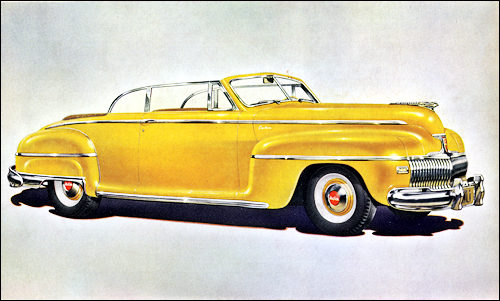
A 1942 DeSoto Convertible. “A very rare model too,” Morris says. (Indeed, no cars, commercial trucks, or auto parts were made from February 1942 to October 1945.) “The factory built only a few of them before converting to making tanks. I can get you into this baby for under a grand.”
“Hmm…,” says Harry. “Nice leather seats, pretty dashboard, ‘Safety Signal’ speedometer, pushbutton radio. It smells good in here…. kinda perfumey.”
The pair is driving away in the “$900 plus” DeSoto when Murphy tells Harry, “I think you got gypped.” She has discovered the dealer bought the car for $400—what’s more, she notices, “This car doesn’t have any headlights!”

This and following images from Mac’s Motor City Garage.
Harry delights in showing Murphy a feature of the ’42 DeSoto: Airfoil Lights, headlights hidden behind articulated lids. (Cords had them earlier, but not nearly as slick in operation.)

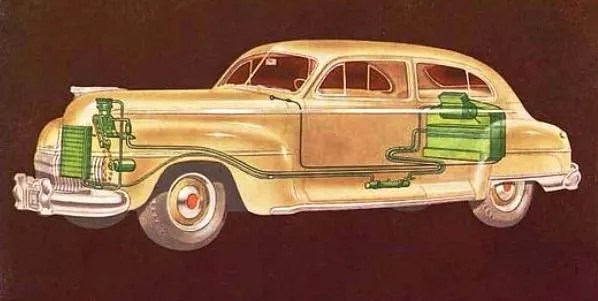
The ’42 DeSoto also featured Chrysler Airtemp air conditioning with the bulky evaporator and distributor mounted behind the rear seat and exterior stying that concealed the running boards.
Mac’s Motor City Garage recounts, “Another advanced feature offered by DeSoto at the time was Simplimatic, a four-speed semi-automatic transmission based on Chrysler’s Fluid Drive system. DeSoto pioneered in marketing as well, offering options not often available to mid-priced car buyers in those days.”
Mac continues, “The Personalized Interiors program offered as many as 10 available upholstery and trim combinations, while an option package called the Fifth Avenue Ensemble included unique chrome rear fender trim, a premium seven-tube radio, and a cigarette case built into the steering wheel.”
Like me, Harry had quit smoking a long time ago. But he still enjoyed the DeSoto’s other innovations—for a brief time.
No spoilers here. It’ll ruin “Almost As Good As New.”
© Dennis Simanaitis, SimanatisSays.com, 2025
 Simanaitis Says
Reminds me of my family’s 1950 Dodge Coronet 4 door sedan with … Fluid Drive …
Looking forward to the next issue of your blog…

>
I wonder, were the Airfoil Lights prone to problems? When De Soto returned after WWII it was basically the 1942 model, but with conventional headlights.
Thanks Dennis. Welcome distraction from the news. My dad had a prewar Desoto four door, 1936 maybe, that carried us from NY to Minnesota to California in 1946. Three years later that was swapped for a 1949 Oldsmobile.
I guess I’m too young here. The DeSotos I remember were essentially rebadged Chryslers. Late 50s…
Just remembered a favorite comic strip (Shoe) in which one of the characters has a DeSoto (obviously a 50s model, magnified). http://www.hasselsvensson.se/Bilder/Desoto/1959/SHOE_1S.jpg
What a wonderful romp the past two days for those with a foot in both the States and at least partly, the Sceptered Isle. If Harry’s Simplimatic ’42 DeSoto also had overdrive, he had a good long-distance, high-speed road car.
As for his previous Plymouth coupe, what’s interesting is that despite Buick furnishing Warner Brothers with Flintmobiles, so much so that in a given WB flick the secretary’s driving a Special, the harried executive or principal a Century or Roadmaster, while Mr. Big ensconced in a Limitied, Bogie always drives a trusty little Plymouth coupe, whether as Sam Spade in the complex The Big Sleep, or Mad Dog Earl in 1941’s High Sierra, even managing to stay ahead of a pack of snarling black and white CHP Buicks.
You’d think a rail fan would be comfortable in a RHD job, since the engineer always sits on the right, but no such luck. The 4 1/4-liter Bentleys were invariably nice-looking, and 200 or so 1938-early ’40 MX Overdrive models offered after Bentley owners suffered spun bearings at sustained Route Nationale and Autobahn speeds. But only in England would a 3.65:1 final drive be considered an overdrive cog.
Will have to discover what became of the missing Cord mentioned yesterday. Ian Fleming knew more about cuisine, skiing, and British naval bureaucracy than cars, but he put Felix Leiter in “a low-slung Cord saloon.” Too bad the movies didn’t get any of the novels’ cars right.
Nice writeup .
In the mid 1950’s pops came home from one of his European work trips with a 1937 Bently St. James Coupe . RHD of course, I no longer remember where the gear shift was but I vividly remember those four levers on the steering wheel, one of which tightened up the suspension for poor roads .
It also had a small pedal you’d depress to lubricate the chassis .
Sadly her let my middle brother the idiot have it in 1967, said idiot left it in an unheated garage in Rochester, New York in January sans anti-freeze, the resulting frozen water punched a hold in the clinder head and Pops got P.O.’d and junked it .
I liked the 40’s DeSoto styling and would have loved a ’42 Business Coupe .
I wonder if that 7 tube radio was a multi band like Chevy had then .
-Nate
Was the entire ’37 Bentley junked, or just the engine? Hard to believe the entire car scrapped in 1967.
Many high-end cars in the US had Bijur “pull daily” chassis lubrication using 50 weight oil in lines to most of the places otherwise served by a zerk fitting. Heavy oil can protect well, but needs to be replaced, joints weren’t sealed in the old days, so such chassis lube systems left a mess on the garage floor and chassis. When many roads still unpaved, that was not such an issue, just as updraft carburetors leaked gasoline on start up and shutting off the engine.
Seven-tube radios were essentially another case of more must be better marketing. According to a poster on antiqueradios.com:
“A higher tube count was a selling point at the time, and some manufacturers would use two tubes to do the same job as one did in another radio.
I had a 40’s RCA series string wooden set at one time with 7 tubes if memory serves—the 7th tube was a ballast tube to provide power to the #47 dial bulb, nothing else.”
About the above cop’s quip to Jack about Terraplanes being fast, Hudson advertising claimed the only thing faster than a Terraplane 6 was the new, one-year-only ’33 Terraplane 8. These would run away from anything else on the road, and were of course the basis for the wonderful Railton 8s, one of which Road & Track founder/editor John Bond long owned, and perhaps Dennis drove, reviewed it at one point.
Now, about that ’67 James Young-bodied Bentley coupe. Surely the rest of the car was saved, still exists?
Meant ‘37 James Young-bodied Bentley coupe.
Re: the optional air conditioning in the ’42 DeSoto, looks like the Bishop & Babcock, Cleveland, OH device first seen in closed, eight-cylindered models of 1940 Packards, the first cars to offer AC. Cadillac followed in 1941, as did Chrysler’s Imperial.
About 2,000 1940-42 Packards were so fitted with this $275 option, the bulky evaporator in the trunk, compressor mounted on the engine, running continuously unless the drive belt removed, there being no automatic disconnect clutch. The faster the car went, the cooler it became. If air cost about the same when Harry’s DeSoto new, it would’ve been nearly a quarter the price of the base car.
Hadn’t known about these Harry Nile radio dramas before now. Listening to a couple of them, you know their Seattle-based producer Jim French and his associates had an enthused time doing them.
Thank you, Monsignor Simanaitis for another overlooked delight.