
Simanaitis Says
On cars, old, new and future; science & technology; vintage airplanes, computer flight simulation of them; Sherlockiana; our English language; travel; and other stuff
AVOIDING “LOCK-IN” SUBSIDIES PART 1
AAAS SCIENCE OFFERS A POLICY FORUM IN ECONOMICS, its title “A Cautious Approach to Subsidies for Environmental Sustainability,” October 3, 2024.

This extensive discussion was assembled by Kathleen Segerson et al. (indeed, a total of 24 authorities in areas such as biology, climate change and the environment, ecology, economics, energy and the environment, energy and sustainability, evolutionary biology, human evolution, limnology, public policy and global affairs from ten countries). For example, Segerson is in the Department of Economics, University of Connecticut, Storrs, together with nine others in the U.S. Other countries represented are Australia, Canada, Columbia, Germany, Italy, the Netherlands, Norway, Sweden, and the U.K. Altogether, quite the informed group.
Here, in Parts 1 and 2 today and tomorrow, are tidbits gleaned from their principal thesis about subsidies: “Transformation change is possible,” they say, “but design and implementation must seek to avoid lock-in.” All quotes following are from the article.

The Beijer Institute of Ecological Economics, Royal Swedish Academy of Sciences, supported these researchers collaboration.
Subsidies Versus Taxes. “Because subsidies involve net positive benefits for the groups engaged in the subsidized activity (‘carrots’), they can be politically easier to enact than taxes and regulatory restrictions (‘sticks’), which typically face strong political opposition due to the easily identifiable costs they impose on specific groups. Moreover, because of these targeted benefits, subsidies are sometimes used as a political tool to buy support from pivotal interest groups.”
Environmentally Harmful Subsidies. “At the same time, there have been repeated calls to eliminate (or reform) environmentally harmful subsidies, e.g., to the fossil fuel, agricultural, and fishing industries because they contribute to some of humanity’s largest environmental threats, including climate change and biodiversity loss.”
“World leaders have committed to phasing out harmful subsidies in these sectors. Over a decade ago, the leaders of the G20 committed to phasing out inefficient fossil fuel subsidies, and recently the World Trade Organization’s Agreement on Fisheries Subsidies and the Kunming-Montreal Global Biodiversity Framework committed to reducing harmful subsidies.”
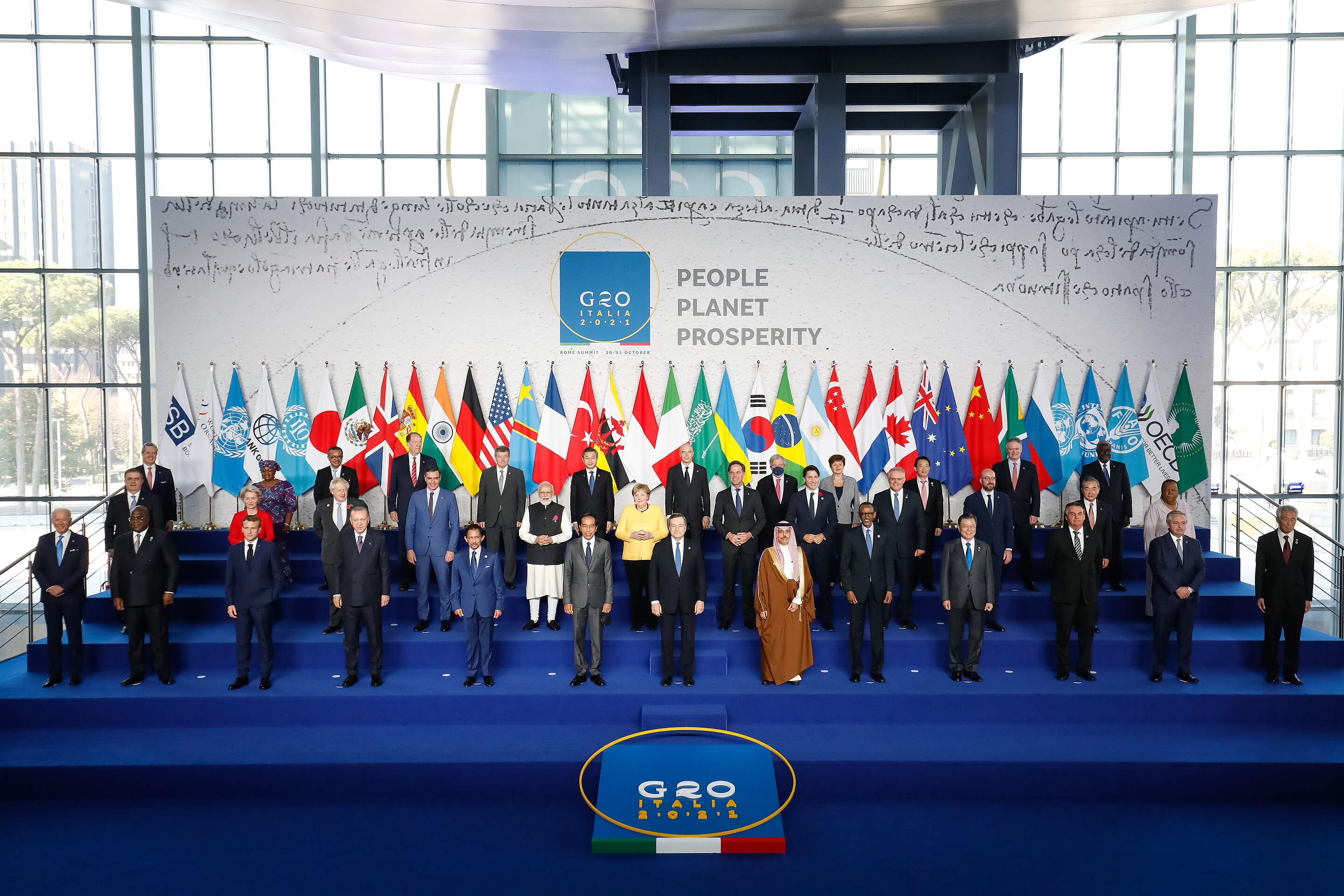
A G20 gathering from 2021 in Italy. Image by Alan Santos/PR via Wikipedia.
Locked-in Subsidies. “Eliminating subsidies is not easy, though…. Unlike taxes and regulatory restrictions, once enacted, subsidies can create a concentrated and powerful group of beneficiaries with a strong interest in keeping them in place. This can make it difficult to eliminate or reform subsidies even when they are harmful from a broad societal perspective. For example, despite the G20 commitment, estimates indicate that explicit fossil fuel subsidies were $1.3 trillion globally in 2022.”
Ouch.
Differences in Locale. “For example, the overall environmental benefits from an increase in the EV market share depend critically on how the electricity used to power those vehicles is generated. Estimates suggest that in most places, EV displacement of gasoline-fueled vehicles would reduce greenhouse gas emissions.”
“However, in terms of local air pollution, the environmental impacts of switching from gasoline-fueled cars to EVs vary considerably by location. Those impacts are estimated to be beneficial in places like California (where local damages from gasoline vehicles are high and electricity production is relatively clean) but harmful in places like North Dakota (where the opposite is true).”
Tomorrow in Part 2, our Policy Forum addresses a critical point: Are subsidies necessary? ds
© Dennis Simanaitis, SimanaitisSays.com, 2024
 Simanaitis Says
This is a thoughtful look at what drives so much activity today. It is also why, simply as conflict is human, why many of us revere the UN, NATO, and now the G20. They are trying, and those with education, humanity, and empathy should support them.