
Simanaitis Says
On cars, old, new and future; science & technology; vintage airplanes, computer flight simulation of them; Sherlockiana; our English language; travel; and other stuff
PUTTING THINGS IN PERSPECTIVE
AH…. THE FIFTIES.… THE REACTIONARY’S DREAM…. HistoryFacts posted a tantalizing question, “What Did Gas Cost in the 1950s?”

And, to its credit, the website’s answer of 27¢/gallon isn’t just wowed-over. It’s put in perspective: “That low price might sound practically idyllic, but the average household income at the time was $3,300 per year. Adjusted for inflation, $0.27 in 1950 equates to about $3.52/gallon in today’s dollars. Nowadays, the median household income is $74,580.”
And, of course, these aren’t the only economic—and societal—changes occurring between the Fifties and today.
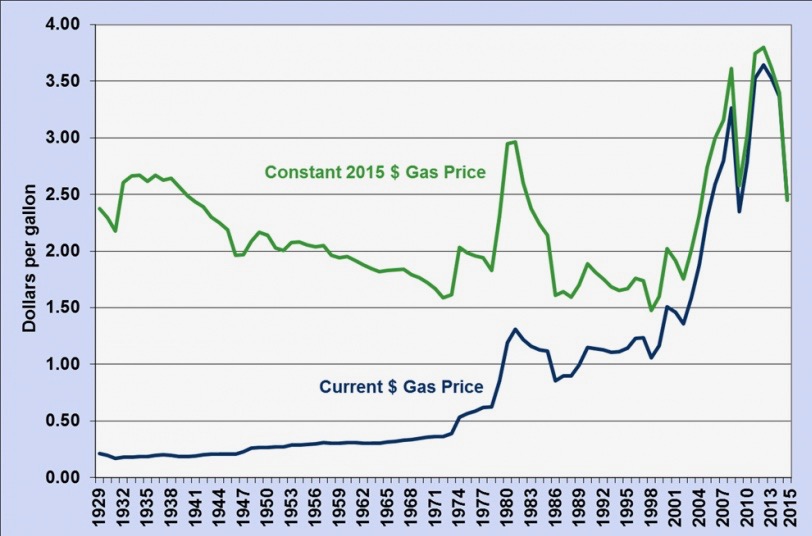
These graphs show U.S. average gasoline prices from 1929 to 2015. The green line is normalized to 2015 dollars. Image from energy.gov.
HistoryFacts is Spot-on. If you’re filling up today with anything but California’s Phase 3 Reformulated gasolines (of which more anon), the website is spot-on with AAA’s national average of $3.521 for regular. Mid-grade is a tad higher, $3.968; Premium, $4.314.
Indeed, it’s not far off from the U.S. Bureau of Labor Statistics CPI Inflation Calculator, which equates 1950’s 27¢ with today’s $3.56.
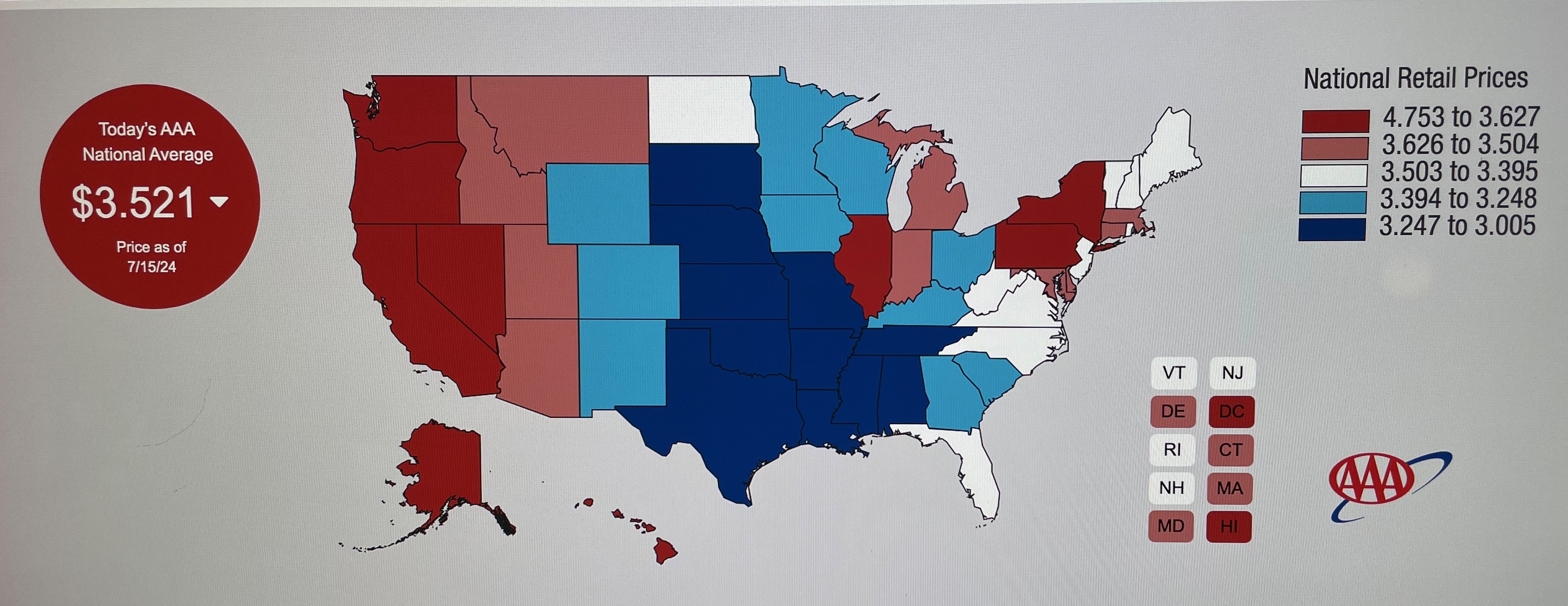
Image from AAA, Gas Prices as of July 15, 2024.
Other HistoryFacts Facts. “The 1950s,” HistoryFacts recounts, “were a transformative decade for transportation in the United States. Factors such as postwar prosperity, suburban living, and a decline in public transit led to a major increase in car ownership. At the start of the decade, approximately half of Americans owned an automobile; by 1960, nearly 75% of Americans owned at least one car, and many owned two. It was the golden age of the automobile.”
And, in a sense, this encouraged automakers into a styling frenzy of exuberance. Cars grew in size (and in fins); their average fuel economy diminished.
Mobilgas YouTubes. Two YouTube videos are exemplary of this growth/diminishment: “For 3rd Straight Year Studebaker Wins Again” describes the 1952 Mobilgas Economy Run. A 6-cylinder Champion posted 27.82 mpg; a Studie Land Cruiser V8 was second at 25.59 mpg.
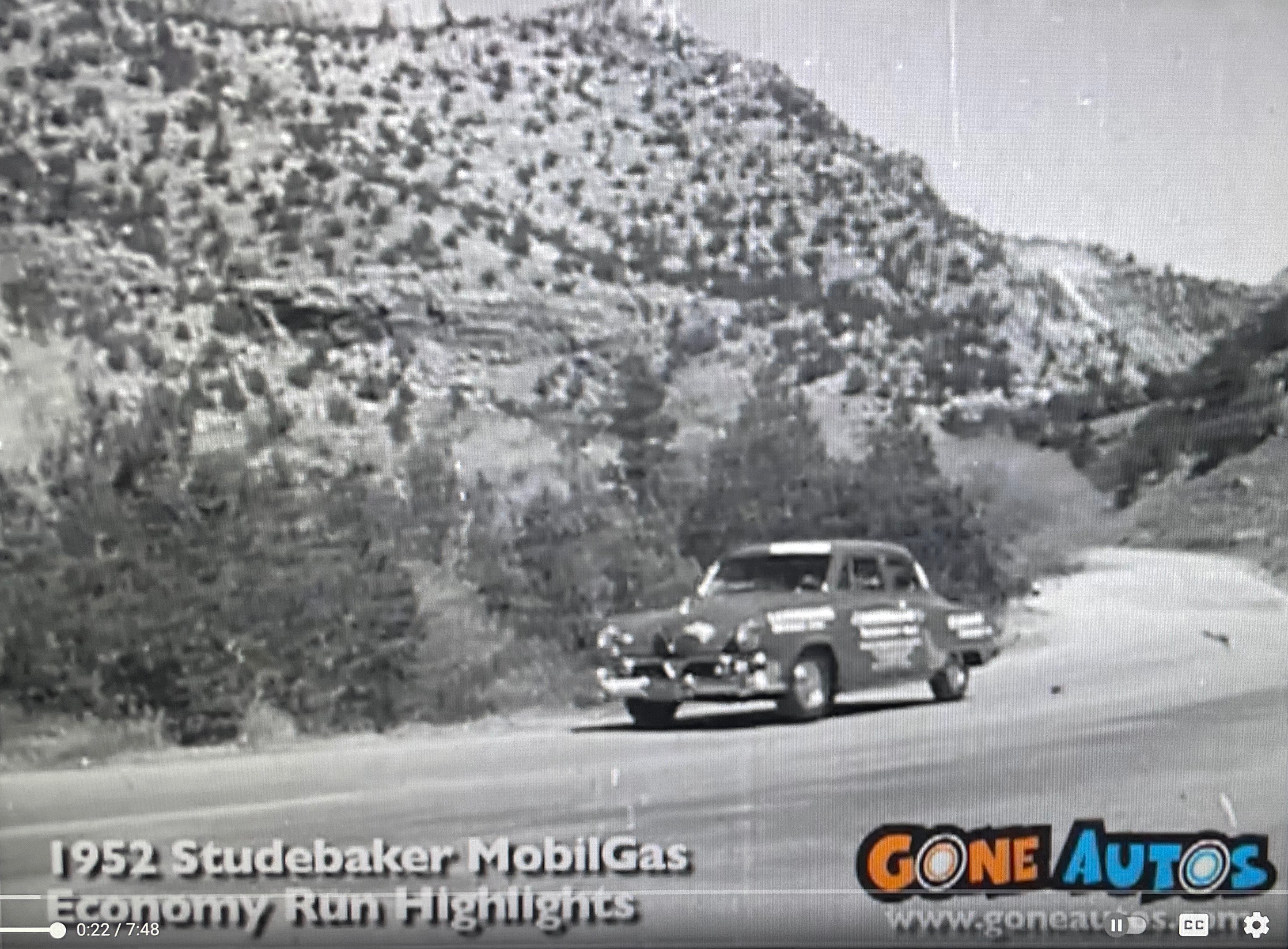
1952 Mobilgas Economy Run. This YouTube video from Gone Autos.
A Studebaker Hawk’s 22.9899 mpg took first in the 1960 Mobilgas Economy Run, surrounded by other makes that had grown considerably.
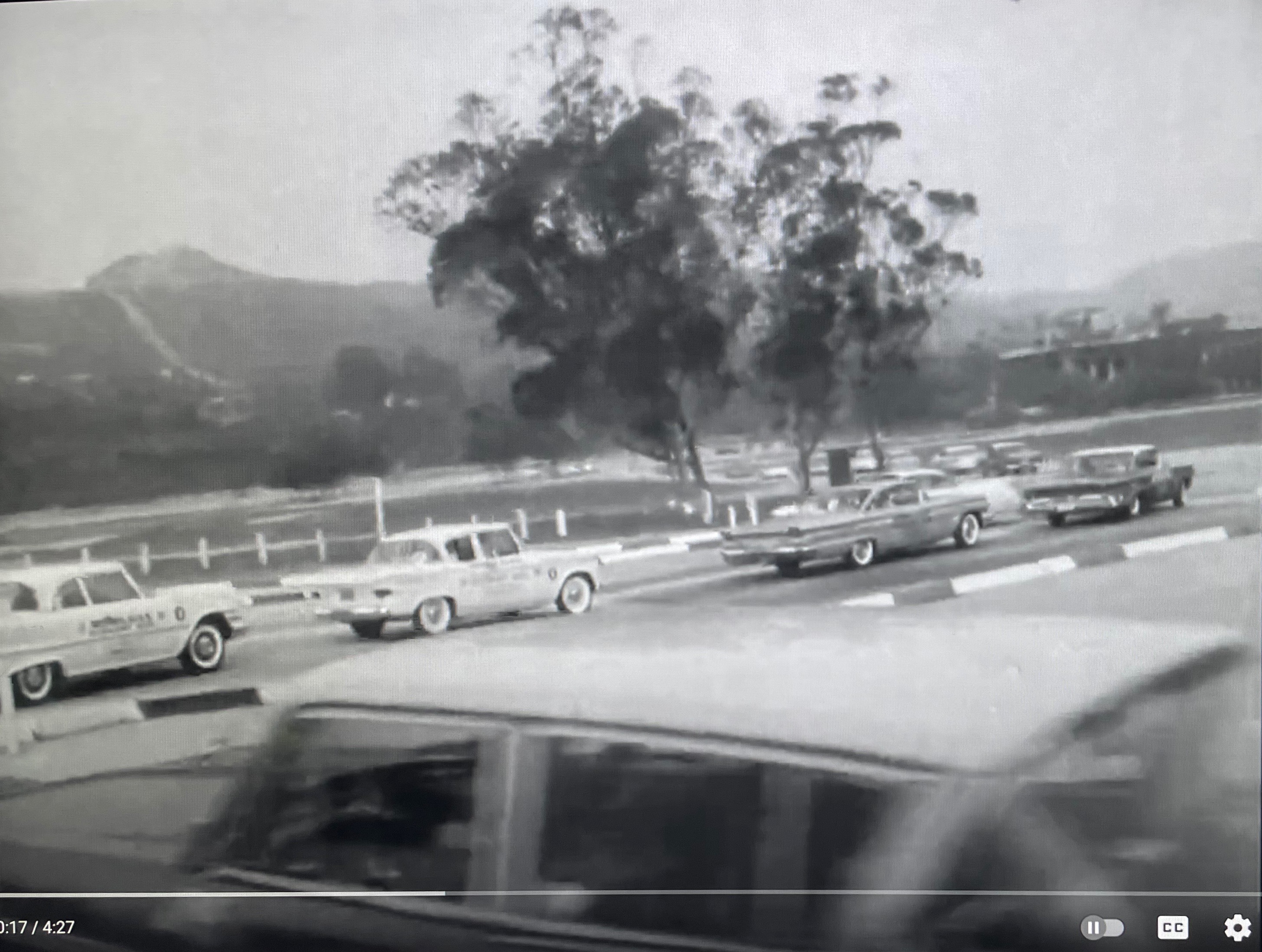
1960 Mobilgas. Image from The Studebaker National Museum YouTube.
For more on the Mobilgas event, see the “Mobilgas Economy Run—1954,” here at SimanaitisSays. Continuing on its winning streak, Studebakers posted the best numbers, a Champion Custom recording a top 29.5 mpg. Among other domestics in 1954 were a Ford Mainline 6’s 26.1 mpg; a Chevrolet Two-Ten’s 22.3; a Chrysler New Yorker and Packard Clipper Deluxe tieing at 17.8, least frugal of the bunch.
Clean Air. What’s clean air? It wasn’t until 1972 that unleaded fuel became the U.S. norm; this, because clean-air catalytic convertors are poisoned by TEL, tetraethyl lead. For an extremely interesting (and well-documented, if not completely unbiased) history of TEL’s quelling combustion-chamber preignition (aka knock), see Environmental history’s “Special timeline: Leaded gasoline.”
Cleaner Gasoline. Motor fuels contain complex blends of hydrocarbons, some more detrimental to the environment than others.
The U.S. Environmental Protection Agency writes, “The RFG [Reformulated Gasoline] program was mandated by Congress in the 1990 Clean Air Act amendments. The first phase of the RFG program began in 1995 and the second (current) phase began in 2000.”
“RFG,” EPA continues, “is required in cities with high smog levels and is optional elsewhere. RFG is currently used in 17 states and the District of Columbia. About 25 percent of gasoline sold in the U.S. is reformulated.” You’ll note the more expensive gasoline prices in the AAA map corresponding to these cities.
As described by the California Air Resources Board, “Governor Davis signed Executive Order D-5-99 (Executive Order) on March 25, 1999, which directs the phase-out of methyl tertiary butyl ether (MTBE) in California’s gasoline by December 31, 2002. The Executive Order also directs the ARB to adopt gasoline regulations to facilitate the removal of MTBE without reducing the emissions benefits of the existing program. This page presents information regarding the Proposed Phase 3 Reformulated Gasoline Regulations.” Further, it links “The complete California Reformulated Gasoline Regulations as of February 16, 2014.”
The U.S. Energy Information Agency writes, “California gasoline prices are generally higher and more variable than prices in other states because relatively few refineries produce California’s unique blend of gasoline. California’s reformulated gasoline program is more stringent than the federal government’s program. California’s tax on gasoline is also higher than most states’ gasoline tax.”
A Purely Personal Note. Other places around the world (among them Iran and Russia) have cheaper gasoline than in the U.S. And other states (Texas, Oklahoma, and Florida, to cite three of many) have less expensive blends than California’s Reformulated. For a variety of reasons I’m happy to pay more. ds
© Dennis Simanaitis, SimanaitisSays.com, 2024
 Simanaitis Says
RFG is a subject near and dear to my heart. I love reformulated gasoline because my company (30 years about a month) makes optimization and control software for blending (gasoline, diesel and fuel oils).
That super-subjective caveat aside, RFG is much healthier for humans and the planet we need to survive. “The good old days” weren’t so good if you got lead poisoning and/or had massive smog (among other problems from emissions.
The prices are still too high in California . Recently they dropped to just under $5 / gallon, they’re back up again over $5 / gallon .
Ouch for us Blue Collar folks who tend to drive more than the average .
-Nate
Ever notice that any hiccup in the actual or perceived supply chain causes prices to immediately rise, then they take months to slowly fade back to near (or, rarely, below) where they started? It’s not taxes doing that.
I recall when McDonald’s touted, “a five course meal, and change for a dollar!” Burger, fries, soft drink, soft ice cream cone and a fried pie.
Actually, yes I do know, in the 1970’s during the fake “Gas Shortage” by the big oil companies to drive out the competition of the independents I was working for Atlantic Richfield (ARCO) .
At that time I’d drive to San Pedro at least once a week late at night and one could see the dozens if not hundreds of full oil tankers waiting to off load, stretching to the horizon and beyond .
Then as now they <magically> were never able to schedule “refinery maintenance” for the slow times of the year .
Oddly enough we who worked there never were short of gasoline .
When I’d ask about this and how it affected American Citizens I was told ‘shaddap or loose your job’ .
Funny how that works, isn’t it ? .
If the media truly was liberal don’t you think they’d be all over the easily disproved bullshit ? .
-Nate
Lowest price I remember was during a price war in the late 1950s. Mager’s Richfield in SF on South Van Ness had regular for 19.9. Dad made frequent use of the place; the ’57 Chevy wagon (aka family bus; 6 cyl, Powerglide, no other options) got < 15 mpg. Some no-name places were as low as about 15¢ for a while, but had well-deserved reputations for dispensing bad gas. When he got a VW Beetle for local commuting (which I eventually learned how to drive in), the gas mileage was amazing – on the freeway, it could approach 30 mpg.
The graph of prices in constant dollars is sort of interesting. So we *have* been paying more recently, but otherwise the real price seems to be roughly level. Would agree overall; back when gas was 20-30¢/gal (including taxes!) a nickel would buy you a cup of coffee and dinner out was a few to maybe (for fancy) 5 bucks. In CA, of course, we have the triple whammy of no good pipeline links to the rest of the country so we’re more dependent on imports than most places; only a few refineries owned by a few colluding giants make our relatively “boutique” blends that actually work for reducing smog (and last I heard only one can still refine California crude that resembles asphalt more than West Texas or Arabian light), and a tax structure that actually yields a useful amount of revenue for maintaining roads (things *have* noticeably improved in the last few years since the method for figuring the tax was revised) and provides some incentive for switching to EVs (that for model years since 2020 pay more per mile in “road tax” via a registration surcharge than a similar gas car would pay in gas tax unless driven a LOT so the incentive is not unmitigated).
Mike ;
I too am a child of the 50’s & 60’s, in rural Hew Hampshire was a local filling station out side of Jaffery, N.H. that for years was able to keep the price at .27 Cents . he owned his own tanker truck and would drive it out of state and buy the last bits of nasty filthy, low quality gasoline the major retailers didn’t want polluting their holding tanks .
-Nate
When I was a kid in the mid-50s, the only auto events to get into major US newspapers were the Indy 500, LeMans, the Monte Carlo Rally and the Mobil Economy Run, with the latter guaranteed of front page publication. A lot of top drivers got paid by manufacturers to balloon foot their cars, and the stops in cities and towns were treated like holiday parades and circuses. Two of the top drivers who had special ways to eke mileage and subtly tweak the cars were Mickey Thompson and Smokey Yunick, and both have written about their ventures … often more entertaining than major races.
Bob Storck
Bob ;
I became a VW Mechanic in the glory days (? dayze ?) of Beetles, I still have one last old VW a 1959 #113 Deluxe (it’s pretty crude but still runs well) that I love to drive every where (parked 50′ away in the 1028 head right now) and yes, 30 MPG is it’s lower fuel economy to this day .
I don’t mind only going 65 ~ 79 MPH .
Oddly enough my 2001 Ranger truck with 2.5 liter engine only gets 16 ~ 19 MPG .
-Nate
When I graduated from U. C. Berkeley in 1955, my first job paid $310/month, pretty close to the national avg. my new ‘55 VW with sunroof, red leatherette upholstery and radio was around $1750. Gas wars often brought gas down under 20 cents/gallon. Grocery stores often advertised hamburger at 5 lbs/$1. BUT, it’s all relative.Financialky, the “ good old days” weren’t much different than the present.
I’ve tried to repost this twice to FB, and it’s been labeled spam both times. I also cannot comment HERE by listing my email and name, as I have many times in the past.
FB= Facebook, right? (I haven’t been there in years.) I’m unsure why WP (Word Press) should be any problem.
WordPress needs at least the following domains to be whitelisted by any script blocker: simanitissays.com, wordpress.com, and wp.com. If those are not whitelisted the comment box won’t work. As long as those have scripts unblocked, the Privacy Badger, DuckDuckGo, and uBlock Origin defaults otherwise work.
I did have some problems when using an earlier version of Firefox, but at v128 it’s OK now.