
Simanaitis Says
On cars, old, new and future; science & technology; vintage airplanes, computer flight simulation of them; Sherlockiana; our English language; travel; and other stuff
EV POLE-TO-POLE!
A TECHNOLOGY REPORT IN SAE International Automotive Engineering, April 2024, caught my eye: Cami Buchholz’ “All-Electric Nissan Ariya Handles Ultra-cold Temps on Pole to Pole Trek.” What’s this? What about EVs not liking cold weather (even when we’re thinking of “cold” as temperately defined in most places). Here are tidbits about this significant achievement.
Not Your Average Adventurers. Chris and Julie Ramsey (of “Plug-in Adventures”) are from Aberdeen, Scotland. In 2017, they were the first to complete the Mongol Rally in an all-electric vehicle. The pair took their Nissan Leaf on a 56-day route of almost 10,000 miles extending from England’s Goodwood Motor Circuit to Ulan-Ude, Mongolia.

Here the Ramseys cross the finish line in Mongolia. Image from Nissan Global Newsroom.
Not Your Average Nissan Ariya e-4ORCE—But Almost. Cami Buchholz reports in Automotive Engineering, “Engineers from Reykjavik, Iceland-headquartered Arctic Trucks added a full underbody skid plate, installed front and rear towing points and altered the Ariya’s wheel arches to accommodate 39-inch (991-mm) tires.”
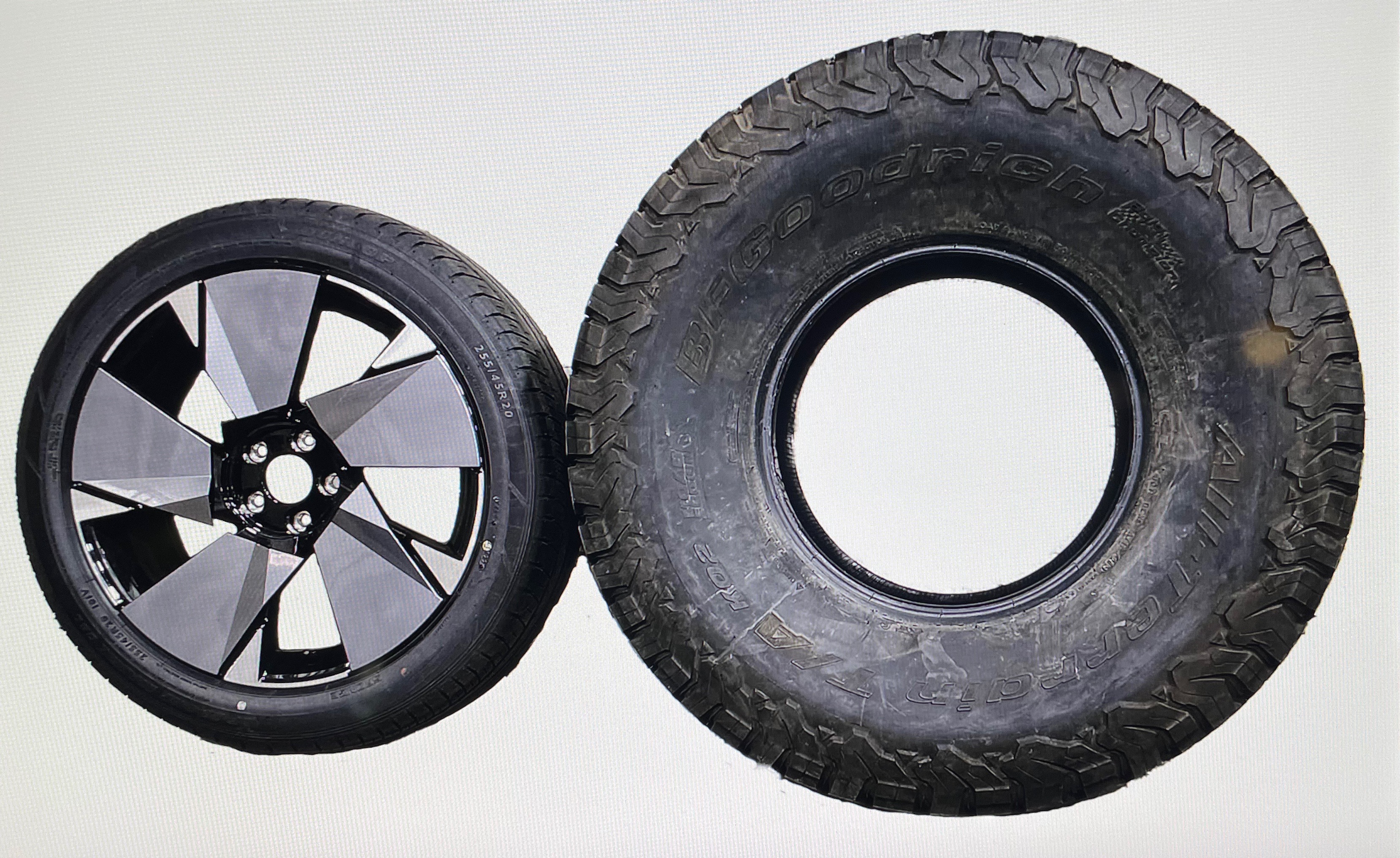
Image from Arctic Trucks.
“These colossal tires,” Buchholz says, “rolled at 4 psi to handle the Arctic’s snow-covered boulder fields and slick ice.”
Two additional Arctic Trucks Ford F-350 AT44s supported the Ramsey Nissan in the Arctic; two Toyota Hilux 4×4 AT44s supported them in the Antarctic.
BYO Charge. Buchholz notes, “With charging stations non-existent in the polar regions, the Ramseys relied on prototype mobile charging systems: a 5 kW wind turbine that powered a petrol generator in the Arctic, and solar panels to supply generator power in Antarctica. ‘When we had good sun for the solar panels, we used about a third less of the fuel than if we were just running the generator,’ Chris Ramsey said.”
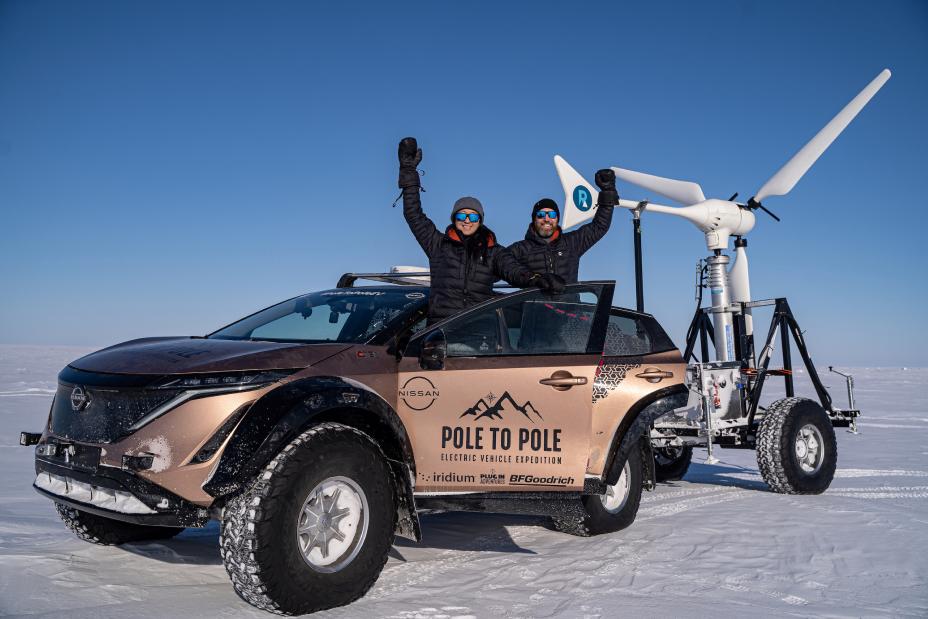
Arctic Starting Point, Then.… The Ramseys chose an historic 1823 Magnetic North locale on the frozen Arctic Ocean for their starting point. It’s about 20 miles north of King William Island’s northern tip in Canada’s Nunavut.
Their U.S. portion ambled as far east as South Carolina then back along the West Coast and across to Austin, Texas, and south into Mexico. They traveled through Central America, but swapped the Darian Gap for a boat trip from Panama to Columbia.
The expedition traveled along South America’s West Coast ending with another boat trip to Antartica and its geographic South Pole. See Pole to Pole for a neat graphic of their route.

Driving Range. Buchholz reports, “While Ariya’s driving range can reach 304 miles (489 km) when equipped with e-4ORCE all-wheel drive and the 87-kWh battery system, the driving range… was roughly halved (to about 150 miles, or 241 km) in the Arctic, and sometimes dropped as low as 62 miles (100 km), according to the Ramseys. “The terrain is very variable,” Julie Ramsey said. “It can change from hour-to-hour, so that also has a big impact on the car’s range capability.”
Public Charging. Buchholz observes, “In addition to using experimental hybrid charging systems at the Poles, the Ramseys primarily relied on public charging station in the 14 countries the expedition passed through. The Ramseys were stymied by the unreliability of many public charging stations in the U.S. ‘What let us down was the infrastructure to charge the car. That part needs improvement, but the car performed amazingly,’ Julie Ramsey said.”

Ultra-cold Charging. Buchholz notes, “For Nissan, the official car partner of the Pole-to-Pole trip, the successful expedition brings additional confidence to Ariya’s capabilities and its innovative technologies, which include a dedicated battery heater to prepare the Li-ion battery system for charging.”
Good for the Ramseys. And they’ve certainly earned a reputation of the Plug-in Adventurers. ds
© Dennis Simanaitis, SimanaitisSays.com, 2024
 Simanaitis Says
So, without the petrol generator to charge the battery it wouldn’t have been possible.
Note, the generator was used only in the Arctic and Antarctic regions where no charging stations were available. Also, as noted, the wind and solar support reduced the amount of gasoline needed to fuel the generator.
I looked at the whole trek from north to south poles and was quite impressed with the whole journey.
Starting from the magnetic North Pole location and obviously driving cross country on the tundra until they hit a highway around Yellowknife made sense. Then they followed highways from Yellowknife down to near Edmonton, but suddenly at Rivière Qui Barre, northwest of the city, the route line veers off the roads and cuts a cross country path through farms, houses and even a warehouse, and crossing several deep ravines and the North Saskatchewan River, rejoining a major highway south of Leduc, a southern suburb of Edmonton. I found this amusing as this certainly would not have happened.
Loss of range under cold weather is still a major concern. This is probably due to multiple factors, including continuous heating to maintain battery performance and heating for occupants.
Electric cars as urban transportation for those who can charge at both home and/or work is probably where this mode will work best. Issues like lack of home charging ability (think of people who have no off-street parking), long distance travel and very cold conditions may favour hybrid, fuel cell or possibly even hydrogen combustion.
How much easier it would have been to use a petrol or diesel car and just take enough petrol with you.
They could have taken enough electricity along with them by towing a massive trailer packed with batteries. The petrol or diesel cars would have required a tanker truck, or trailer full of gerrycans accompany them to provide the fuel supply. I think that the solar/wind solution was more elegant in the regions that are so remote that any conventional fuel source (petrol or electricity) supplies are non-existent.
And the exercise was to test electrical transportation over a long distance.