
Simanaitis Says
On cars, old, new and future; science & technology; vintage airplanes, computer flight simulation of them; Sherlockiana; our English language; travel; and other stuff
RPI BEATS WPI—QUANTUM-WISE!
BACK IN MY DAY, WORCESTER POLY always scheduled its homecoming weekend for when it played Rensselaer Polytechnic Institute—because a victory was all but assured. However, I must report that RPI beat WPI fair and square this time in being the first university with an on-campus quantum computer. Not just a “proof-of-concept” device, but a production IBM System One.
Here are tidbits on that football rivalry and this quantum-computing achievement. And who would have guessed these two topics appearing in the same sentence?


RPI/WPI Football Rivalry. Wikipedia gives details of this pigskin rivalry stretching back to 1894, “making it one of the oldest rivalries in college football history. The series was played uninterrupted from 1947 until 2020, when it was interrupted by the COVID-19 pandemic.”
That first meeting, November 3, 1894, resulted in a WPI victory, 4–0. (A field goal and a safety? Wikipedia doesn’t say.) By contrast, over the years there have been some real routs, typically with WPI on the losing side: for example, 1922-1924’s RPI 59–0, RPI 27–0, and RPI 33–0.
WPI had a winning streak 1934–1938: WPI 32–6, 7–0, 25–0, 14–0, and 14–7. The two teams tied in 1939, 7–7. RPI had a 9-to-4 edge on victories 1940–1952; and they tied again in 1953, 12–12.
WPI’s Glory Streak. The years 1954–1965 were all WPI’s, including interspersed routs of 45–0, 21–0, 20–0, 40–0, 40–0, 31–0, and 13–0.
Overall. There was a cliff-hanger in 2007, RPI winning 21–14 in Overtime. Overall, RPI leads the series, 63–48–5. The record rout was RPI’s 59–0 in 1922. The longest winning streak was WPI’s 15 years, 1951–1965.
I confess I had other things on my mind during my WPI attendance 1961–1965. But I probably bent a few with colleagues during the last four years of the streak.
Quantum Computing. SimanaitisSays had a “Quantum Computer Update” ’way back in 2016: To cite, “Specialists figure that a 50-qubit device will achieved ‘quantum supremacy,’ a term denoting its doing something beyond the capability of conventional digital technology.”

Enter the IBM System One. Keumars Afifi-Sabet writes in LiveScience, April 5, 2024: “The Rensselaer Polytechnic Institute (RPI) in Troy, New York, has unveiled a new campus-based quantum computer that can be used for scientific discovery — rather than one that’s just used to run proof-of-concept trials.”
“The new IBM System One quantum computer,” Afifi-Sabet says, “is powered by a processor called ‘Eagle’ that has 127 quantum bits, or qubits, IBM representatives said April 5 in a statement. This quantum processing unit (QPU) was first announced in 2021 and debuted in a System One machine in November last year that is used by the University of Tokyo. This quantum computer is not based on campus.”
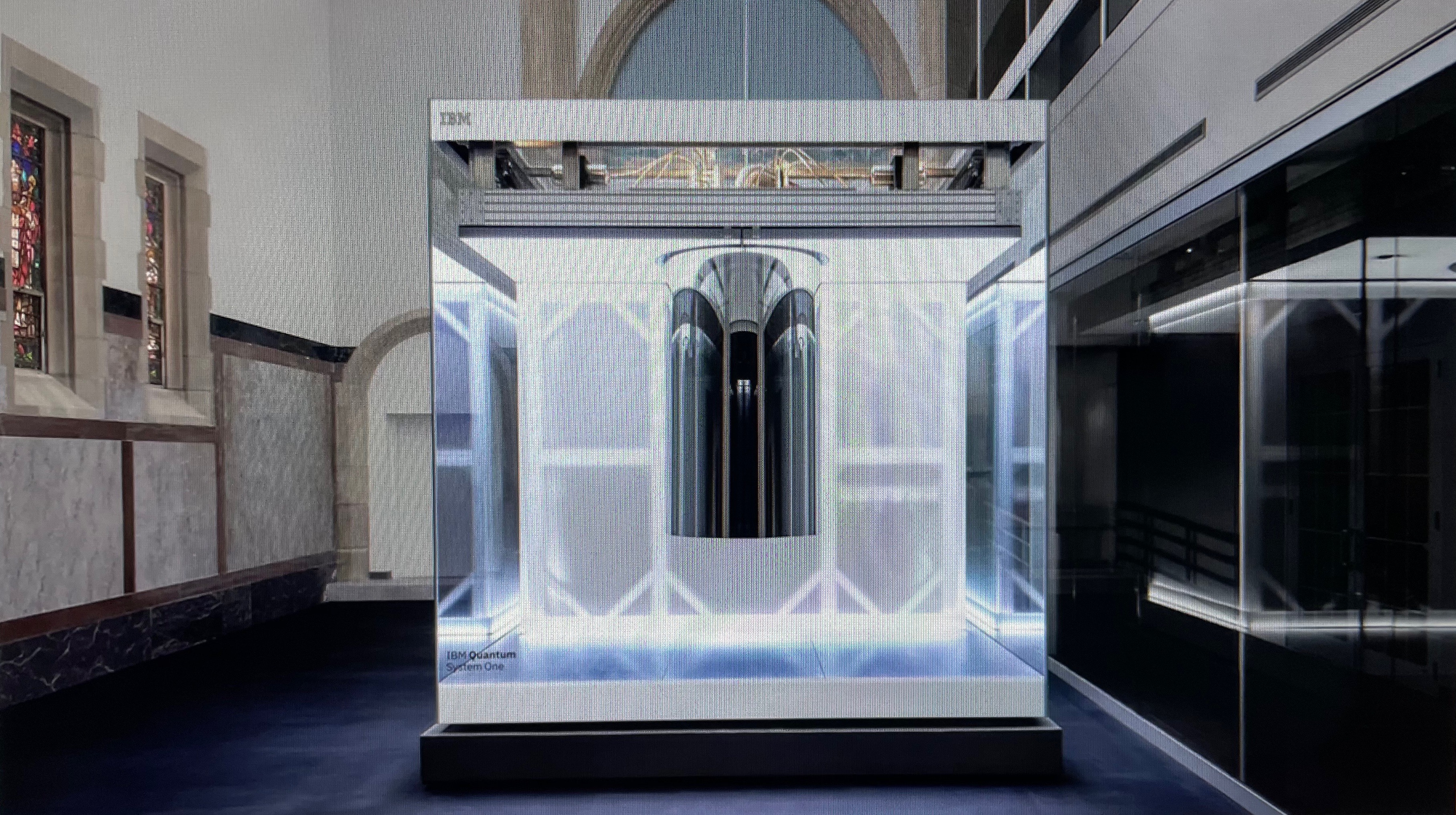
The IBM System One is described as a “utility-scale” machine. Image from IBM via LiveScience.
Afifi-Sabet quotes Jamie Garcia, technical program director for algorithms & partnerships at IBM Quantum: “When we describe ‘utility-scale,’ we’re specifically referring to how quantum computers can now serve as scientific tools to explore new classes of problems in chemistry, physics, materials, and other fields that are beyond the reach of brute-force classical computing techniques.”
“Put simply,” Garcia says, “quantum computers are now better at running quantum circuits than a classical supercomputer is at simulating them. This means, for the first time in history, quantum computers can be used as a computational tool for scientific exploration.”
Bringing WPI back into the picture, I recall days of its IBM 1620 and our carrying stacks of punch cards to M.I.T. for time-sharing with its state-of-the-art machine. And, by the way, I congratulate RPI on this victory. ds
© Dennis Simanaitis, SimanaitisSays.com, 2024
 Simanaitis Says
Talking about punch cards reminds me of engineering grad school. We were able to use the private terminal of an associated research group that was denied access for other students. It consisted of a punch card reader, console and line printer, connected to a CDC Cyber machine elsewhere on campus.
The procedure was to put the cards in the input bin on the card reader, make sure that the counter weight was down on the output bin, hit start on the reader and then go over to the console and punch in a few commands, then head over to the printer. Usually the printer was already spitting out output by the time that you walked over there (the Cyber was a pretty fast machine in the day). Common courtesy was to make sure that the counter weight was down after removing your card deck.
One time I was in there, followed shortly after by a couple of other people. When the second person put his cards in the machine and hit start (my back was turned focused on the printer) I heard a “trrrrrr” sound and turned around to see this rooster tail of cards flying across the room.
We quickly learned to make sure that the counter weight was down when we started a deck, made sure that the counter weight was down when we left, and to number the cards (columns 72-80) so that we could sort them back into the correct order should we fall victim to the rooster tail event or even an accidentally dropped deck.