
Simanaitis Says
On cars, old, new and future; science & technology; vintage airplanes, computer flight simulation of them; Sherlockiana; our English language; travel; and other stuff
A.I. DOOMERISM? PART 2
YESTERDAY, we learned about aspects of Artificial Intelligence, both good and bad, described in Paul Taylor’s LRB review of two books on the subject.
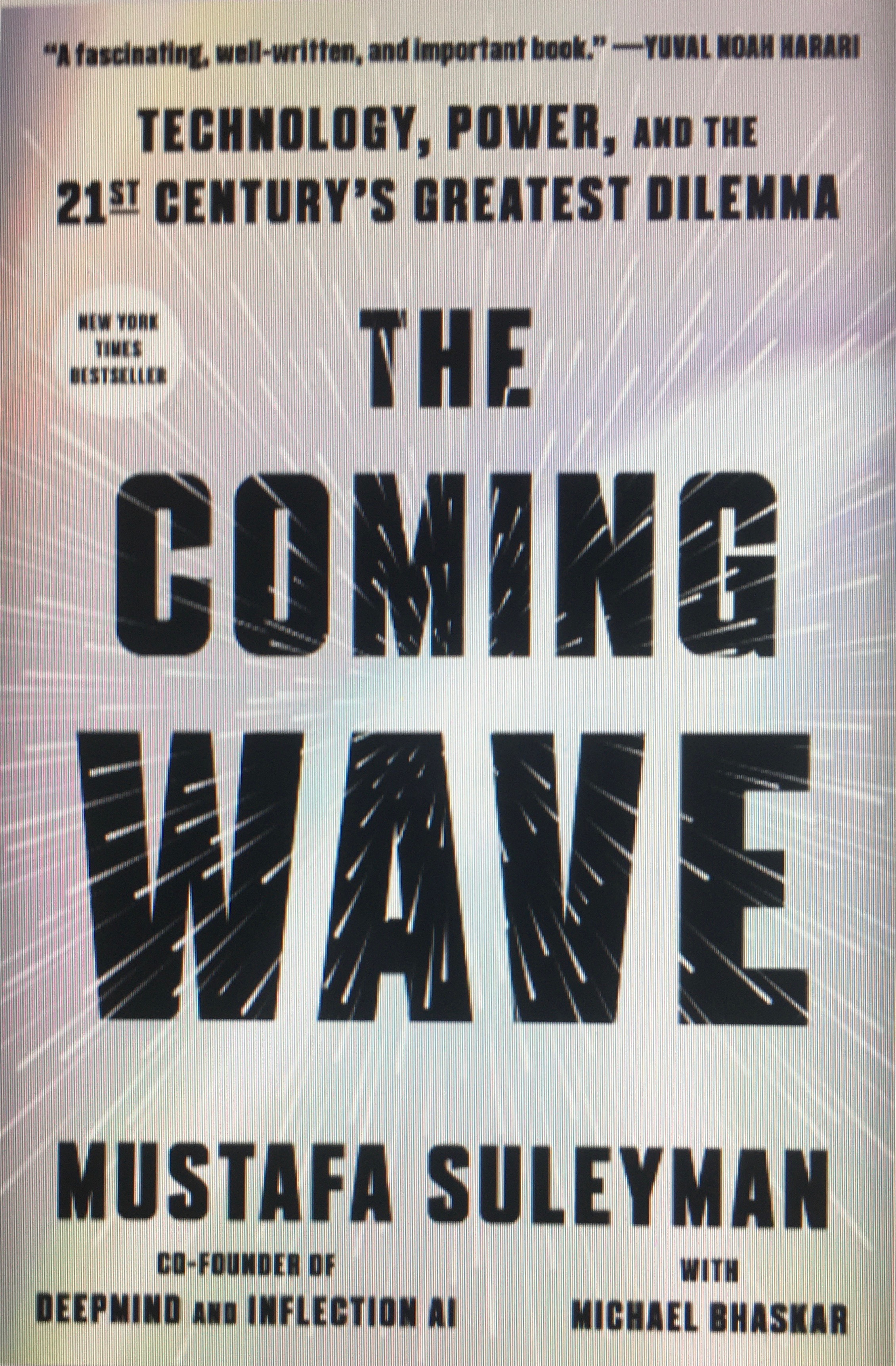
The Coming Wave: Technology, Power, and the 21st Century’s Greatest Dilemma, by Mustafa Suleyman with Michael Bhaskar, Crown, 2023.

The Worlds I See: Curiosity, Exploration, and Discovery at the Dawn of AI, by Fei-Fei Li, Flatiron Books, 2023.
Today in Part 2, Taylor addresses generative A.I., up-scaling, and whether—if ever—A.I. will achieve human-like consciousness.
Generative A.I. Taylor writes, “We talk more often now about ‘generative A.I.’ in which, instead of training a model that, given an image, will predict a label, you train one that can generate new images. A discriminative model must learn the features associated with a label, but a generative model must learn every possible way in which images in the class can vary. This means it requires an even larger and more diverse dataset and a correspondingly vast amount of processing power.”
The goal is for the A.I. to perform “new tasks without any additional training.” I wish I knew more about who or what decides whether these tasks are beneficial to humanity ( and not just the A.I.).
Scaling Up. “One estimate from January 2023,” Taylor cites, “suggested that it costs around $300 million to train a trillion-parameter model, but that one with 10 trillion parameters would cost something like $30 billion, running on a million GPUs for two years and requiring more electricity than a nuclear reactor generates.”
To Human Neural Network Size? Taylor describes, “The human brain contains around 100 billion neurons, each with up to 10,000 synaptic connections, making it potentially a quadrillion-parameter network. So the idea that scale is a necessary condition for consciousness is natural. But this line of thinking could be plain wrong.”
More or Less Human Employment? Taylor says, “A key question for all of us is whether A.I. is used to augment the capacities of existing workers, making them more productive and generating new economic activity, or used to automate that work, making workers redundant.” He cites one researcher calling a preference for automation the ‘Turing Trap’ and notes that automation leads to short-term benefits for business leaders and is perversely incentivised by governments that tax labour at higher rates than capital investment.”
A Dour Prediction. What’s more, “A PwC survey of 4702 CEOs in 105 countries, unveiled at Davos in January, found that 25 per cent of them expected their adoption of A.I. would allow them to make significant job cuts this year. It’s hard to know how far or how quickly A.I. will have an impact on employment, but the widespread conviction that the technology will create as many jobs as it destroys isn’t a given.”
Conclusion. Taylor is in academic life, and notes that while universities can’t compete with industry processing power, they “still encourage a wider range of inquiry than corporate labs, and allow academics some freedom to follow their interests—at least if they are the sort of academic who wins grants and attracts students.”
“I only wish,” he says, “I had a clearer idea about how we should be educating the young people who come to us, now that so many of the skills we teach are susceptible to automation.”
Thus, the two books Taylor reviewed having “Curiosity” and “Dilemma” in their titles. ds
© Dennis Simanaitis, SimanaitisSays.com, 2024
 Simanaitis Says
Another good and timely overview from Monsignor Simanaitis.
But continued perspective might suggest, and reassure the thinking — surely those here gathered at this marvelous site — that A.I. be much ado ’bout relatively little. Pixels is pixels, and A.I. still garbage in, garbage out. It’s but a tool already, hardly a self-aware entity like we allegedly are.
But then John Cleese, remarking last month on so much of the US’s adherence to Bratman, aka Orange Julius, observed “35-40 Americans are morons.”
Hope all enjoyed the eclipse, much as possible.
I suspect that the most functional use of AI, will be as task specific tools, such as medical scan interpretation, etc. where the data educated into the system can be curated rather than just mass dumped. The end result would be a tool to assist the medical professional make a better assessment. The money savings would come from earlier and better detection not cheaping out on professionals.
I know from my own experience as a structural engineer that there were management types who felt that they could replace engineers with structural software, just using technicians (2 years of college versus 4 years of university). In reality the software was sufficiently complex to use that even junior engineers were frequently misusing it. Only engineering experience enabled proper use of the software. AI tools could improve the software, perhaps helping to avoid errors from bad inputs/modelling, but ultimately the correct use of the software still requires understanding what the software is doing, and why results may be telling you something other than the ‘final’ design.
Reminds me of an apocryphal story about an engineer who retired after keeping a plant running efficiently for years. Shortly after he retired, the equipment broke down and the plant maintenance people couldn’t get it running again. So they called him to come back and take a look. He came, spent about an hour looking at several things and finally marked an ‘x’ on the casing at a certain spot and said replace a certain part inside. Sure enough that fixed it. He sent an invoice for $50,001 for his services and was challenged by the accountant to justify his bill. He responded, ‘x’ mark on the machine $1, knowing where to put it, $50,000. They paid his bill.
Good one, and not at all unsure the story apocryphal. A famed automotive engineer, don’t think it was Charles “Boss” Kettering, turned in a bill including the weekend. When asked to explain, he replied, “I was thinking.” And they paid him for his “off” days, too.