
Simanaitis Says
On cars, old, new and future; science & technology; vintage airplanes, computer flight simulation of them; Sherlockiana; our English language; travel; and other stuff
LOTUS SPORTS AND 26 YEARS LATER PART 1
“AN IMPRACTICAL, HIGHLY DESIRABLE COMBINATION,” R&T wrote in September 1957. And October 1983’s Peter Egan wrote about “Crate Expectations.” Curiously these were very similar cars: The 1957 Lotus Sports was the less expensive sibling to the Coventry-Climax Lotus 11. The 1983 Westfield was a DIY project assembled by Peter and friends in the R&T garage. Here in Parts 1 and 2 today and tomorrow are tidbits gleaned from these two articles.
The Lotus Sports. September 1983 R&T described the “Sports (‘Club Sports’ is not correct) is very similar to the famous 11 model except for the British Ford engine, three speed transmission, solid rear axle and drum brakes. The multi-tube frame and low-pivot i.f.s. are used, and the body panels appear to be of identical contour.”
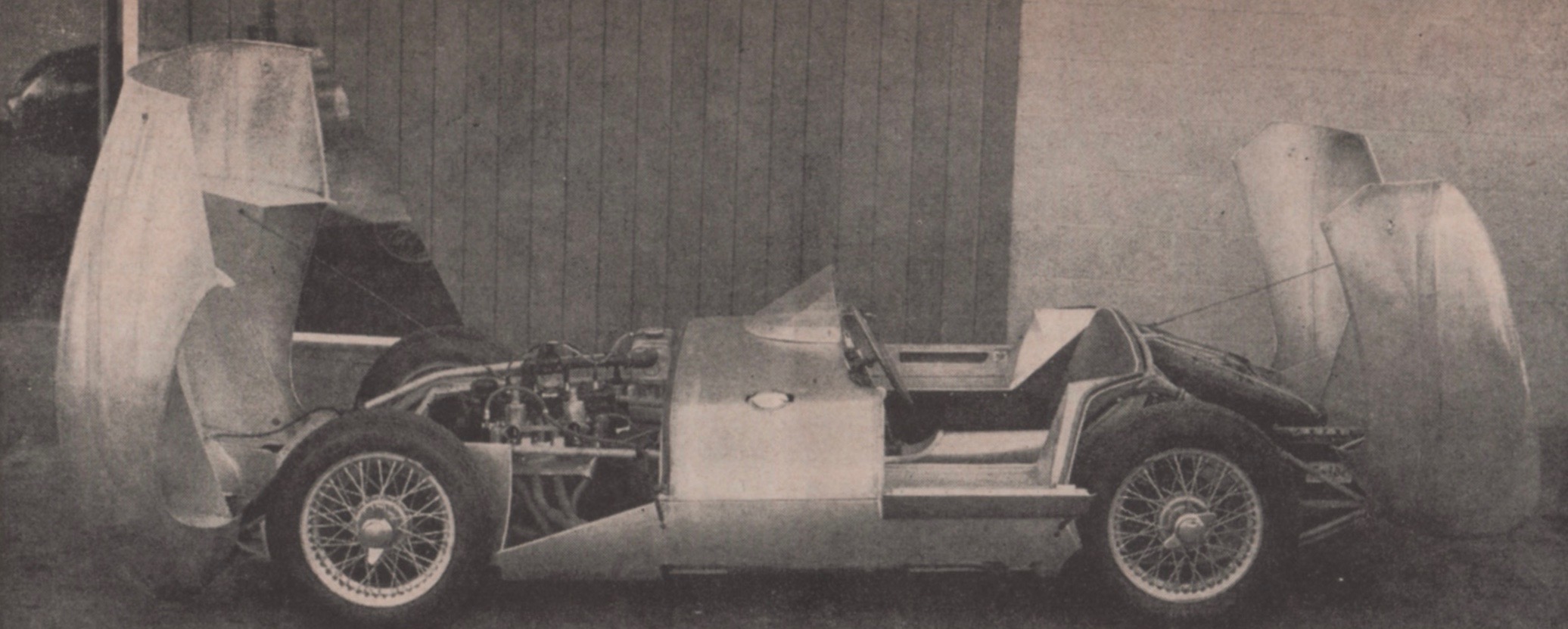
This and other images from R&T September 1957.
Its Cockpit. “The seating position,” R&T said, “feels just right. In the cockpit area there is a good feeling of neat, functional aluminum—comfortable but hardly luxurious. All the controls work smoothly and easily, and the shift pattern is standard.

R&T noted, “Expanse of sheet metal in front of passenger will make the Lotus popular in drive-in restaurants.” Provided, of course, your burger isn’t that heavy….
R&T’s Sainted Tapley Meter in Use. R&T observed, “In starting off, the high first gear (9.87:1 overall) is noticeable for the first few feet, and for an instant one wonders whether this might not be second gear. But from 5 mph upwards, the surge of power is very good indeed; the Tapley meter swings over to 510 lb/ton and 30 mph comes up in under 5 seconds, even after the initial hesitation.”
Measuring Drag. R&T recounted, “… this car showed—after numerous tests in both directions—a total wind and rolling resistance of only 55 lb at 60 mph, as compared to 68 lb for our Lotus 11 test. From this we can calculate that the Sports model, with racing screen and two persons up, can hold 60 mph with only 9 bhp required at the flywheel.”
A Steering Too Quick? “Up to 70 mph or so,” R&T said, “the steering feels wonderful. With 1.5 turns and a 42-foot turning circle, the overall steering ratio isn’t terribly quick. Nevertheless, at 90 mph the car suddenly seems to get as nervous as a wild horse, and frankly it was rather frightening. Experienced Lotus drivers say you get used to this, but for most tastes a slower gear and smaller turning circle would be preferable.”
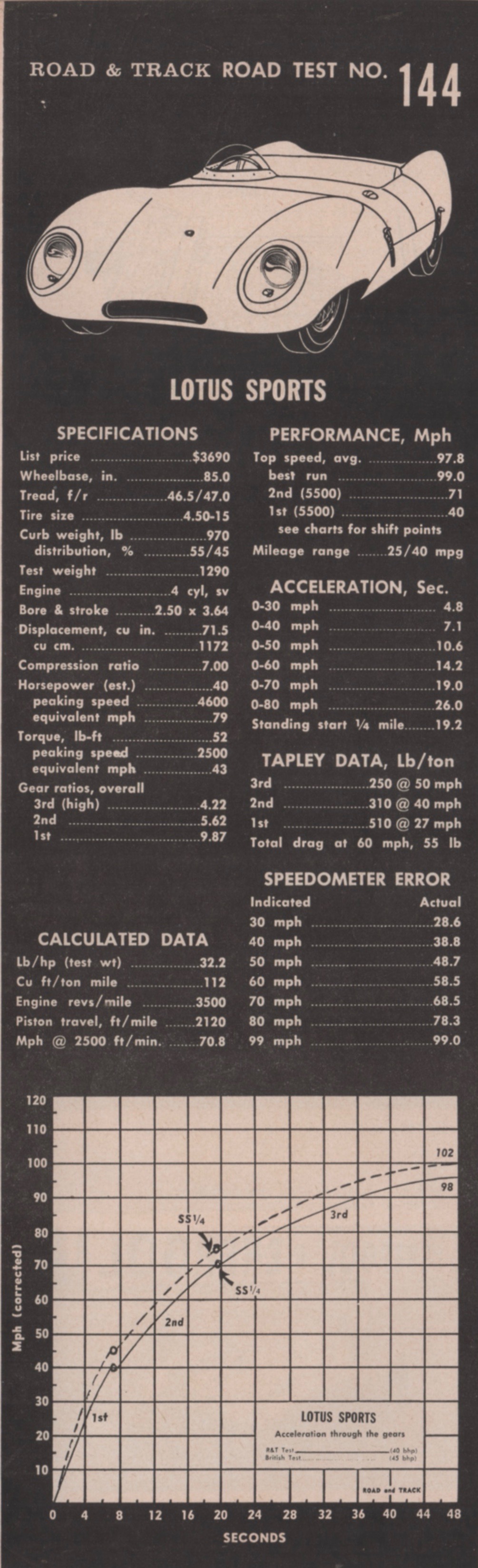
More Power Available. “In order to show the range of performance which can be expected from a modified Lotus Sports,” R&T recounted, “we have plotted the results of a British test in dotted lines against our usual acceleration graph. However, the overseas car carried a test weight approximately 200 lb below our figure, and the engine had quite a few internal modifications, including higher compression ratio, polished ports and oversize valves…. Accordingly, we have estimated that our car had about 40 bhp as compared to 45 or so for the more modified machine.”

However…. “In short,” R&T said, “and with only one or two complaints, we liked the Lotus Sports very much indeed. But now we must register what may sound very much like a sermon—and it is. Here is a car for which we can discover no useful purpose whatsoever!”
“So,” R&T conjectured, “we add the windshield, top and side curtains [What’s a side curtain, Grandpa?], securing thereby a very fine and unique dual-purpose car? Almost, but wait.”
“In the first place, the price is $1500 more than the Ford-10-powered Morgan 4/4, although the Lotus weighs 580 lb less. But, more importantly, the Lotus has so little ground clearance that anything larger than a pebble on the street will rake the belly pan from stem to stern. Enclosed front wheels would make parking a matter of finding a space vacated by a Chrysler Imperial, and what American bumpers would do to that beautiful but unprotected aluminum would be sheer slaughter.” Plus, R&T deemed it not particularly competitive in its racing class.
Gee, what kinda nut would want a car like this? Tomorrow in Part 2 we find such an enthusiast. (Hint: His initials are P.E.) ds
© Dennis Simanaitis, SimanaitisSays.com, 2024
 Simanaitis Says