
Simanaitis Says
On cars, old, new and future; science & technology; vintage airplanes, computer flight simulation of them; Sherlockiana; our English language; travel; and other stuff
POM’S ANALYSIS OF THE 1951 FERRARI 4 1/2-LITRE GRAND PRIX CAR PART 2
YESTERDAY I MARVELED AT Laurence Pomeroy’s untranslated Latin in The Grand Prix Car Volume Two. It’s always refreshing to read someone who assumes you’re smarter than you are (because it challenges you to become so). In any case, here in Part 2 Pom continues with his erudite analysis of the Ferrari 4 1/2-Litre Grand Prix car.
Steeply Domed Pistons. Pom writes, “The light alloy pistons are steeply domed and provide choices of compression ratio lying between 11 and 14.5:1….” This seems high, but a couple paragraphs later he notes, “An alcohol-benzol blend fuel is fed into the float chambers….” Unlike today, Grand Prix fuels were allowed to be exotic blends.
Power Output. “On the prototype,” Pom recounted, “a single sparking plug was used with provision for 40 degrees of advance, and the maximum engine power was approximately 330 hp. at 6,500 r.p.m., equal to 3,160 ft/min. During 1951 the works cars appeared with two sparking plugs per cylinder, and in this form 380 hp. was given at 7,500 r.p.m., which is the equivalent of 147 lb. sq. in. b.m.e.p. at 3,660 ft./min.”
Getting to the Rear Wheels. Pom captioned a fine L.C. Cresswell illustration: “The final drive on the Ferrari is by means of spur gears, the right angle drive being placed beneath the centre line of the half-shafts so that the gearbox and propeller shaft can conveniently be placed below the driver’s seat.”

Aft details. This and following images by L.C. Cresswell from The Grand Prix Car Volume Two.
Performance Capabilities. “Both the spur box and gearbox proper are split lengthwise on their centre line and a very wide range of final and indirect gear ratios can be provided. A typical set gives an overall engine:road wheel relationship of 3.9, 4.55, 5.6, and 9.2:1 and with the normally used 7.50 by 17 rear tyres there are resultant road speeds at 7,500 r.p.m. of 173, 148, 120 and 73 m.p.h.”
One of Pom’s calculations, the Ferrari’s top speed, was verified in Daytona Speed Week 1956.
By the way, today’s F1 tires, Pirelli the sole supplier, are 305/720-18 front and 405/720/18 rear. That is, they’re a little taller and vastly wider than the Ferrari’s 7.50 x 17s. (7.5 in. is only 190 mm verses today’s 405 mm.)
Suspension. Pom describes, “The Ferrari de Dion tube is typical of the efforts which are made to keep the weight of the car down [“All-Up Starting Line Weight.—20.75 cwt.”], for it has a wall thickness of only 2 mm. and a diameter of only 2.36 in. The suspension is, somewhat surprisingly, effected by a single transverse leaf.” (Its right-hand tip can be seen connected near the lower right track rod.)
“The front suspension,” Pom wrote for another Cresswell illustration, “is of two unequal-length wishbones, a single transverse leaf spring being connected to the top arm by a link (as shown here) on earlier models and directly to the lower arm on the latest types.”
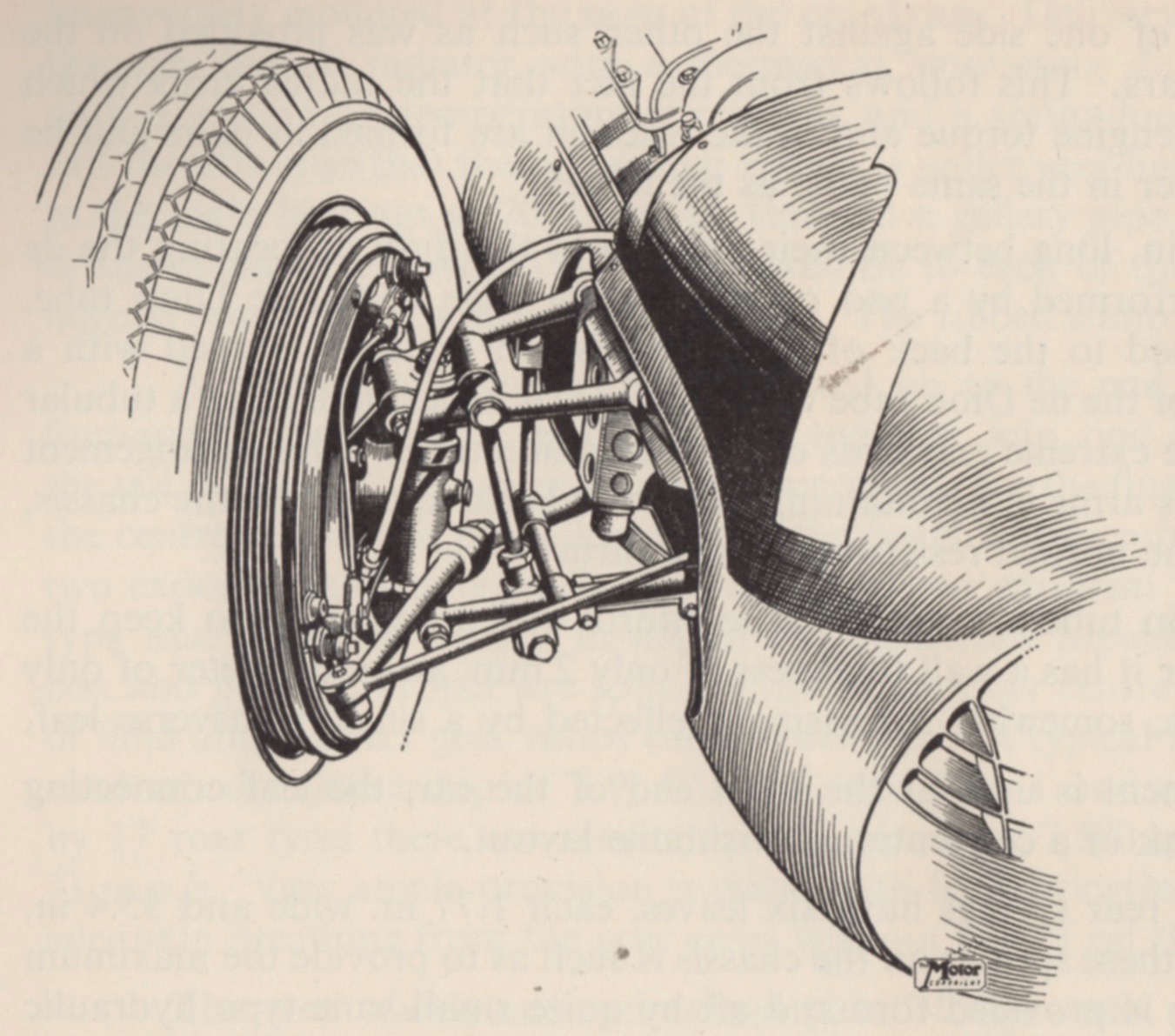
“The drawing,” Pom noted, “shows the considerable offset of the brake drum and king-pin in relation to the tyre centre [‘so that maximum air circulation can be provided around the periphery of the drum’] and the forward mounting of the three-piece trackrod system.”
Pom’s Overall Assessment: “The 4 1/2-litre Ferrari is a very handsome-looking car, the front end of which has a very over-shot appearance, the tail as short as possible, consistent with the provision of 45 gallons of fuel.…” Today’s F1 cars carry a maximum of 110 kg of fuel in their flexible-bladder tanks; figure around 38.5 gallons U.S.
He continued, “For the Indianapolis race of 1952 [four cars were sent, Alberto Ascari’s qualified 19th, he dropped from 9th on lap 25] and for the relatively few Formula I and formule libre races for which the works cars entered a car in 1952 and 1953 [during those years Grands Prix were contested by Formula II cars], modifications were made to the engine, the frame and the general appearance.”

Pom notes that the car depicted in this cutaway is in 1951 configuration, though modified with Girling brakes.
A Personal Note. I almost met Carroll Shelby in 1956 at the Giants Despair hillclimb where he broke “the magic minute” in John Edgar’s 4 1/2-Liter Grand Prix car.
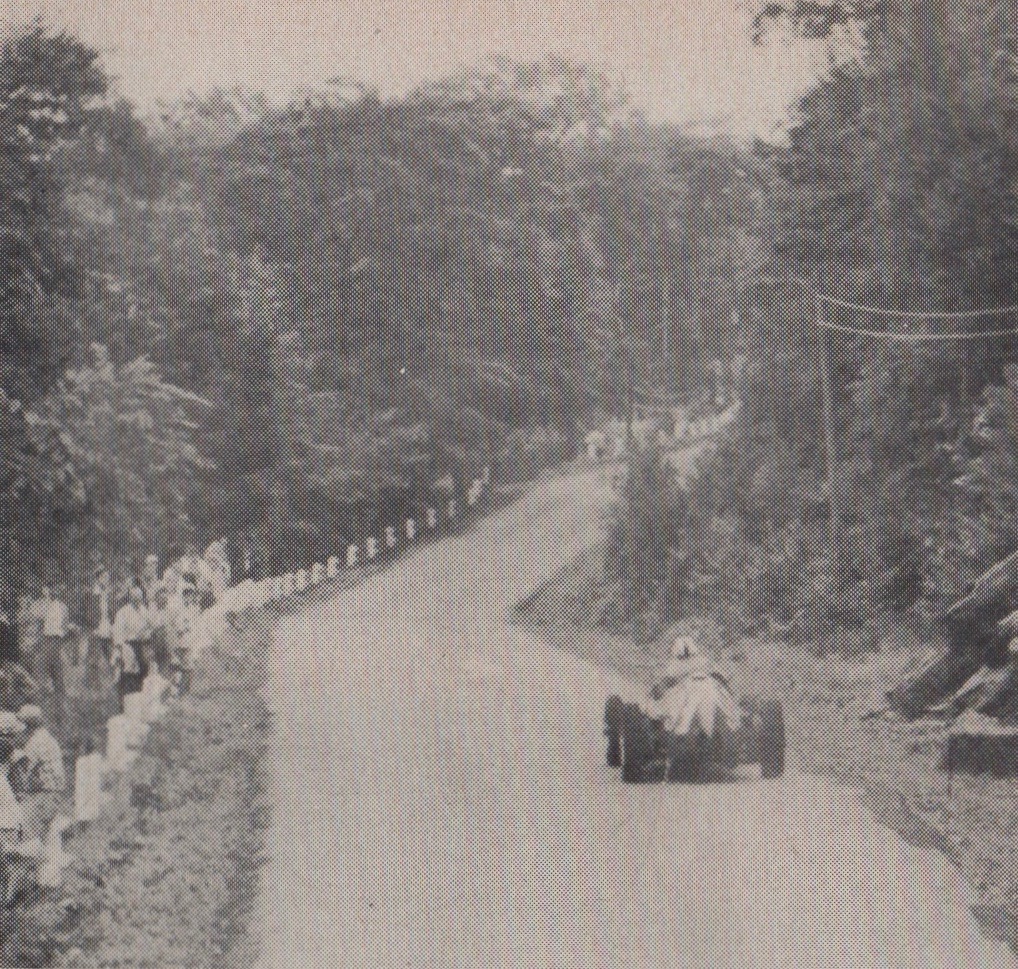
Image from R&T, October 1956.
At the time, it was the closest I had ever come to a Grand Prix car. Who would have dreamt that I would ever drive one? Ditat Deus! ds
© Dennis Simanaitis, SimanaitisSays.com, 2024
 Simanaitis Says
I should like some of those “s p a r k l i n g” plugs, 4th line under Power Output above.
Faith and begorrah, no snakes in the above; drum brakes held sway ’til ’55, ’59 for Ferrari, and the above’s suspension akin to a ’48 FoMoCo product.
Alfa Romeo straight eight still dominated through 1951, Mercedes fielded a straight eight 1954-55, ’20s through early ’50s GP cars somehow more interesting to some of us than today’s ground effect, wide-tired techmobiles.
Happy St. Patrick’s Day.
Thanks for the correction, Mike. And please pass more of that Asti Spumante.