
Simanaitis Says
On cars, old, new and future; science & technology; vintage airplanes, computer flight simulation of them; Sherlockiana; our English language; travel; and other stuff
DECIMAL SEPARATOR TIDBITS
“THE DECIMAL POINT,” REPORTS SMITHSONIAN MAGAZINE, February 29, 2024, “is 150 Years Older Than Previously Thought, Medieval Manuscript Reveals.” Sarah Kuta writes, “A Venetian merchant used the mathematical symbol while calculating the positions of planets between 1441 and 1450.”
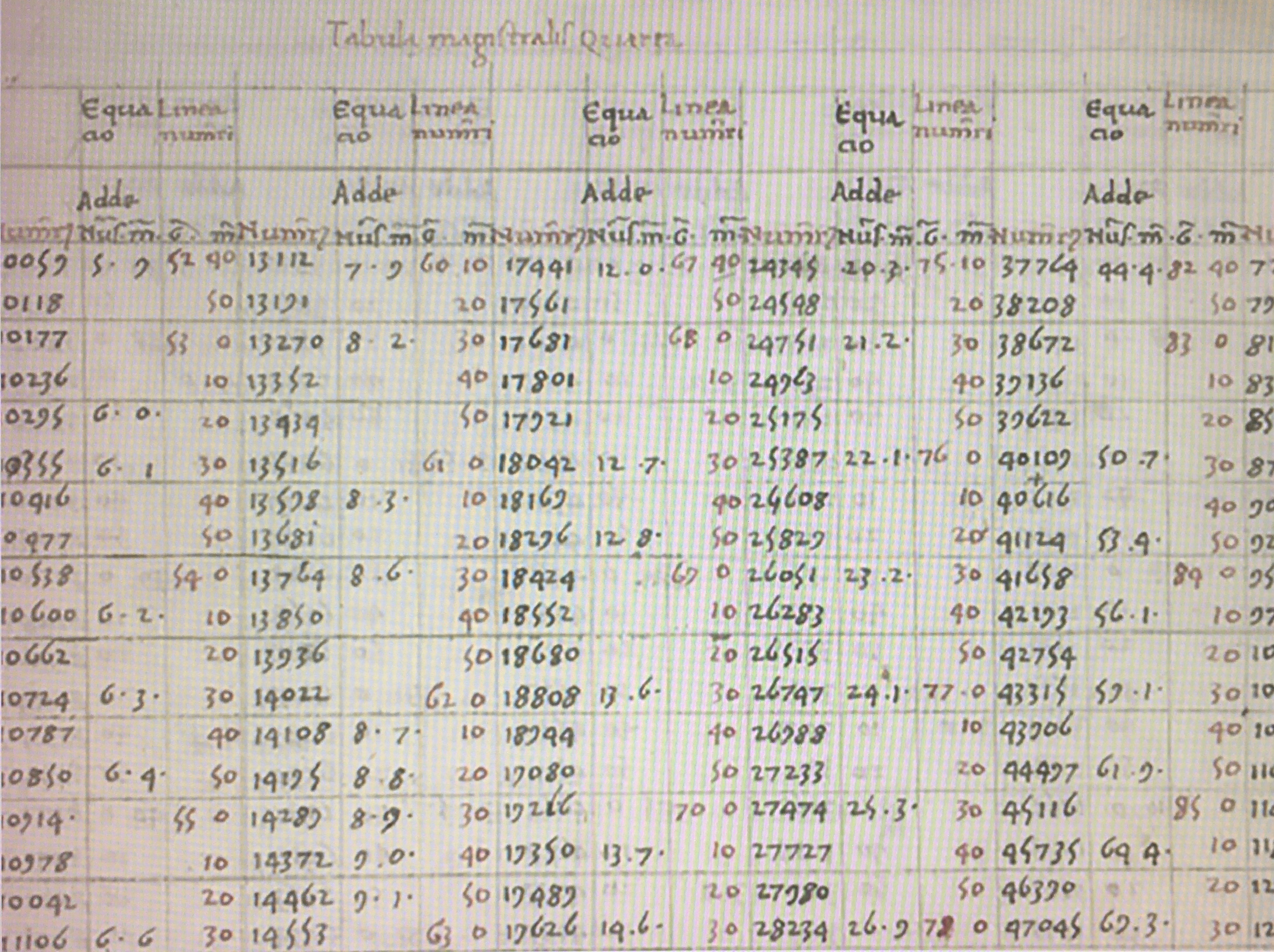
Math historian Glen Van Brummelen came across decimal points in Giovanni Bianchini’s manuscript, Tabulae primi mobilis B. Image by Van Brummelen/Historica Mathematica, 2024, from Smithsonian.
Previously, the German mathematician Christopher Clavius got credit for using them in astronomical writing in 1593. And, in fact, the concept of numerical separators is more complex than this. Here are tidbits collected from a variety of sources about how we denote numbers both large and small. Curiously, much of this concerns differences still existing from place to place around the world.
Europe’s Pre-Arabic Numbers. As late as the 12th century, Europe used Roman numerals, essentially a base-5 system. Which reminds me of a Frank Muir/Denis Norden bit: “Roman soldiers: Count off from the left!!” To which they respond, “Eye, Eye Eye, Eye Eye Eye, Eye Vee, Vee, Vee Eye,…”
Which, by the way, shows a rule of Roman numeration: never repeat more than three characters in a row. That is, IV, not IIII. Of which more anon.
Thank You, Fibonacci. Arithmetic was a bothersome activity indeed until Italian Leonardo Pisano aka Fibonacci (1170-1240) borrowed base-10 Arabic numerals 1, 2, 3, …9, 10, 11, … etc. He found them, notes Britannica, especially in the writings of Middle Eastern mathematicians al-Khwarizmi and al-Kindi. We got the word “algorithm” from this first guy and “algebra” from one of his books, Kitab al-Mukhtasar fi hisab al-Jabr wal-muqabala.
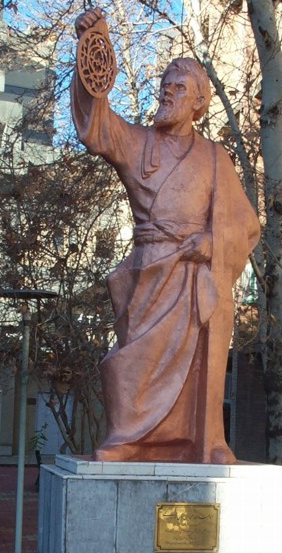
Muhammad ibn Mūsā al-Khwārizmī, c. 780 – c. 850, Persian polymath. He produced influential works in mathematics, astronomy, and geography. His statue with astrolabe is at Amir Kabir University, Tehran, Iran.
But What About Large Numbers? As numbers increase, the Roman scheme denotes them with different symbols, but only up to a point: I (the basic unit), V (the basic 5), then X (10), L (50), C (100), D (500), and M (1000). Curiously, because of the rule limiting repetition, the largest Roman numeral is MMMCMXCIX, 3999.
No big deal, as long as I can count movie years, preferably from the 1930s.
With our base-10 Arabic numerals, it’s easy to go high. Just keep added places. But really huge numbers are a pain: 13827467563820. Uh… As described in Wikipedia, various readability schemes have been—and still are—employed.
The Space, the Period, the Comma. Wikipedia notes that a space is the internationally recommended separator of thousands: 12 345. The comma is used in most English-speaking countries: 12,345. The period (aka full stop) is used in many non-English countries: 12.345. And, in special cases such as years, the digits alone suffice: 1932.
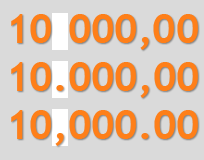
Image by Inteloutside2 from Wikipedia.
All bets are off in computer programming languages: Wikipedia observes, “Julia, Swift, Java and free-form Fortran 90 use the underscore (_) character for this purpose; as such, these languages allow seven hundred million to be entered as 700_000_000. Fixed-form Fortran ignores whitespace (in all contexts), so 700 000 000 has always been accepted. Fortran 90 and its successors allow (ignored) underscores in numbers in free-form. C++14, Rebol, and Red all allow the use of an apostrophe for digit grouping, so 700’000’000 is permissible.”
What About Fractional Parts? The choice of thousands separator has effect on fractional notation as well. English-speaking countries (having already taken commas for thousands separation) use the period for fractional notation: 2.3 for “two and three tenths.” The rest of the world (having already used the period for thousands) use the comma for fractional notation: our 2.3 would be rendered 2,3.

Image by Sauer202 from Wikipedia.
There has been a lot of international crossing-dressing of commas and full stops: “In the nations of the British Empire (and, later, the Commonwealth of Nations), the full stop could be used in typewritten material and its use was not banned, although the interpunct (a.k.a. decimal point, point or mid dot) was preferred as a decimal separator, in printing technologies that could accommodate it, e.g. 99·95.”
Also, “During the beginning of British metrication in the late 1960s and with impending currency decimalisation, there was some debate in the United Kingdom as to whether the decimal comma or decimal point should be preferred: the British Standards Institution and some sectors of industry advocated the comma and the Decimal Currency Board advocated for the point. In the event, the point was chosen by the Ministry of Technology in 1968.”
By the way, lots of software is bilingual in this respect: In setting up my GMax, for instance, I had to specify whether I’d be typing 2.3 or 2,3.
Another Fractional Oddity. Wikipedia observes, “Previously, signs along California roads expressed distances in decimal numbers with the decimal part in superscript, as in 37 meaning 3.7.
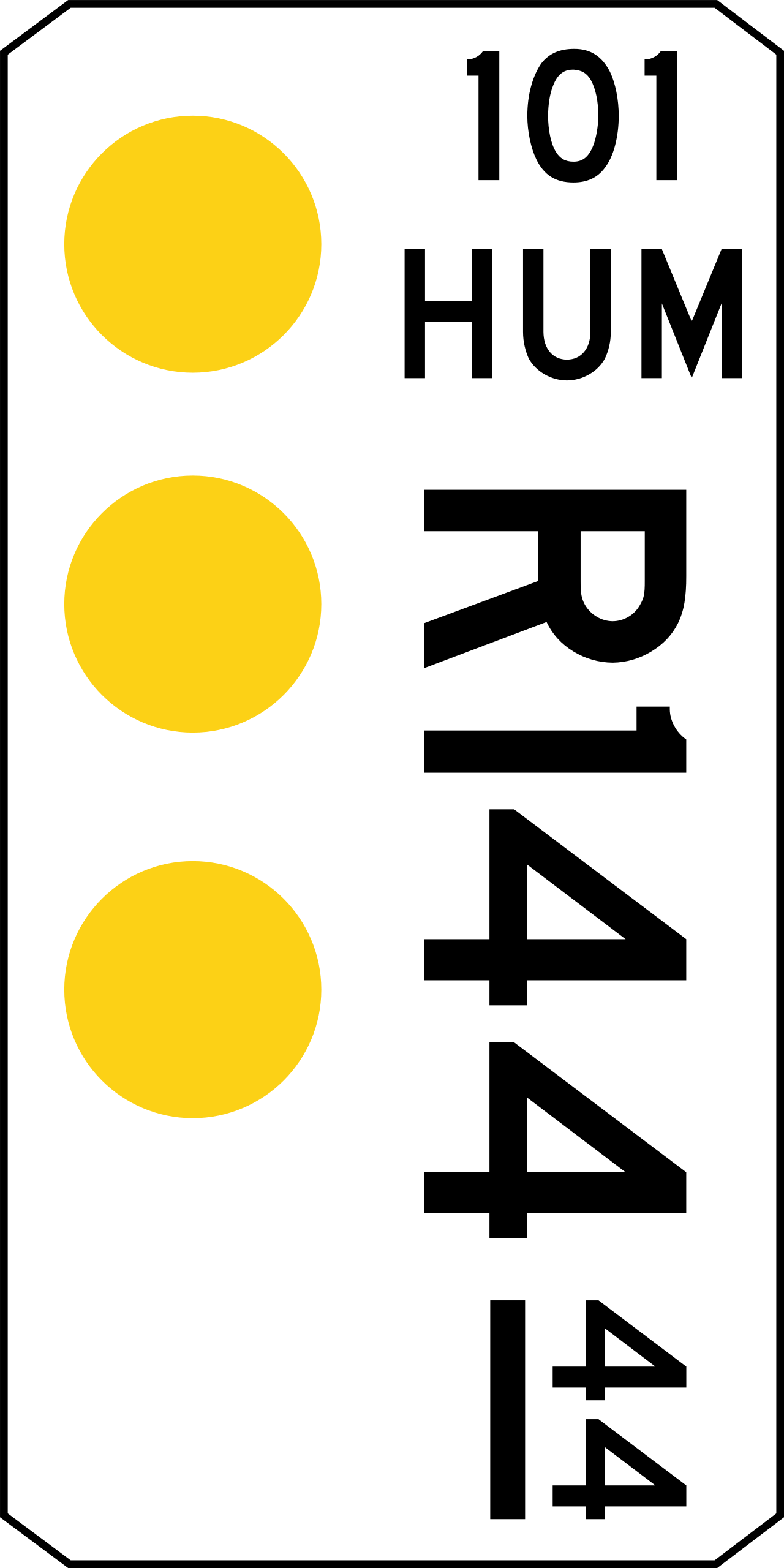
Image by Caltrans from Wikipedia.
Though California has since transitioned to mixed numbers with common fractions, the older style remains on postmile markers and bridge inventory markers.
In a sense, it’s akin to how we might write a check’s amount as $12345.
Grandpa, what’s a check? ds
© Dennis Simanaitis, SimanaitisSays.com, 2024
 Simanaitis Says
It took Microsoft until about 15 years ago (IIRC) to manage to make Excel handle the decimal place correctly when transferring files between continents. Simple fix, but since they are a monopoly, they needed about 20 years to fix it.
Ha. A lamentable example of cornering a market.
The above example of corporate might makes right is also what contributes to the decimation of the English language, of literacy.
Thank you for the above math history, or “back story” as people now say. Isn’t that akin to “free gift” or “at the present time we are currently…?” A story by its nature is past tense.