
Simanaitis Says
On cars, old, new and future; science & technology; vintage airplanes, computer flight simulation of them; Sherlockiana; our English language; travel; and other stuff
LET’S HEAR IT FOR….
I DETEST CANNED APPLAUSE and especially canned laughter. Somehow it sounds ever so phony. But genuine applause is a joy to performers. And a fascinating topic in Nick Slonimsky’s Lectionary of Music. Here are tidbits about applause gleaned from this book along with others sources here and there.

Lectionary of Music: An Entertaining Reference and Reader’s Companion, by Nicolas Slonimsky, McGraw-Hill, 1989.
Origin and the O.E.D. Not surprisingly, The Compact Edition of the Oxford English Dictionary’s first citation of the word “applause” involves Shakespeare, who no doubt was familiar with the practice. In The Merchant of Venice, 1596, Act III, Scene 2, Bassanio says to Portia, “Hearing applause and universal shout,/ Giddy in spirit, still gazing in a doubt/ Whether these pearls of praise be his or no—.”
Only, according to O.E.D., Shakespeare spelled it “vniuersall.” Elizabethans were into Free Spelling.
Etymology. Slonimsky wrote that the word “applause” comes “From the Latin verb paludere, ‘to clap hands,’ an instinctive reaction to an excellent artistic performance.” Merriam-Webster has a slightly different take: “Medieval Latin applausus, from Latin, beating of wings, from applaudere.” Just for fun, I sought confirmation of either “hands” or “wings” by checking out Latin “applaudere” in Google Translate. It hedges with “to applaud,” and doesn’t say with what.
On Other Adulations. Slonimsky says, “Shouts of ‘bravo’ often join the applause. Outside Italy, ‘bravo’ is shouted equally at men and women performers, although the proper grammatical form for a female artist should be ‘brava.’ ” And, I’d guess, “bravi’ would be the appropriate praise for ensembles. Or at least I’ve shouted this without others in the audience staring all that much.
Slonimsky cites other adulatory words: “In Moslem countries, audiences cry out ‘Allah Allah’ to commend a singer; in Spain it is ‘olé olé.’”
An Operatic Tug-of-War. Slonimsky describes, “When there is an orchestral coda after a particularly successful aria, it is often drowned out by intemperate applause…. A tug-of-war ensues when the conductor makes a definite effort to proceed with the music and the singer is eager to prolong the applause. Sometimes a singer, expiring at the end of an aria, is forced to rise from the scene of death and bow to the public.”
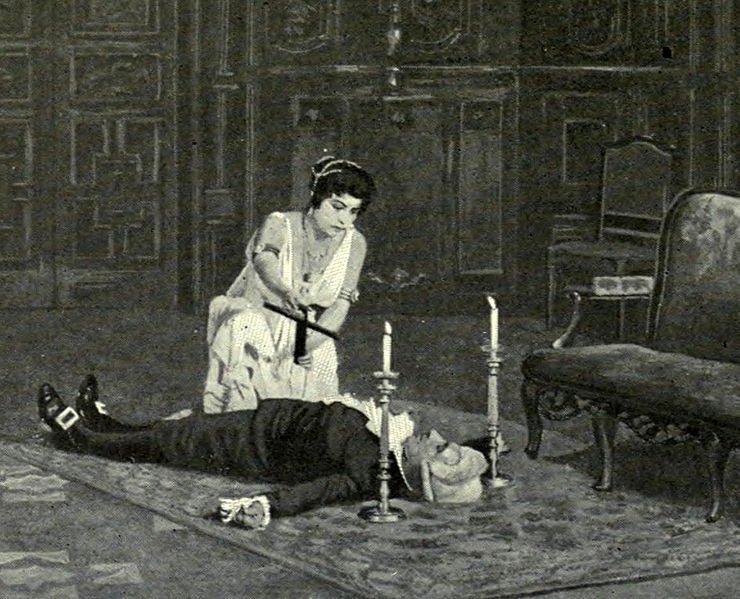
Tosca, the harrowing end of Act II. Image from the Metropolitan Opera, c.. 1910.
Imagine the scene-shattering that would occur if Scarpia arose to take a bow after Tosca does him in. This reminds me of another Scarpia incident described here in SimanaitisSays in “Opera Chaos IV.”
The Claques. Slonimsky recounts, “It was once a common practice among opera singers, especially in the 19th century, to hire people to applaud them. The hired group was known as a claque.” Members of such groups were known as claqueurs.
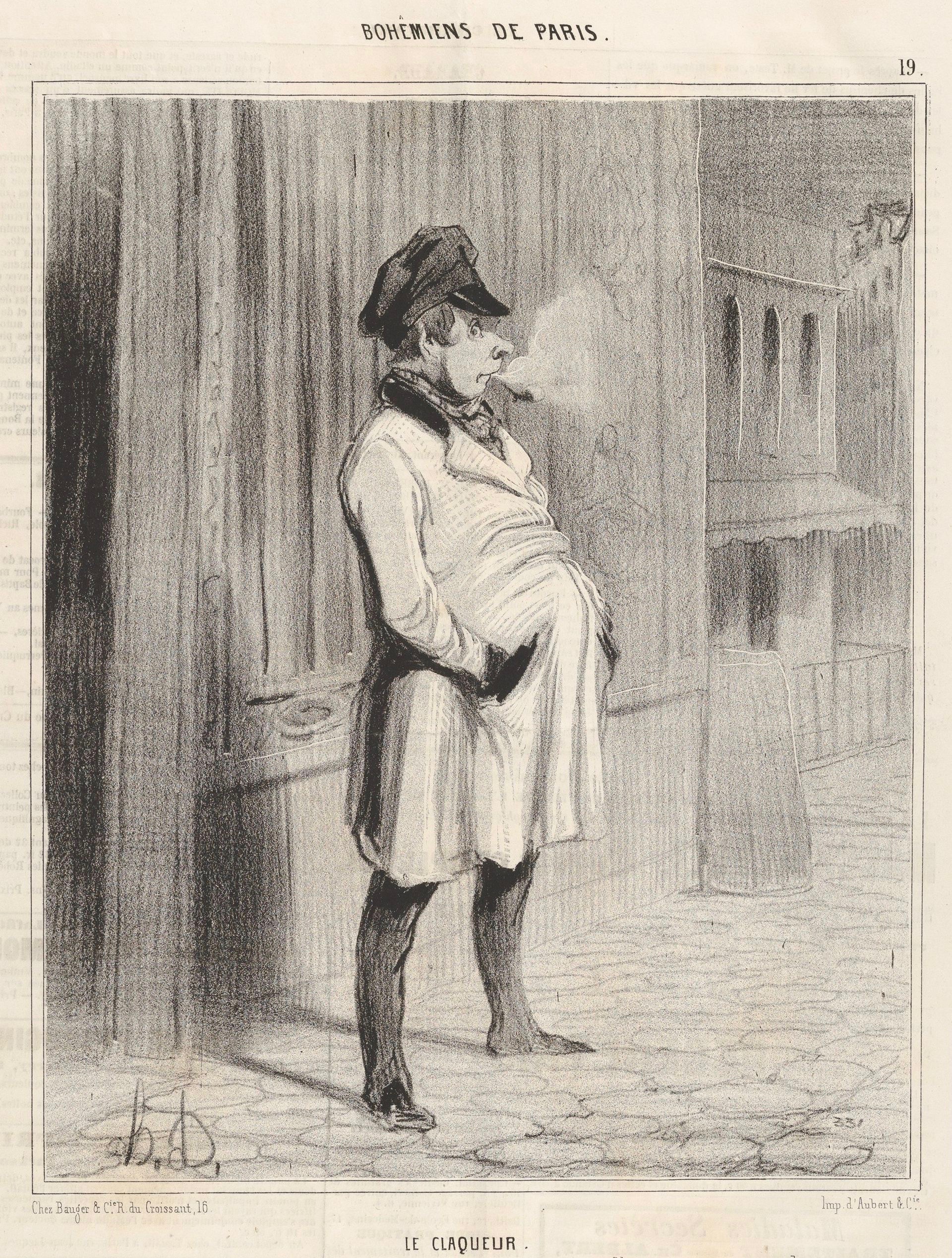
Le Claqueur, by Honoré Daumier, 1842. The job: Burst out laughing with the comic, cry with the heroine, and defend the author. Image from Wikipedia.
“In 1820,” Wikipedia says, “claques underwent serious systematization when an agency in Paris opened to manage and supply claqueurs. By 1830 the claque had become an institution. The manager of a theatre or opera house could send an order for any number of claqueurs.”
In a sense, this was a pre-canned version of canned responses.
“Claques,” Wikipedia recounts, “were also used as a form of extortion, as singers were commonly contracted by the chef de claque before their debut and forced to pay a fee in order to avoid being booed.” See “Caruso and the Extortionists” here at SimanaitisSays.
Responsorial Applause. Slonimsky describes, “A peculiar type of what may be called responsorial applause developed in Russia toward the middle of the 20th century, when the artists themselves applauded the audience, usually in a rhythmic measure of one long and two short claps. The origin of this custom can be traced to the practice of political leaders returning the applause of an enthusiastic audience.”
Picked Up from Dictators. Extra credit: Can you name an American politico who has picked up this practice?
“Although,” Wikipedia recounts, “the practice mostly died out during the mid- to late-20th century, instances of actors paid to applaud at performances still occasionally appear, most famously with the Bolshoi Ballet.”
What About Whistling? Slonimsky observes, “It is interesting that whistling, which is the expression of the most passionate pleasure at a performance in England and America, is equivalent to hissing in France and particularly in Russia. When, shortly after the victorious conclusion of World War II, American soldiers greeted the Russian dancers in Berlin with whistling, the performers were in tears, believing that they had been hissed down.”
I wonder: Is there canned whistling? ds
© Dennis Simanaitis, SimanaitisSays.com, 2024
 Simanaitis Says
Another terrific look at something so many take for granted. Canned laughter seemed moronic to us even as kids. It only increased an idiotic sitcom’s idiocy. A studio audience’s laughter during a skit, whether live or taped broadcast, was and is natural.
The bit about murdered operatic characters rising to take a bow had me laughing–without a canned nudge. It recalls something you would’ve seen on Sid Caesar, Ernie Kovacs, or Steve Allen.
And thanks. When i get to France, i’ll only clap and cheer.