
Simanaitis Says
On cars, old, new and future; science & technology; vintage airplanes, computer flight simulation of them; Sherlockiana; our English language; travel; and other stuff
LOTUS ELITE PART 1
“TO THE HARD-CORE ENTHUSIAST,” the Lotus ad copy reads, “any twisty stretch of road holds a downright hypnotic challenge to send it in screaming: red line it on the straight, pick up the brake point and shut down, punch the big Girlings and stir the gear box, then set upon the good line to send her snarling out the far side, hungry for the next turn.”
The car was the Lotus Elite and the year was 1963; you hadda be there.
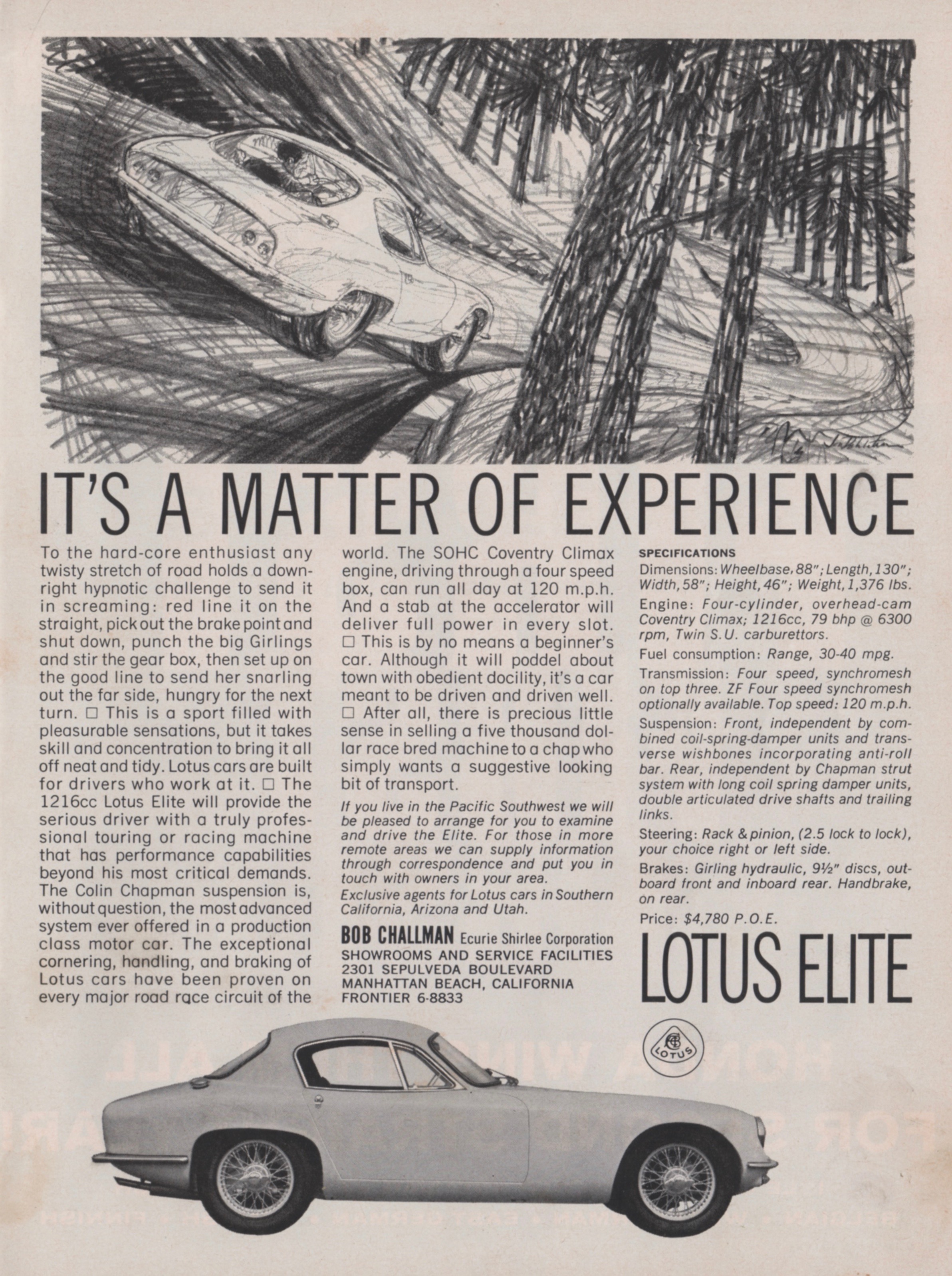
This and following image from R&T, April 1963.
The April 1963 issue of R&T had a road test of the Elite; indeed, the second in less than four years. And I just happen to have Classic Cars in Profile Volume 2, which contains David Phipps’ article about the Lotus Elite. Here in Parts 1 and 2 today and tomorrow are tidbits about this car gleaned from these two sources, from my usual Internet sleuthing, and from my own recollections of the car.

This and following image from Classic Cars in Profile Volume 2.
Elite Firsts. Phipps wrote, “Although only 988 were ever made [other sources say 1030 or 1047], the Lotus Elite has a very significant place in the history of automobile engineering. It was the first Lotus designed for series production and intended primarily for road use rather than for racing, and it was the first car ever to use glass-reinforced plastic as a major structural element. It was also, at the time of its introduction, the only small British sports car with an overhead camshaft engine, four-wheel disc brakes, and advanced fully independent suspension.”
All of this reflected the fact that Lotus founder Colin Chapman trained as a structural engineer at University College London.
Terminology: Fiber-reinforced Plastics. Wikipedia notes a variety of usage: Glass-reinforced plastic (GRP), fiberglass (U.S. spelling), fiber glass, fibreglass (U.K. preference), and Fiberglas (one “s,” Owens-Corning patent since 1936). I recall R&T getting reminder letters if we inadvertently confused Fiberglas with mere fiberglass.
Another Pause: a Corvette Tidbit: From its 1953 beginning, the Chevrolet Corvette was fiberglass-bodied, beneath which resided/resides a conventional chassis of steel, later steel/aluminum. Other GRP-bodied cars included the British Jensen, TVR Grantura, and Daimler SP250. The Ferrari 308 GTB and French Matra Rancho also had GRP bodywork atop steel chassis. Also the Devin, the Glasspar, and others were speciality manufacturers of fiberglass bodywork (and occasionally complete cars).

The Elite’s Design. R&T wrote in April 1963, “Introduced at the Earls Court Show in London, in the fall of 1957, the Elite represented the most outstanding esthetic automotive design to come out of England since the MG-TC. And in many ways it surpassed even that venerable example of automotive architecture for it made a complete break with British ‘traditional’ design.”
Unit Body/Chassis of Fiber Glass. David Phipps offered extensive description of the car’s unitary construction: “The Elite chassis/body unit consists of three major mouldings, and with the exception of the front suspension frame, the windscreen hoop and the bonded-in mountings for engine, suspension, etc., it is entirely composed of glass-reinforced plastic.”

“As in all unitary construction cars,” Phipps continued, “some parts of the bodywork are more highly stressed than others. The radiator air intake and headlamp mountings, for instance, have no direct structural function, but the radiator inlet duct plays an important part in stabilizing the front suspension frame and is built in the form of a diaphragm. Engine, as well as suspension, loads are taken out into the front suspension frame, and the latter is diagonally braced by being bonded to the inner body moulding. Bending loads in the area are taken out into the vertical sides of the engine bay—and thence into the main side members of the body.”
Portions of each moulding had varying thicknesses based upon the loads they carried. As an example, Phipps noted, “The rear diaphragm completes the structure in this area, coupling the body sides and the tunnel by means of a beam. The rear suspension unit pickups are located at the top corners of this beam and the final drive is mounted in the centre of it; in this highly loaded area the glass-reinforced plastic is 3/8 in. thick, tapering to 3/16 in. and finally 1/8 in.”
That is, Colin Chapman’s training as a structural engineer hadn’t been wasted.

Tomorrow in Part 2 we’ll see a portable fire pump finding its way into the Elite, and learn R&T thoughts of the total package. Hint: “Noisy, but nice; the smallest, prettiest and most intriguing GT car in a decade.” ds
© Dennis Simanaitis, SimanaitisSays.com, 2024
 Simanaitis Says
A jewel of a car, 88% the spiritual forebear of my girl’s Miata.
The new Lotus Elise doth beckon.
I suspect that the preferred English term would have been fibre glass, not fiber glass.
Ha! As expected, you’re an early viewer of the website. I caught this fiber/fibre mistake in my 6:06 a.m. final editing and corrected it by around 6:30. It’s so much easier than running from drugstore to drugstore.
Especially if you have to do it in every single store. As of Jan 1 this year there are at least 12,000 plus in Canada alone, not counting the three territories that don’t report such statistics!
I guess you have plenty of old R&Ts. I have doubles and trips going way back. Willing to donate any of them to you.John McNulty
Many thanks. My collection runs from late 1949 through 2012. July 1955 is lurking somewhere in the garage, with the rest more or less where I expect them.
Yes, mine all all up stairs n the barn. They go back to the early 50s, Do have the repros from the 40s.JohnPS, I do not think anyone wants them. My son is not interested in my Morgans. Hurts.
I sense and share your feelings. Fortunately I have Daughter Suz who knows more of current F1 than I do. And Daughter Beth’s (and Michael’s) kid Carter who’s a Pierre Gasly groupie. (I gifted Carter with Zone Rouge vests from Monaco and Canada.) —d
Sent from my iPhone
>