
Simanaitis Says
On cars, old, new and future; science & technology; vintage airplanes, computer flight simulation of them; Sherlockiana; our English language; travel; and other stuff
ROENTGEN ARCHITECT’S TABLE
THE ARTISTRY OF DAVID ROENTGEN was unknown to me until an ad in The New York Times, January 28, 2024. What a splendid combination of marquetry and mischievousness. How else to describe the 18th-century mechanical architect’s table offered by M.S. Rau, a New Orleans purveyor of fine art, antiques, and jewels that have appeared here at SimanaitisSays.
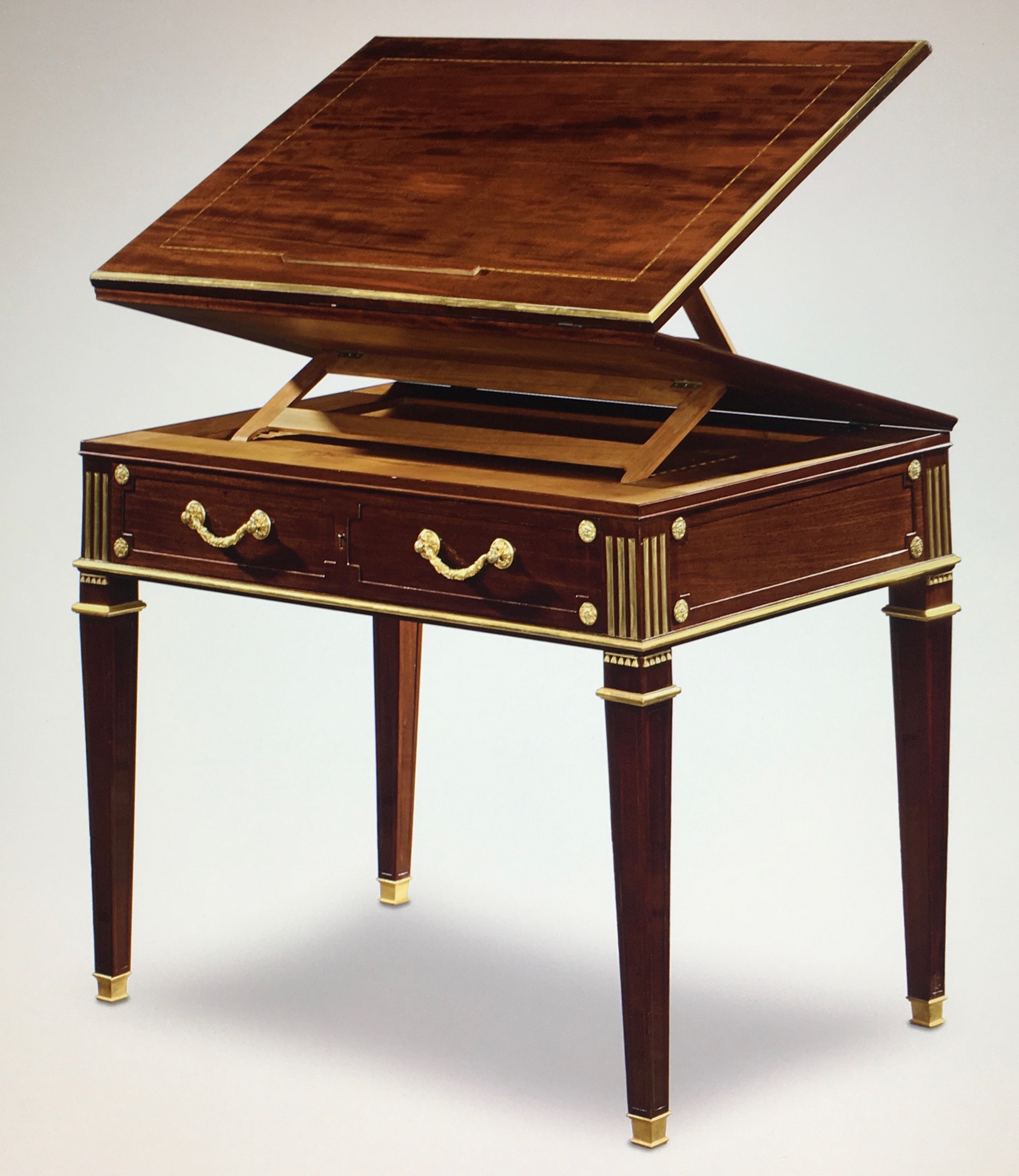
This and other images from rauantiques.com.
Enhancing my curiosity upon learning more of the Roentgen table is its sharing a mechanical feature with a decidedly more modest piece of furniture in what I could only immodestly call my own collection.
Accepted Eventually, and Royal Customers Galore. Wikipedia notes that David Roentgen learned his trade in his father Abraham’s workshop at Neiwied, near Coblenz, Germany. He inherited the business in 1772 and later opened a showroom in Paris, then “the style center of Europe.”
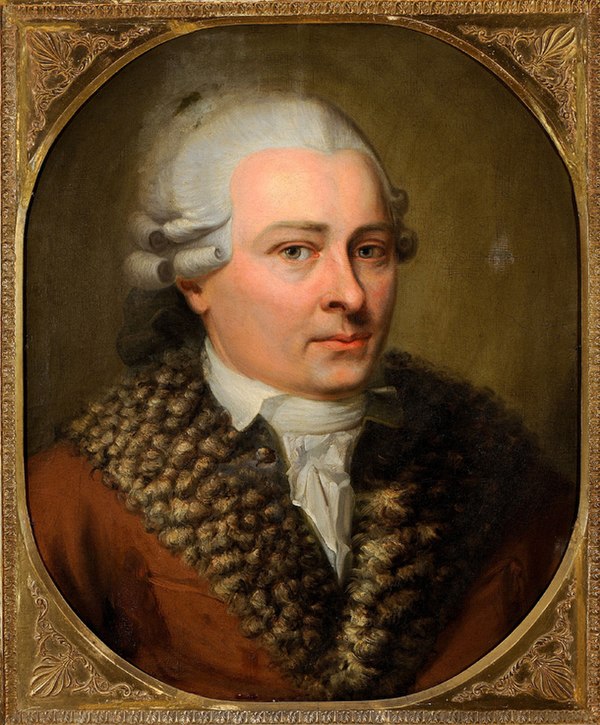
However, Wikipedia notes, “the maîtres ébénistes disputed his right to sell in Paris furniture of foreign manufacture. In 1780 he resolved this restriction by inventing new style of marquetry, which attracted a good deal of attention. Instead of representing light and shade by burning, smoking or engraving the pieces of veneer, DR arranged intricate patterns of wood inlay to create the impression of pietra dura. His great rivals admitted him to their exclusive guild.”
“He appears to have curried considerable favor with the queen, Marie Antoinette, whose first language was also German,” Wikipedia recounts. “Because of his proficiency in constructing furniture with amusing mechanical features, the queen appointed Roentgen ébéniste-mechanicien. Popular in the late eighteenth century, ladies’ dressing tables were designed to appear as a desk, drawing table or other less personal furniture, to conceal toiletries. A spring trigger, hidden catch or button revealed its dual purpose.”
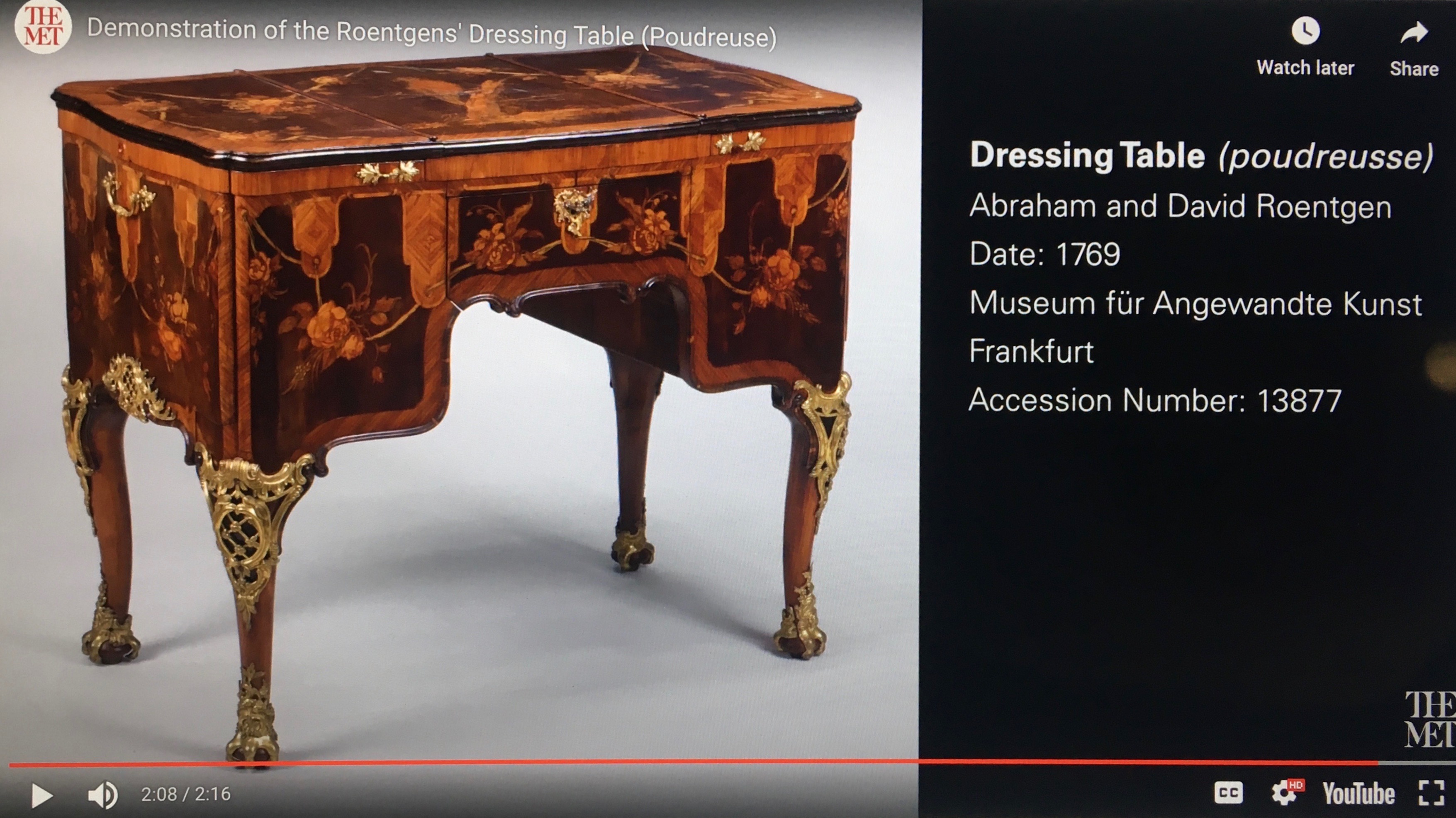
A Dressing Table (Poudreusse), Abraham and David Reontgen, 1769. Video from The Met via YouTube.
Roentgen had shops in Berlin and Saint Petersburg. Wikipedia notes, “Undoubtedly his aptitude as a commercial traveler was remarkable.” Yet the Encyclopædia Britannica Eleventh Edition of 1911 claimed that Roentgen was not a great cabinetmaker: “His forms were often clumsy, ungraceful, and commonplace; his furniture lacked the artistry of the French and the English cabinetmakers of the great period which came to an end about 1790. His bronzes were poor in design and coarse in execution; his work, in short, is tainted by commercialism.”
Geez. I wonder how much furniture this Britannica contributor ever made?
Success—Until 1789. Wikipedia recounts, “David mastered this style, dubbed Harlequin after the theatrical character, whatever the reference to archetype implied. His mechanical inventiveness outshone more accomplished cabinetry. The extent of his fame is shown by Goethe mention of him in Wilhelm Meister. The box inhabited by the fairy during her travels with her mortal lover is compared to Roentgen’s desk in which a single pull released many springs, latches, hidden drawers, secret compartments and mechanical devices.”
But then came the French Revolution: “In 1793,” WIkipedia writes, “the Revolutionary government, declaring him [Roentgen] an émigré, seized the contents of his showrooms, inventory and personal belongings. After that, he did no further business in Paris. Five years later, the French invasion of Germany, Prussia and Austria led to the closing of his factory in Neuwied. He died half ruined at Wiesbaden on 12 February 1807.”
M.S. Rau’s Roentgen Architect’s Table. M.S. Rau describes, “This 18th-century architect’s table is a rare and ingenious piece of furniture created by famed German master David Roentgen, hailed as ‘the greatest cabinetmaker of all time’ by furniture scholar Simon Jervis.”
Take that, Britannica!
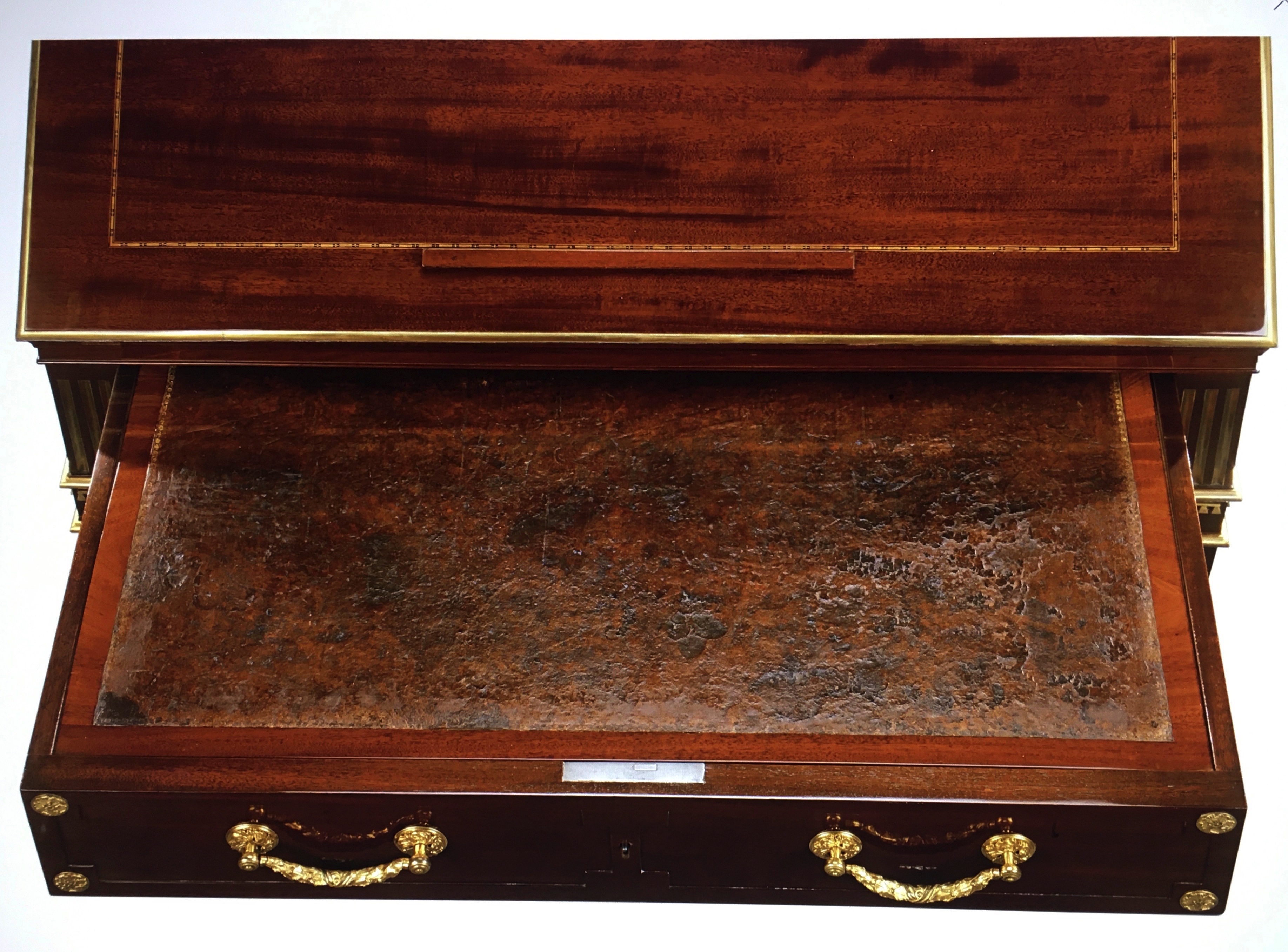
Roentgen Architect’s Table. Above, its leather-covered writing surface; below, several of the drawers hidden beneath.
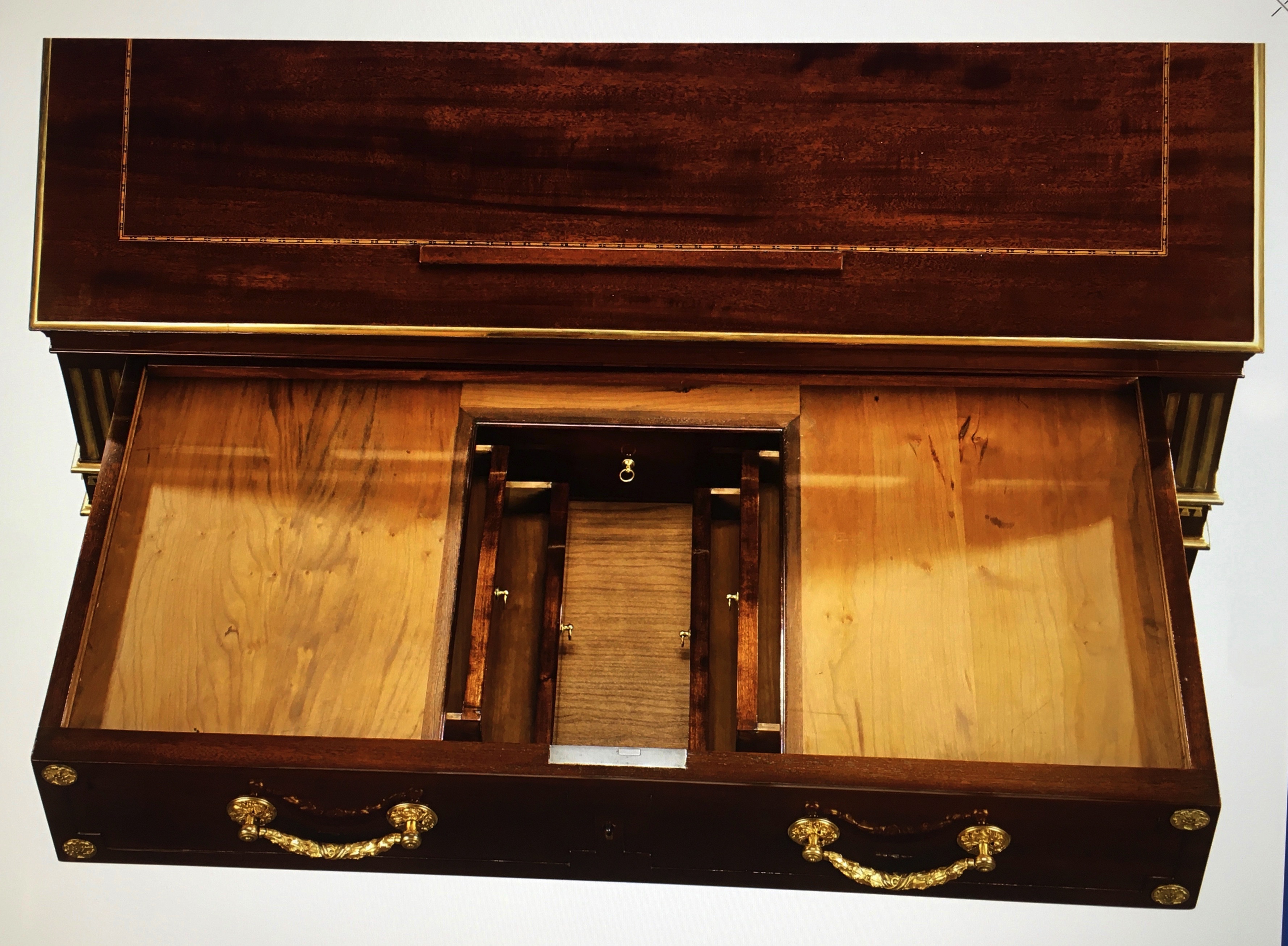
M.S. Rau offers the piece’s medical provenance: “In the mid-18th century, Dr. Theodore Tronchin, a renowned French expert in bone disease, observed that architects’ ‘slouched’ postures were causing serious back pain. Thus, Tronchin developed a rectangular table featuring two adjustable shelves or trays on the top, which could be moved to allow for both standing and sitting.”
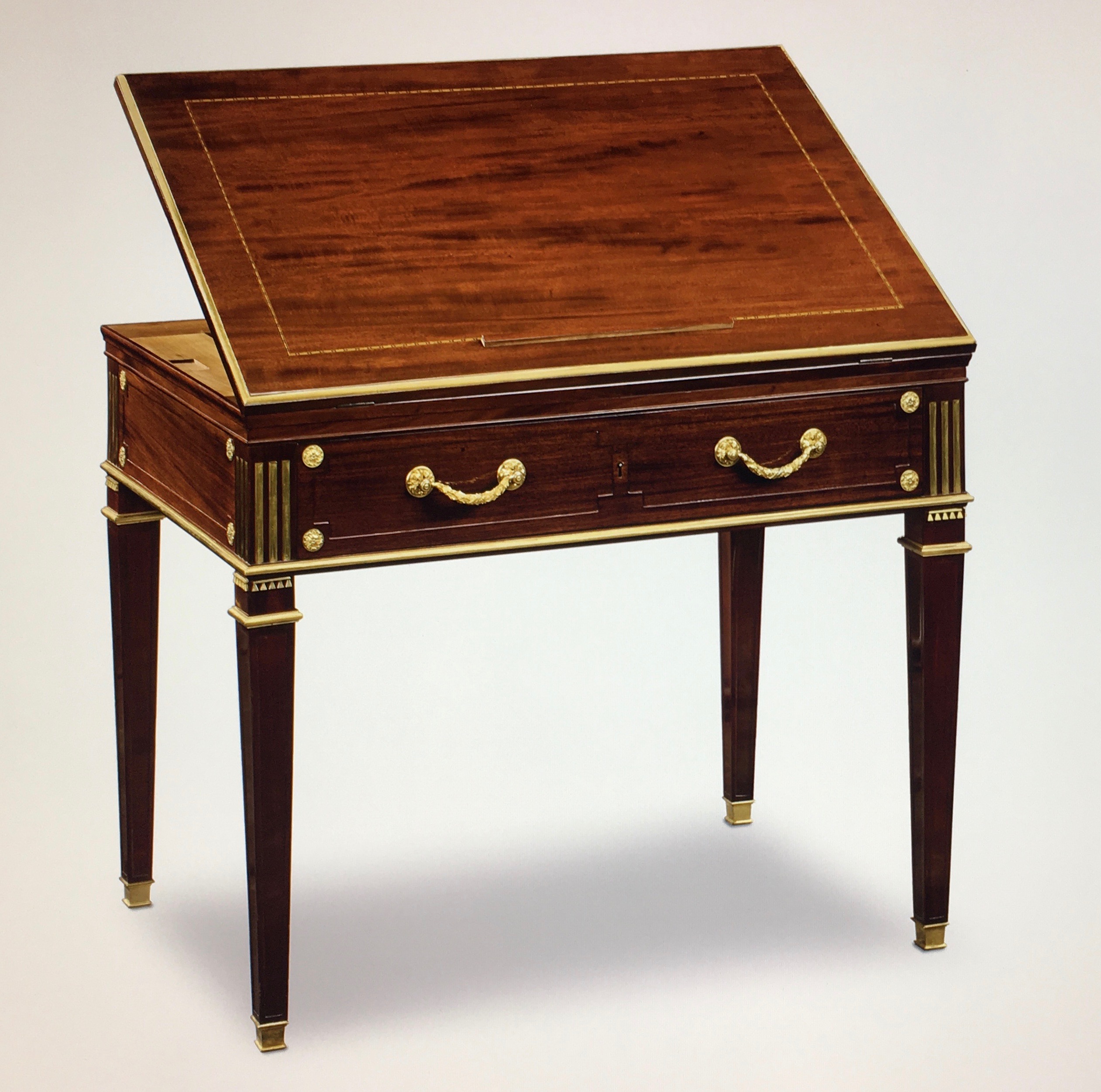
Architect’s Table, 40 in. w x 27 in. d x 32 in. h. Video from M.S. Rau via YouTube.
“One of the most creative features,” M.S. Rau notes, “can be found underneath the tabletop: latches that can be turned outward to hold candlesticks.
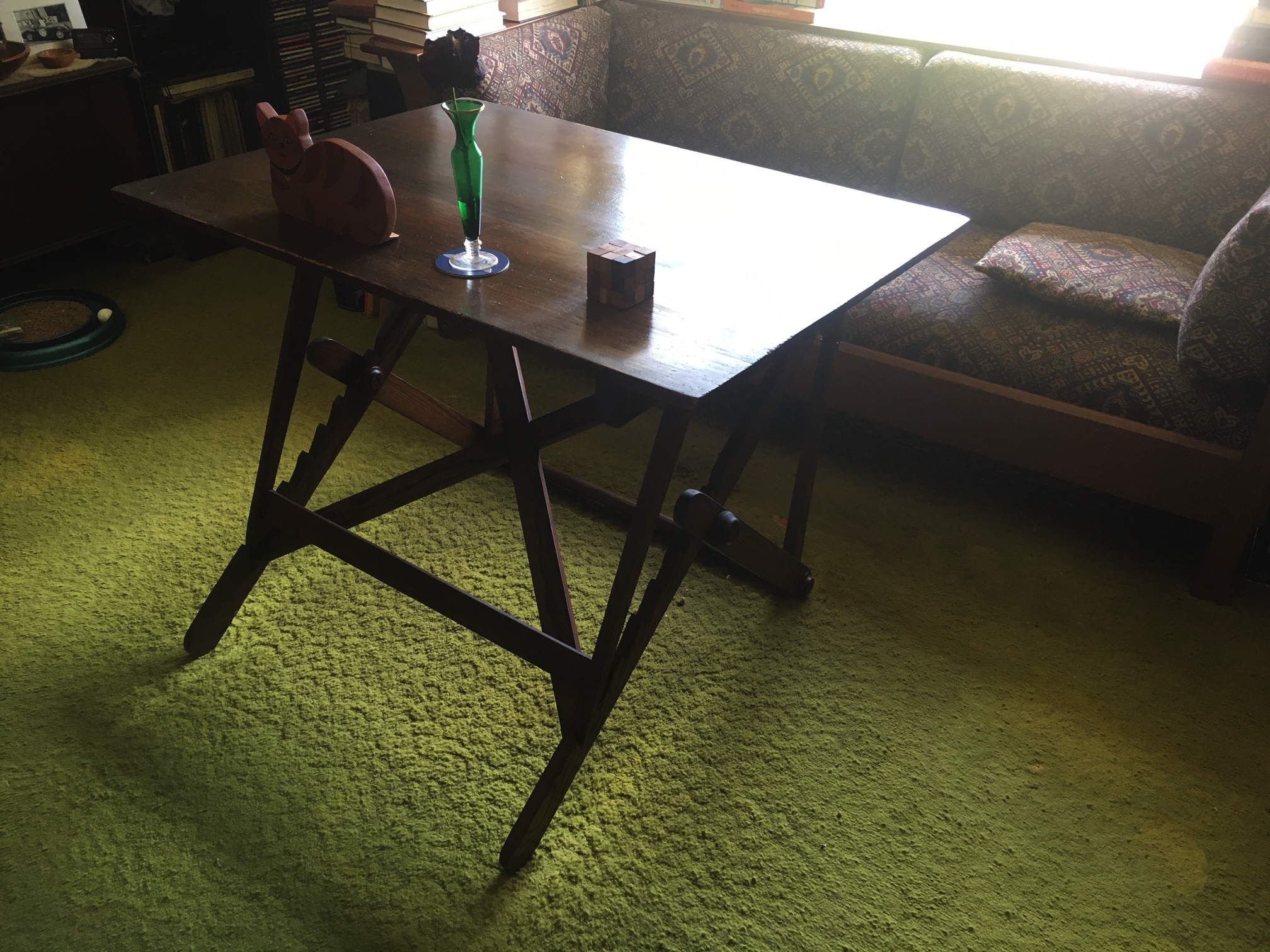
My articulated drafting table shares the notched-arm concept shown in the M.S. Rau video.
However I must depend upon electric or natural lighting, no candlestick holders. ds
© Dennis Simanaitis, SimanaitisSays.com, 2024
 Simanaitis Says
You inspired me to a bit of internet sleuthing of my own. I wondered if David Röntgen was related to Wilhelm Röntgen, the inventor of the X-Ray (Röntgenbilder in German). I thought the name is so peculiar, and David’s work is very technical and inventive.
It appears they are not related, but maybe I didn’t dig deep enough…
I had a similar thought but likely gave up earlier. I wonder if David’s technical, inventive, and whimsical achievements may have been in countering those apparently superior French and English cabinetmaker rivals.