
Simanaitis Says
On cars, old, new and future; science & technology; vintage airplanes, computer flight simulation of them; Sherlockiana; our English language; travel; and other stuff
JAGUAR ARITHMETIC
R&T SUMMED UP ITS June 1955 road test of the Jaguar XK-140 with what it called “COVENTRY’S FINEST FORMULA.”

The magazine said, “For six years the Jaguar XK sports car has been the standard of comparison for performance and value in its field. When first introduced in 1949 the car was truly sensational, and although the company has pursued a policy of gradual improvement rather than radical change, the latest XK-140 sports roadster is still a car to be reckoned with.”
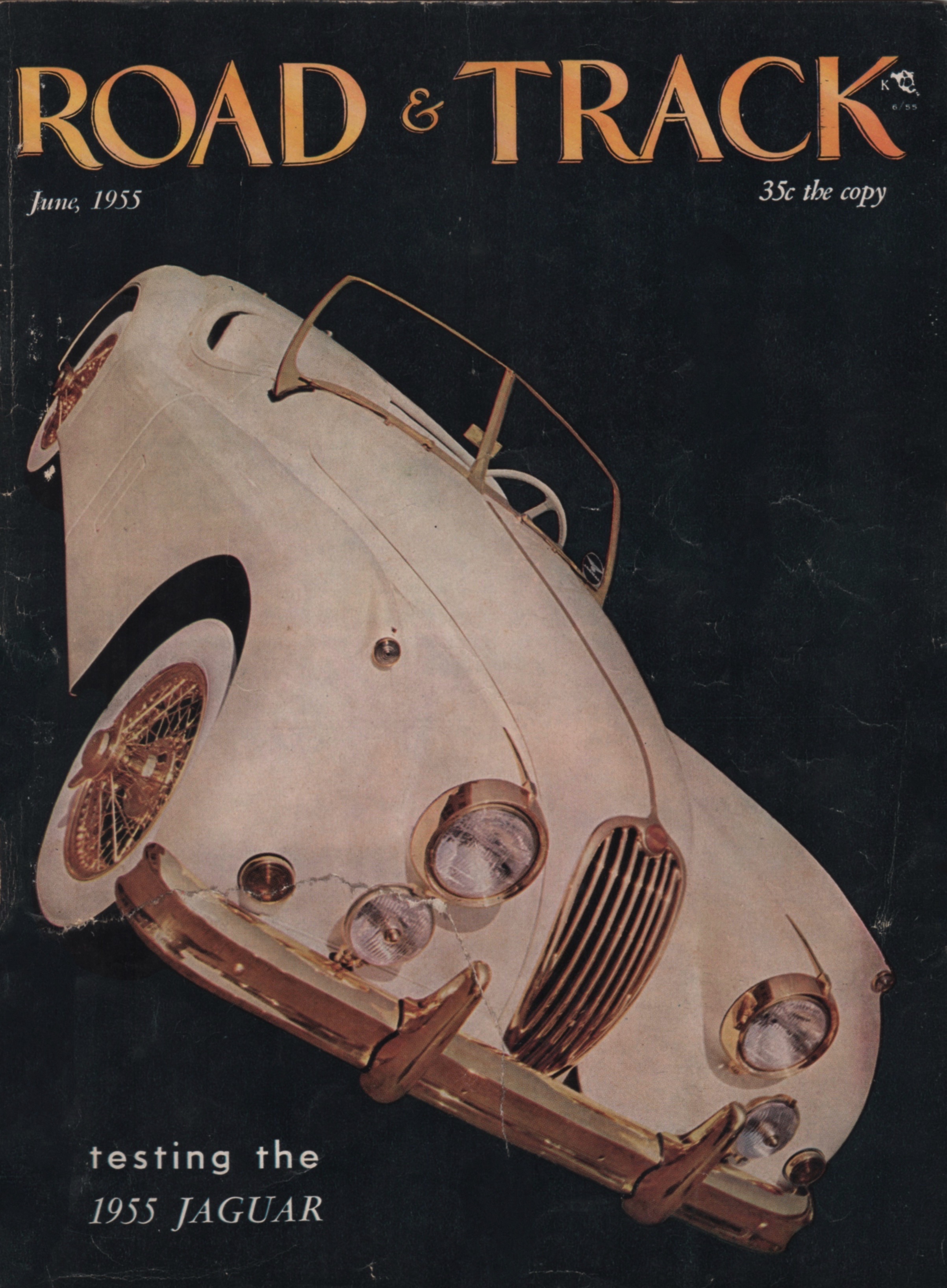
This and other images from R&T, June 1955.
“Coventry’s Finest Formula” Explained. “It has been nearly four years,” R&T recounted, “since we tested a Jaguar roadster. Both the car and our test procedure have advanced considerably in the interim. Accordingly, we elected to test the latest roadster in its most ‘deluxe’ form, the XK-140MC, M for modified (which includes wire wheels, dual exhaust) and C for the C-type cylinder head.” Include the year and 210 for the car’s horsepower (versus the XK’s-140’s 190), and Coventry’s Finest Formula is complete.

XK-140MC Performance. “Concerning the performance data,” R&T wrote, “ the figures tell much of the story. It is clearer than ever that only cars costing twice as much (or more) can improve on such times as 0-to-60 mph in 8.4 seconds, or a standing 1/4 mile in 16.6 seconds. What the figures do not show is the consummate ease of obtaining the same readings again and again.”
Do we get the impression that the R&T staff had a ball?
“The Jaguar takes off best with a throttle setting of about 2500 rpm, and after the initial ‘chirp’ from the rear tires the accelerator goes down hard.”
In More Mundane Driving. “At very low rpm,” R&T reported, “there was a faint tinkle with the foot pushed down hard, an indication that the engine tuning is near-perfect for local premium fuel.”
The magazine continued, “As exhilarating as it is to drive a car such as this in traffic, only on the open road does it really begin to come to life.”
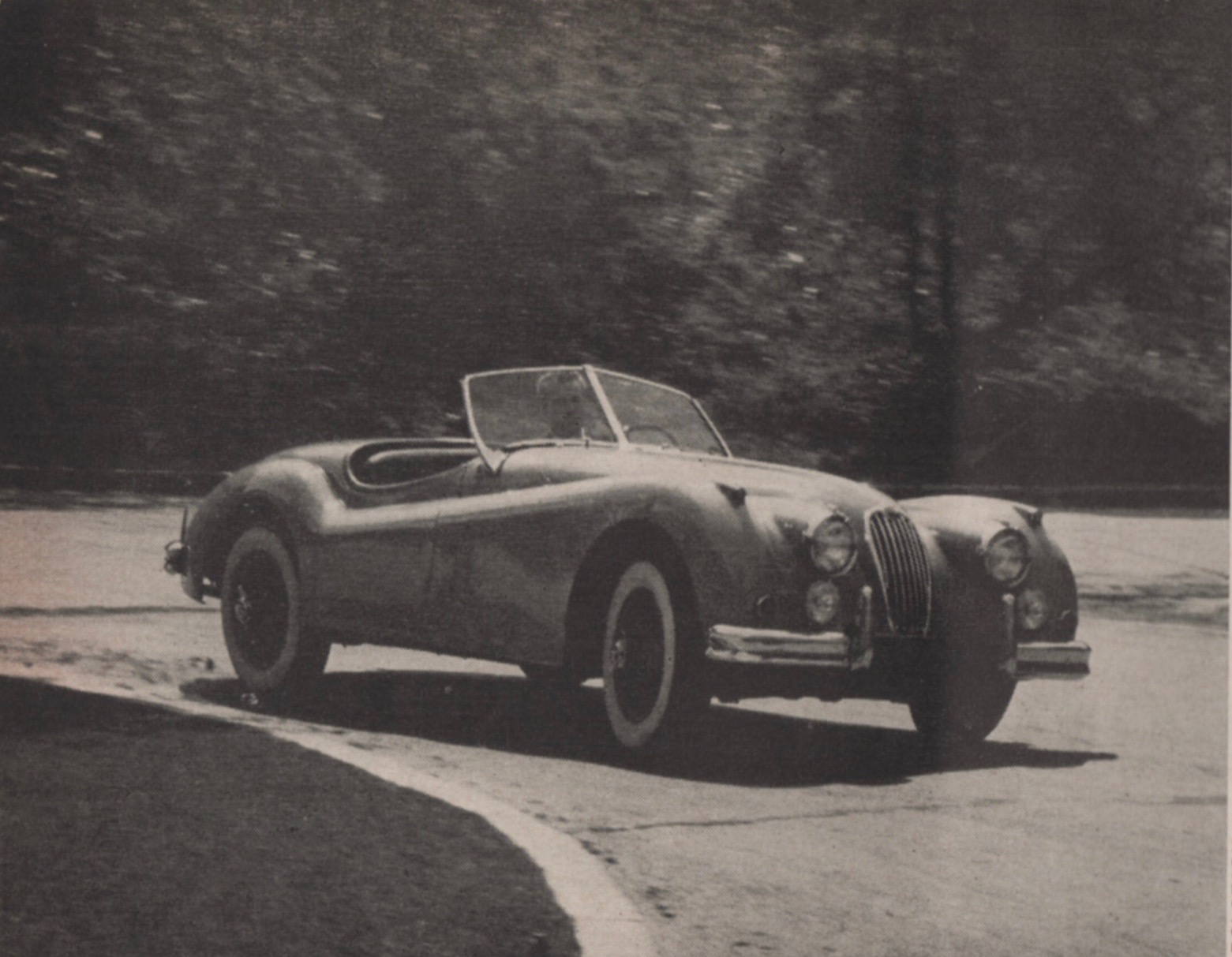
The Jag’s Cornering Stance. “The Jaguar does have considerable roll in a hard corner, for a sports car, but the extra comfort of such springing is worthwhile to all but the toughest diehard, and a reasonable amount of roll is generally considered to be desirable than none at all. The commencement of noticeable roll is a reliable indication of safe cornering speed and such a car as the Jaguar reduces ‘driver skill required’; it is in fact one of the easiest and safest automobiles to drive being built today.”
Top Speed. The data panel’s 125-mph top speed with best run 121.1 calls for comment: “Top speed runs,” R&T recounted, “were made with top and side curtains installed, and wind noise became noticeable as low as 40 mph; normal conversation ceases at about 75 mph.”
I’ll bet.
“The timed top speed was a little below expectations,” R&T reported, “although the car was obviously in perfect tune, having been loaned to us by Jaguar Cars North American, Inc. The odometer read 2315 miles at the start of the high speed runs, and the car had experienced one high speed roundtrip to San Francisco (The California Mille Miglia).”
How prescient of R&T in naming an event 36 years ahead of time. The California Mille was founded by Martin Swig and friends in 1991.
R&T continued, “While we believe that this is a fair evaluation of an MC type Jaguar, the mileage is perhaps insufficient to give a fair test of the best possible top speed…. Results at the 1955 Daytona speed trials prove that this is so, for the best two-way average by a production type ‘M’ Jaguar was 124.6 mph and a 1955 XK-140 recorded 119.68 mph.”

XK-140MC Pricing. R&T’s XK-140MC roadster had a list price of $3745 (including the MC’s $295). The magazine noted “…whereas the original price (abut $4000) seemed high to the average American, the price today—after a spectacular 1953 drop of up to $800—is not only lower in dollars but is also an even better value in comparison to the fantastic prices being asked for ‘middle-priced’ U.S. sedans.”
Still the Standard. R&T concluded, “With performance per dollar excelled by no other car, the nicer details of finish and fittings on the XK roadster come a a pleasant bonus feature. The quality of finish is immediately apparent on the outside, but a look under the hood shows attention to detail that is in marked contrast to that found under a domestic product.”

“Small plaque on valve cover identifies ‘Type C’ head.”
Even in a burgeoning horsepower race, the domestics had no such cachet. ds
© Dennis Simanaitis, SimanaitisSays.com, 2024
 Simanaitis Says
I enjoyed your essay about the XK-140MC enormously.
The R&T road test reminds me of a question that I’ve been carrying around in my head for a while. What is a “Tapley meter?” Is it like the one in the attached photo, taken in my garage this morning? I see references on the Internet to using the Tapley meter for brake testing, but it appears that R&T was measuring acceleration with the meter. Is this correct and, if so, what were they trying to show? Maybe the push-in-the-back thrill of acceleration?
Tom Frisardi Long Beach, CA
Thanks for your kind words, Tom. Look no further than “Still Off-Scale After All These Years” (Briefly, a Tapley Meter is a mechanical accelerometer, measuring changes of velocity.)