
Simanaitis Says
On cars, old, new and future; science & technology; vintage airplanes, computer flight simulation of them; Sherlockiana; our English language; travel; and other stuff
CES AND THE AUTOMOBILE
THE CONSUMER ELECTRONICS SHOW is typically a whiz-bang of silicon-based wonders, so it’s no surprise that Artificial Intelligence pokes its way under the edge of the tent. On the other hand (with yet another metaphor), articles in Automotive News, January 15, 2024, depress the Pause button—and, to my eyes, for good reason. A.I.’s potential is high; but so is its yet-to-be-determined trustworthiness. Here are tidbits gleaned from CES happenings, together with my occasionally Luddite commentary.

A.I. Not Yet “Embodied.” Whew. As cited here at SimanaitisSays, today’s A.I. is inherently “learn and inform.” Its vast accumulation of data and speedy algorithmic analyses give it information galore. But, thus far thankfully, it does not “learn and act” in high-priority situations.
By contrast, embodied A.I. sensors and actuators release it from a purely digital realm. In practice, an embodied A.I. nav system could do more than offer directions; it could actuate the steering, accelerator, and brake to control the journey.
However, what about A.I. “hallucinations,” its occasional proclivities for making stuff up?
GM Cruise Casting a Shadow Across CES. Indeed, what we might call “conventional” autonomous vehicles haven’t proved completely trustworthy either. Pete Bigelow reports in Automotive News, January 15, 2024, “The turmoil at General Motors robotaxi subsidiary Cruise cast a long shadow across CES and dampened the outlook for self-driving technology.”
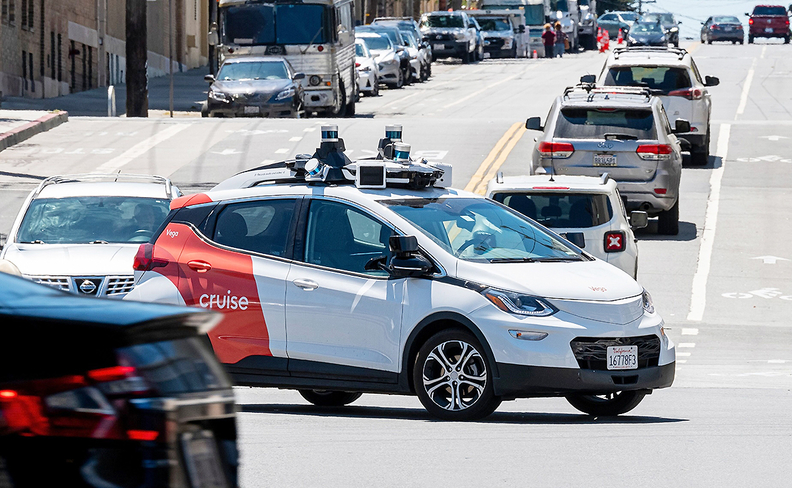
Image from Automotive News, August 17, 2023.
Bigelow continues, “California regulators said Cruise misrepresented the circumstances of an Oct. 2 robotaxi crash with a pedestrian in San Francisco. Cruise omitted information that revealed the robotaxi dragged the pedestrian 20 additional feet following the initial strike, officials said. They subsequently suspended the two permits needed for driverless operations in the state.”
It was a horrific accident: The pedestrian was hit first by another “ordinary” car and fell into the path of the Cruise. Apparently (and not surprisingly), the robotaxi guidance capabilities weren’t programmed to recognize this.
Bigelow reports one specialist noting, “What’s unfortunate is the way this incident was handled undermined confidence in the industry, and that is creating a headwind that was avoidable.”
Well, I would argue it’s more than just P.R.
This was decidedly more horrific than an earlier incident when another AV got stuck after piloting itself onto freshly poured concrete. “Mom, nobody ever told me not to stuff beans up my nose.”
CES Controversial Topic: “System-on-Chip.” In the same Automotive News, January 15, 2024, Molly Boigon reports that companies “highlighted new forms of consolidated vehicle architecture that can combine many microprocessors into two or three system-on-chips.”
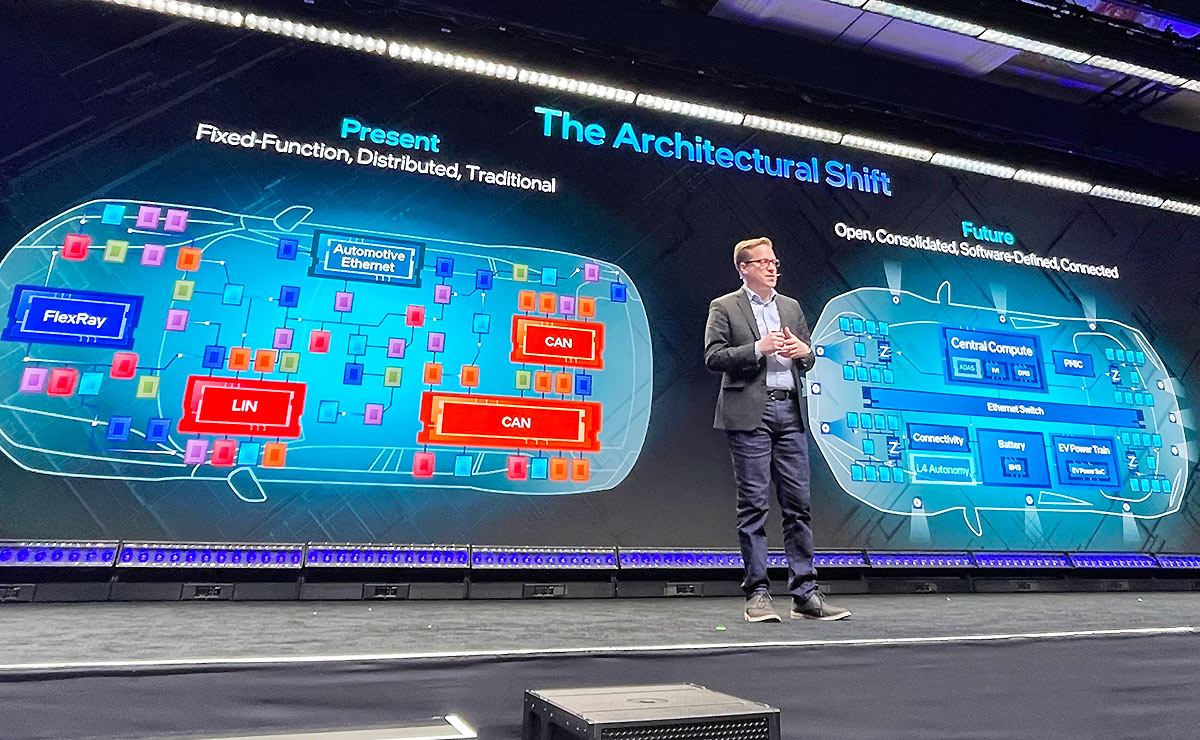
Image by Molly Boigon in Automotive News, January 15, 2024.
“The push for vehicle architecture consolidation,” Boigon writes, “has set off a debate over whether a car’s brains should be this new, more compact technology or the existing system…. Proponents of the current system say the new AI architecture isn’t ready for prime time.”
System-on-Chip Pluses. Boigon observes, “Intel and the other big chip companies argue that rather than using many chips for different vehicle functions, automakers should migrate to system-on-chips. They say this enables not only greater efficiency and integration of the vehicle features, but also creates cost savings.”
“The chipmakers,” she says, “are also highlighting that a system-on-chip can support ‘mixed criticality workloads,’ which include functions that are safety-critical, such as braking, alongside functions related to digital infotainment.”
However…. Those fostering the status quo say that consolidation of vehicle architecture into two or three system-on-chips raises some complex safety questions. Boigon writes, “If vehicle operations are consolidated onto fewer chips, that makes those systems more vulnerable to viruses or other compromise. That may not be a huge deal for infotainment, but it could be catastrophic for high-priority functions such as braking and steering.”
You betcha.
The Future. Trustworthiness through redundancy will remain an important feature, whether in conventional architecture or system-on-chips. As well it should be.

And I’m glad Automotive News is there to keep us informed of these happenings. ds
© Dennis Simanaitis, SimanaitisSays.com, 2024
 Simanaitis Says
I like the term for AI coined by University of Washington linguist Emily M. Bender: “stochastic parrot”. Per Ben Zimmer’s column in this weeks’ Wall Street Journal, the term “was used by AI skeptics to point out that large language models are not capable of understanding language but instead have been programed to parrot back plausible-sounding synthetic text.” Apt description.