
Simanaitis Says
On cars, old, new and future; science & technology; vintage airplanes, computer flight simulation of them; Sherlockiana; our English language; travel; and other stuff
FLAT RAD—AN R&T FIRST!
OTHER THAN MY AFFINITY for the marque, what’s so special about R&T’s September 1952 road test of the Morgan Plus Four? Well, yes, it is a flat rad, the demise of which didn’t come until 1953 when Malvern Link’s source of proper headlamp housings dried up. But that’s not what I have in mind.

This and other images from R&T, September 1952.
Indeed, it’s magazine-oriented: R&T’s Morgan test F-5-52 (the fifth foreign car tested in 1952) was the first to list explicit Acceleration Thru Gears; i.e., including the famed 0-60. Hitherto, as in F-4-52 (August’s Rover 75) and A-4-52 (July’s Hudson Hornet), R&T road tests offered time-versus-speed graphs (from which one could estimate 0-60 times). Technical Editor John R. Bond got these plots back in a couple years by which time 0-60s became benchmarks of automotive performance.

Performance in Perspective. The Morgan’s 17.1 seconds to 60 was competitive for the era: A Porsche 356 (considerably more costly at $4208 versus the Plus Four’s $2395) got to 60 in 13.8 seconds; a Plymouth Cambridge sedan, in around 18. In February 1953, R&T recorded an MG TD taking 19.4 seconds to reach 60; a modified TD Mark II, 16.5.
True, Phil Hill’s Ferrari 212 Barchetta did it in 7.05, but to put all these in perspective, a 1952 Volkswagen Deluxe Sedan (Beetle, to us) took 37.2 seconds to reach 60. The VW’s top speed was around 66 mph and, Autoban-bred, once it attained this speed it could maintain it all day.
Morgan FAQs. R&T recounted, “The Morgan factory at Malvern Link, England, is a very small place—even by the most modest British standards…. To give you an idea of the way their production line works, there is one Morgan employee in particular who is worth mentioning. He is the man who had hand-painted (with a brush, mind you) every Morgan to leave the factory in over twenty years.”
“Until 1936,” R&T continued, “the Morgan specialty was its world famous three-wheeler.” That year, a four-wheel variant came along, quite properly named the 4/4, as in cylinders and wheels or maybe vice versa. The Plus Four, as its name suggested, had a bigger engine and more performance than a 4/4.

The Plus Four was powered by a 2088-cc overhead valve 4-cylinder Standard Vanguard engine, similar to the Triumph TR-2’s.
“The three-wheeler, incidentally,” R&T observed, “was discontinued some time back, but due to hysterical demands on the part of British enthusiasts, the popular vehicle is again in limited production.”
In fact, 1952 was the Morgan trikes’ last year.
Bob Dearborn Reports. Back in the early 1950s, R&T road tests had individual comments separately noted, unlike its later consensus reporting. Oliver Billingsley was Editor; Bob Dearborn, Co-Editor; John R. Bond, Technical Editor.
“There’s a big argument nowadays,” Dearborn said, “between MG and Morgan owners—about the relative merits of their cars. I don’t want to get in the middle, because as far as I can see the argument will never be resolved—the two cars are so different. However, a simple summing of the two sports machines would be that the MG is neater handling while the Morgan had more performance, due to its better weight/horsepower ratio.”
Idiosyncrasies. Dearborn goes on to describe two idiosyncrasies, one particular to this car’s modification, the other to Morgans in general. Briefly, its enthusiastic owner (a latent Porschephile?) had set larger and essentially overinflated rear tires promoting readily induced oversteer. Combined with Morgan’s ancient cam-and-peg steering, Dearborn objected to this: “There was excessive play in the steering wheel which keeps you from setting a true course in a corner and which throws you all off when you try to correct.”

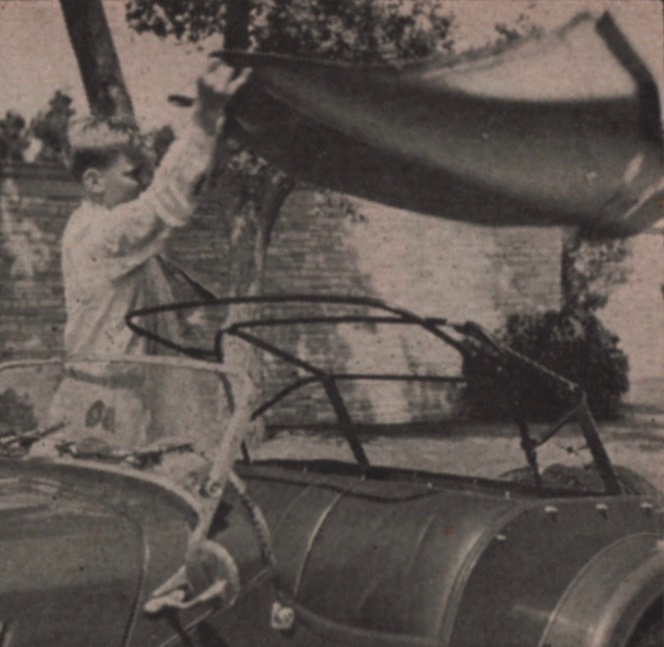
Above, the owner demonstrates his apparently preferred Morgan cornering. And who’s to choose otherwise? Below, he demonstrates another traditional skill, assembling an English sports car “hood.”
Classic Seating—and Pneumatic As Well. Dearborn complained, “I had difficulty in getting in and out of the car, and once seated I was entirely too close to the wheel…. Maybe you won’t be bothered, but with my 250 plus pounds and over six feet in height, I was uncomfortable.”
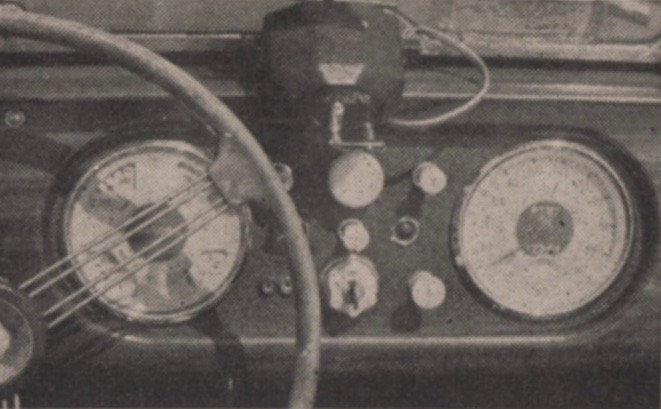
The steering wheel, dashboard—and windscreen wiper motor—are in close proximity.
“On the other hand,” Dearborn conceded, “Morgan’s idea of pneumatic seat cushions is really sparkling. The car has a fairly stiff and firm ride, but the driver is unaware of this because the air in the cushions absorbs practically all road shock.”

Dual-spares were a tradition of English trials practice—getting as much weight aft as possible for rear traction.
Dearborn’s Conclusion (and my Pictorial Addendum). “But with all this,” he said, “the Morgan is a real sports car, and one of the last of a great breed. Sports car today [remember it’s 1952] are getting sleek, quiet, and refined. They are softer riding, and more comfortable. But if you buy a Morgan, you will know that you are the owner of a genuine sports car in the traditional sense. You may put up with some inconveniences, but you’ll have a barrel of fun.”
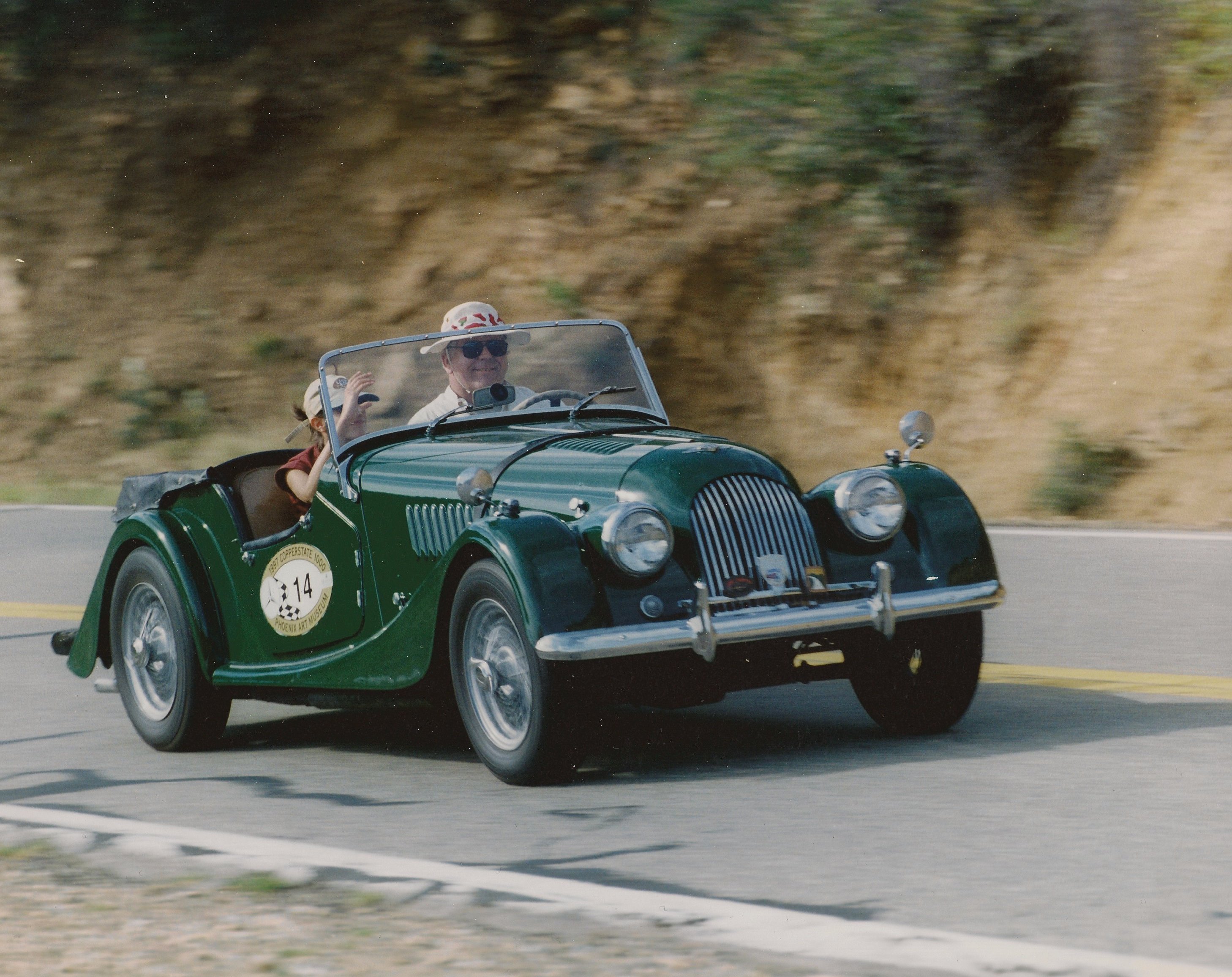
A picture, it is said, is worth a thousand words. ds
© Dennis Simanaitis, SimanaitisSays.com, 2024
 Simanaitis Says
That smile says it all!