
Simanaitis Says
On cars, old, new and future; science & technology; vintage airplanes, computer flight simulation of them; Sherlockiana; our English language; travel; and other stuff
THE AUSTIN A90, SPEED, AND OLD R&TS
WHAT WITH SIMANAITISSAYS EVOLVING from 33+ years at R&T, it’s no surprise that automobiles are occasional topics at this website. Here at the beginning of 2024 let’s return to R&T’s early days 75 years ago. Articles back then share resonance with SimanaitisSays topics. Here are tidbits about these and other musings.
Austin at Indy, 1949. In “American Exuberance From Across The Pond,” the Brits’ Motor Sport magazine was cited: “The Stock-Car Records established by an Austin A90 at Indianapolis rather take one’s breath away!”
A Look Back. And, sure enough, the December 1949 R&T reported, “The 4-cylinder Austin, with a comparatively small displacement of only 162.2 cubic inches, falls into Class D but succeeded in beating records set by an American automobile with a much larger engine.”
These occurred during the A90’s week-long—let’s repeat that: week-long—continuous running around Indy’s 2.5-mile oval.

Records Set. R&T continued, “Official details of the endurance run, just released by the Contest Board of the American Automobile Association, show that the Austin A90 also established six additional records in the ‘unlimited’ category, the Austin now has every distance mark from 4000 kilometers to 10,000 miles, inclusive, and every period mark from two to seven days, inclusive.”

Alan Hess, left, and Arthur H. Marlow, British Consul General at Chicago. Famous pagoda of Indianapolis Speedway is in the background.
R&T recounted, “The 88-horsepower Austin A90, which is now the only 4-cylinder record holder in the stock car classification, was driven continuously from April 12 to April 19 by Alan Hess, Dennis Buckley, and Charles Goodacre, who covered 11,850 miles at an average speed of 70.54 miles per hour.”
Though this was seven years before President Eisenhower initiated the Interstate Highway System, the A90’s record can be put in modern perspective with the longest Interstate’s 3021 miles: It’s like driving I-90 from Seattle to Boston, roundtrip twice.
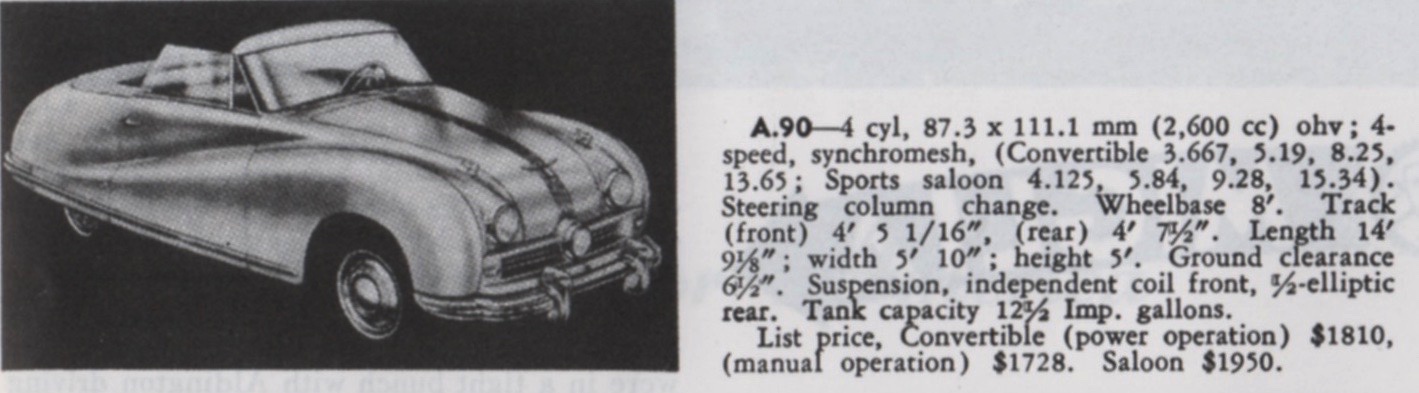
Image from “British Automobiles” by Roger Barlow, R&T January 1950.
A Hardy Team. R&T said, “The drivers, in three hour shifts night and day, piloted the car around the 2 1/2-mile track thru adverse weather conditions, which included 34 hours of continuous rain, a full day of snow, and several heavy thunderstorms and gales.”
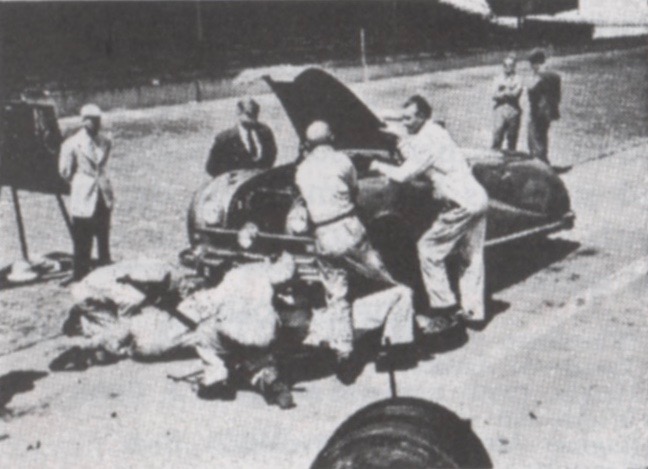
Pit crew races against time to change timing chain. In background is Brockbank of “THE MOTOR,” who created numerous drawings for the drivers.
It was a Drophead, After All. “Because the car competed in the open car division,” R&T noted, “the top could never be raised, even though the temperature dropped 45 degrees in one day to below freezing.”
Indy Laps. “Normally,” R&T said, “speeds for a complete lap ranged up to about 82 miles an hour, but a ‘flying start’ 5-mile run was made at an average speed of 89.58 miles per hour.”
Putting These Speeds in Perspective. In “Wott’le She Do?,” R&T January 1950, Fifth Wheel [possibly John R. Bond?] wrote, “In any case, since a speedometer is supplied with every automobile, and since the inevitable question of how fast will she do (wottleshedoo) always comes up, it seems time for some debunking.”
Fifth Wheel said, “While many things influence the ultimate top speed of a car, two are of paramount importance—these being brake horsepower and wind resistance.” And then he offered the following formula:
HP REQUIRED =V/375 x (.016W + .0013AV2).
“Here,” Fifth Wheel said, ” ‘V’ is velocity in mph, .016W is the rolling resistance factor as influenced by ‘W’ (the car’s total weight in pounds), and .0013AV2 is the coefficient of wind resistance of a typical 1949 sedan, ‘A’ is the frontal area in square feet and V2 is velocity squared.”
Austin claimed a top speed of 92 mph, which agrees with the A90’s 88 hp, estimated weight of 2800 lb., and frontal area of 29.2 sq. ft.
The 1949 Competition. Fifth Wheel also offered this compilation of approximate top speeds for 1949 cars.

By the way, Bill Holland won the 1949 Indy at an average speed of 121.357 mph. Duke Nolan’s pole position came at 132.939. And that the Austin A90 did almost 90 mph for two laps and more than 70 mph for a week there are all the more impressive. ds
© Dennis Simanaitis, SimanaitsSays.com, 2024
 Simanaitis Says
Wow. My Chevy Bolt matches the Austin: top speed 92 mph. Of course, that’s by virtue of a hard limiter in the “engine” management computer; the Bolt is substantially quicker than the Austin, but not faster.
Whenever I hear about new speed or distance records being set, I wonder how many tries it took beforehand that we’ll never know about. There must be some great stories!