
Simanaitis Says
On cars, old, new and future; science & technology; vintage airplanes, computer flight simulation of them; Sherlockiana; our English language; travel; and other stuff
BUSBY BERKELEY—TAKING THE CAMERA TO PLACES IT’D NEVER BEEN
DAVID THOMSON PUT IT WELL in The New Biographical Dictionary of Film: “It is a delicious irony that as the cinema institutionalized its own morality—in the early 1930s—it promoted a visionary who made films (or directed sequences) that revealed once and for all, despite every reference to the moon in June/boy meets girl/love and marriage, that the cinema had a ready, lascivious disposition toward orgy.”
Gee, I believe this explains my enthusiasm for movies of the 1930s.
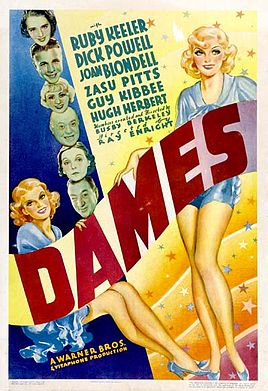
Dames, 1934, starring Ruby Keeler, Dick Powell, and Joan Blondell.
As Dick Powell explained in the title song, “What do you go for/ Go see a show for/ Tell the truth/ You go to see those beautiful dames.”
Thomson quotes French writer, editor, and film director Jean-Louis Comolli: “Berkeley is not a choreographer; people do not dance in his films, they evolve, they move about, they make a circle, the circle tightens or is released, bursts forward and forms again. The syntactical unit of this ballet of images is not the pas de deux but a pas de mille, a dance of a thousand.”
Here are tidbits about Busby Berkeley gleaned from Thomson’s book, from Internet sources, and from my own viewings of his occasionally over-the-top flicks.
Childhood. Berkeley William Enos’s mother Gertrude was a stage actress. Wikipedia says, “In addition to her stage work, Gertrude played mother roles in silent films while Berkeley was still a child. Berkeley made his stage début at five, acting in the company of his performing family.”
He came by his moniker from Amy Busby, an actress pal of his mother. Wikipedia notes, “Whether he was christened Busby Berkeley William Enos, or Berkeley William Enos, with Busby’s being a nickname, is unknown—the ‘Child’s names’ entry on his birth certificate is blank.”
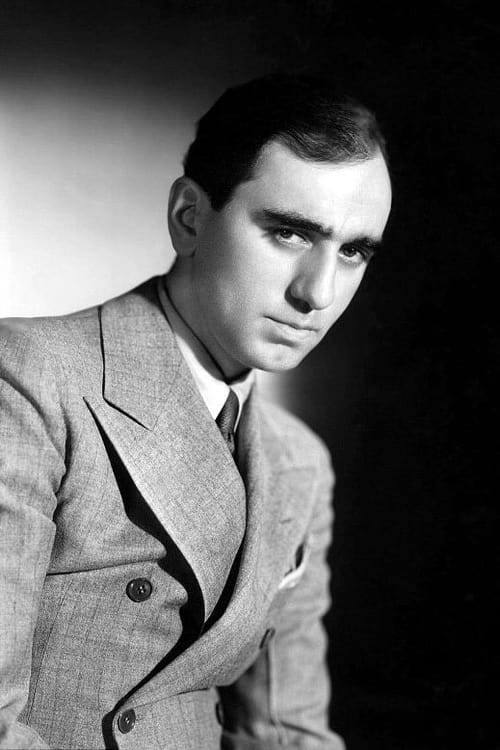
Busby Berkeley, 1895–1976, American film director and musical choreographer. Image, c. 1935.
Training in Dance—What Training? “During World War I,” Wikipedia recounts, “Berkeley served in the U.S. Army as a field artillery lieutenant, drilling 1200 soldiers in complex choreography.” After this hazardous apprenticeship, he never looked back. Nor did Berkeley ever express concern about his lack of formal training.
The Busby Berkeley Formula: “Berkeley’s numbers,” Wikipedia notes, “were known for starting in the realm of the stage, but quickly exceeding this space by moving in a time and place that could only be cinematic, to return to shots of an applauding audience and the fall of a curtain.”
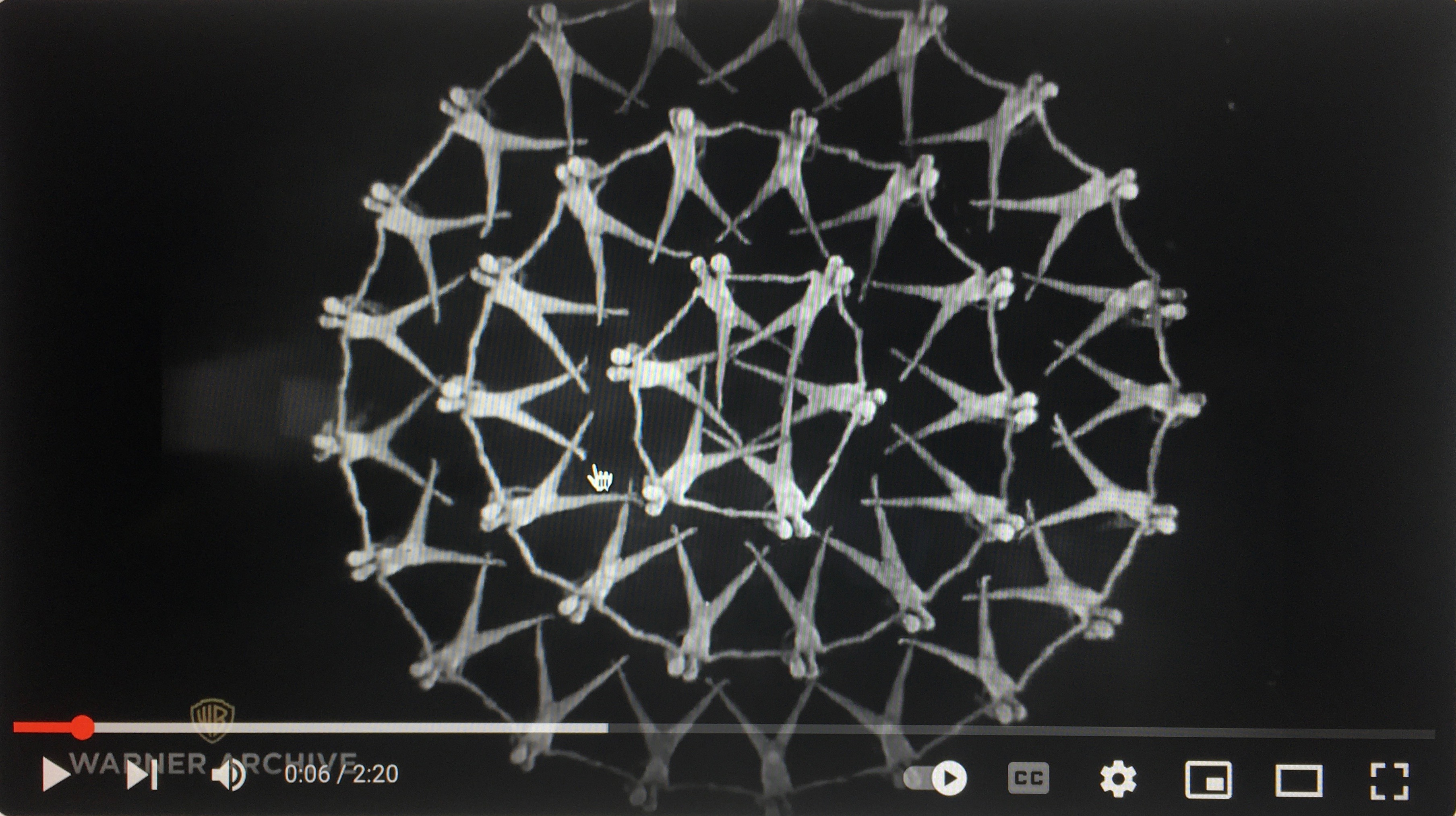
A typical Busby Berkeley scene. Theoretical stage audiences never got this view.
Not to put a damper on this camera legerdemain, but occasionally as I watch a Busby Berkeley overhead routine I imagine that all a stage audience would see is a floor-full of scantly clad gals waving their arms and legs around.
On the other hand, to quote Thomson again: “Berkeley was a lyricist of eroticism, the high-angle shot, and the moving camera; he made it explicit that when the camera moves it has the thrust of the sexual act with it.”
Several of My Favs. While over-the-top exploding flowers and leggy kaleidoscopes have their cinematic charm, it’s the unexpected Busby Berkeley touches that I most admire.
For instance, when a flag transforms into FDR’s face and then into an American Eagle, each created by dancers elevating their hand-held panels just so.

For flag to FDR to an American Eagle, not to say thighs and kaleidoscopes galore, check out this YouTube.
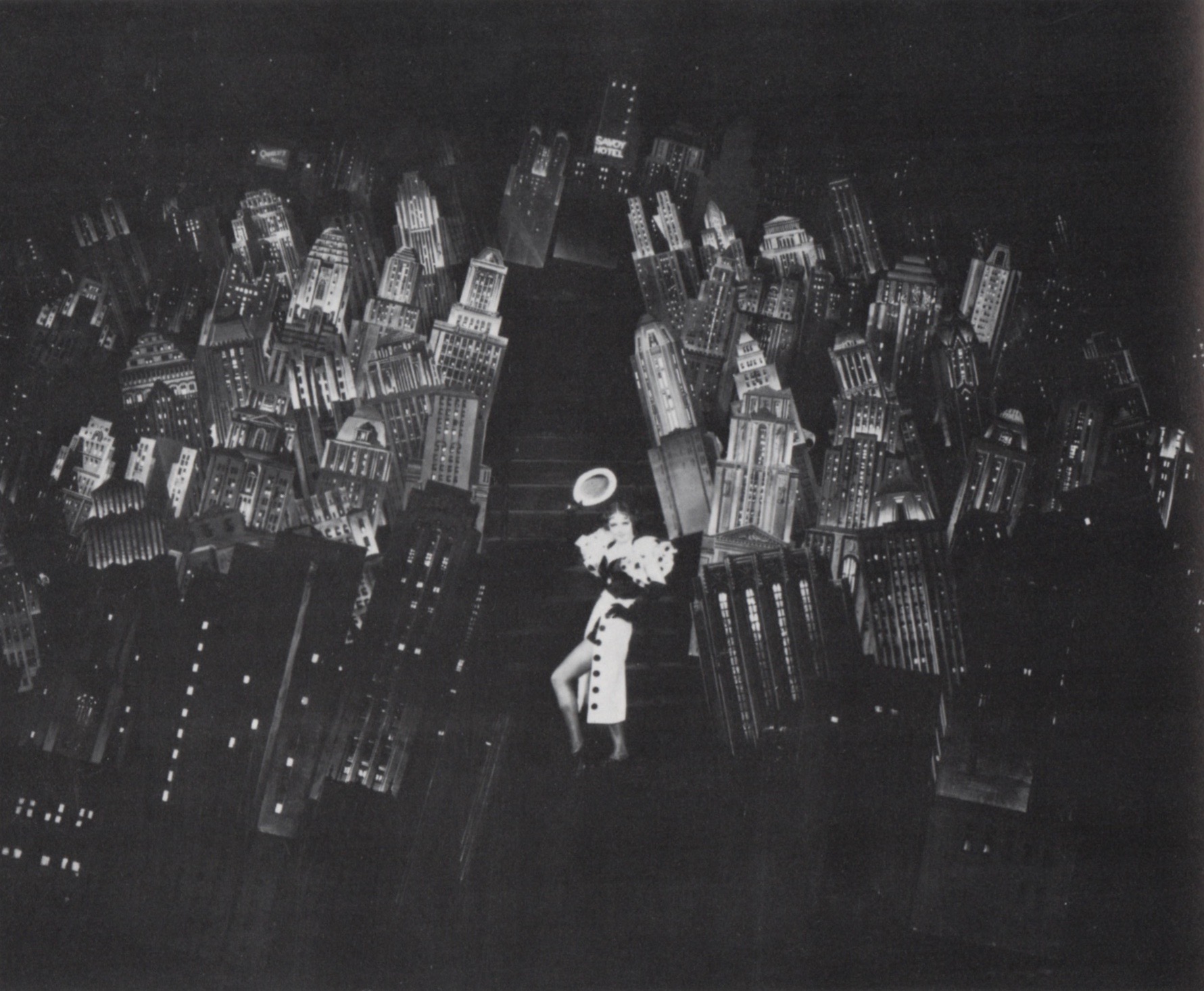
Or when the panels transform into a glittery Manhattan skyline.
Or Ann Miller’s over-the-top dance scene where she whirls among holes in the floor through which protrude musicians’ arms playing instruments. This one, from Small Town Girl, has a scary backstory with three dozen hapless musicians cramped below the set and Miller developing a serious blister from retakes. In fulfilling his creativity Berkeley could be a severe taskmaster.
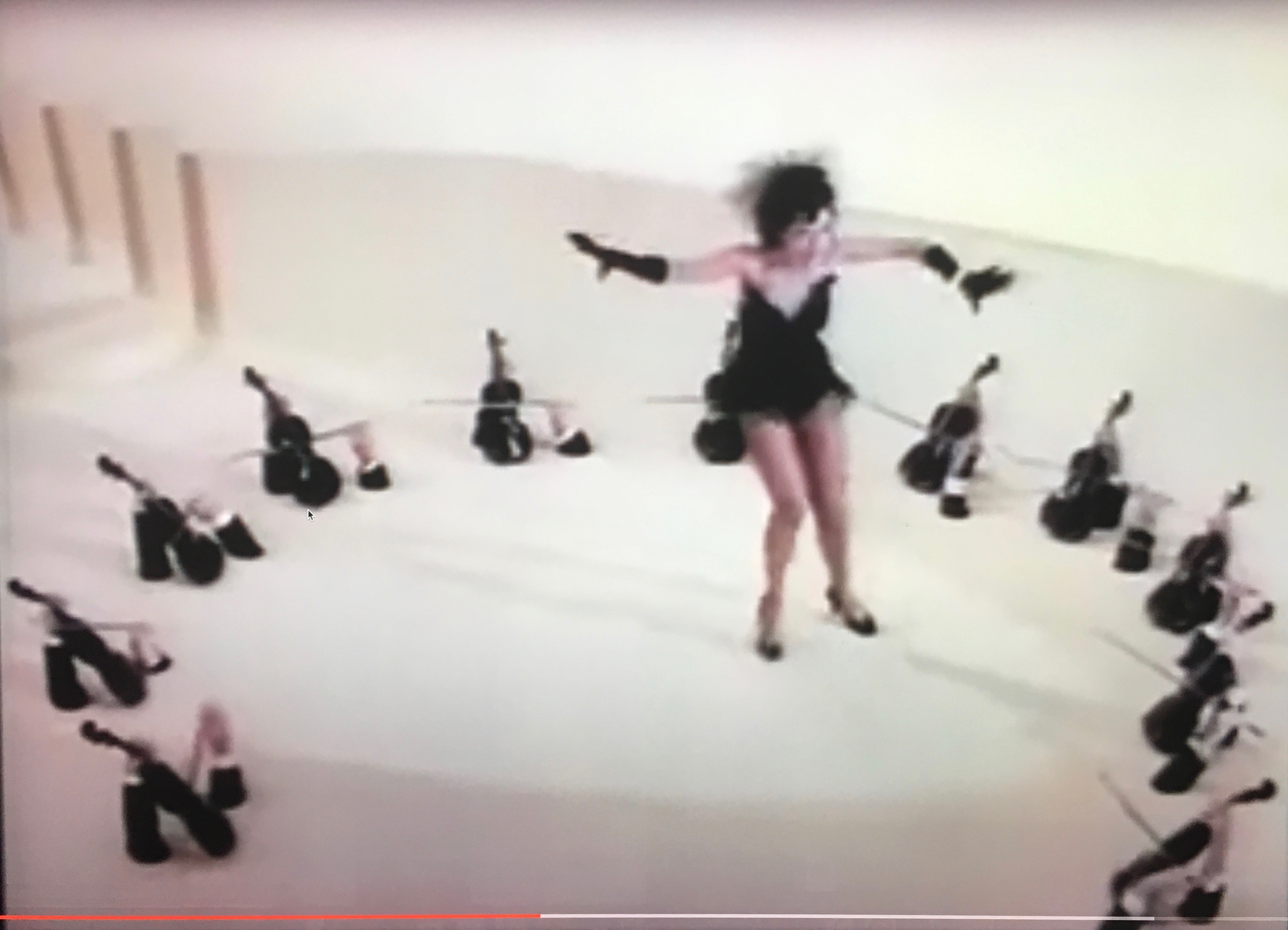
Image from YouTube “Busby Berkeley Director/Choreographer.”
Andre Previn sums up the man in another way: “He did not shy away from any idea…. Busby sat there with a huge story board and said, ‘Now in this one number I want Jane Powell to come onto the set drawn by a cart which in turn is being drawn by forty trained eagles.’”
Previn continues, “And… I said ‘yeah?…’ and he said, “Hey, you’re good, you didn’t even flinch.” ds
© Dennis Simanaitis, SimanaitisSays.com 2023
 Simanaitis Says
What a rush!
>