
Simanaitis Says
On cars, old, new and future; science & technology; vintage airplanes, computer flight simulation of them; Sherlockiana; our English language; travel; and other stuff
FAMILIAR WORDS, OLD FASHIONED USES
OUR LANGUAGE, OF COURSE, IS AN EVOLVING ONE. Not only do new words arrive (recently AI has become commonplace), but familiar words also lose context. Here are examples, with descriptions that seem redundant to those of a certain age. Perhaps you have some favorites?
Winding Windows Up or Down. Are any cars produced these days with mechanical levers rotated one way to open side windows and the other to close them? My 1990 Mazda, for instance, has them.

A Mazda Miata door panel.
There’a a curious story about car windows of the electric actuation sort: Back in the 1970s Lotus got complaints of going soft when it incorporated electric window lifts on its Esprit. But it turned out the decision was logically an engineering one: The electric lift hardware weighed less and was more compact than traditional lever actuation.
By the way, the decision might have been premature judging by lively discussions on various Lotus forums.
Other Windings. Of course, other things required manual winding: the earliest telephones, record players, and to this day many timepieces.

The key of the family classic Santa Fe Railway clock gets precisely 11 twists whenever it runs down. The self-winding of my almost as classic Seiko chronograph no longer functions (complicated by a parts scarcity). Each morning when I listen to BBC World Service at 13:00 GMT (6 a.m. Pacific), I give 23 twists to its manual wind-up. From day to day, the Seiko continues spot-on accurate.
Still Others. Our language continues to “wind up a task” or “wind down after a busy week,” but our car windows have buttons, not levers, and most timepieces have batteries.
Dial a Number. Dials, of course, still exist: among other places on instrument clusters and with (non-digital) timepieces. But in the old days we “dialed a number” on the telephone.
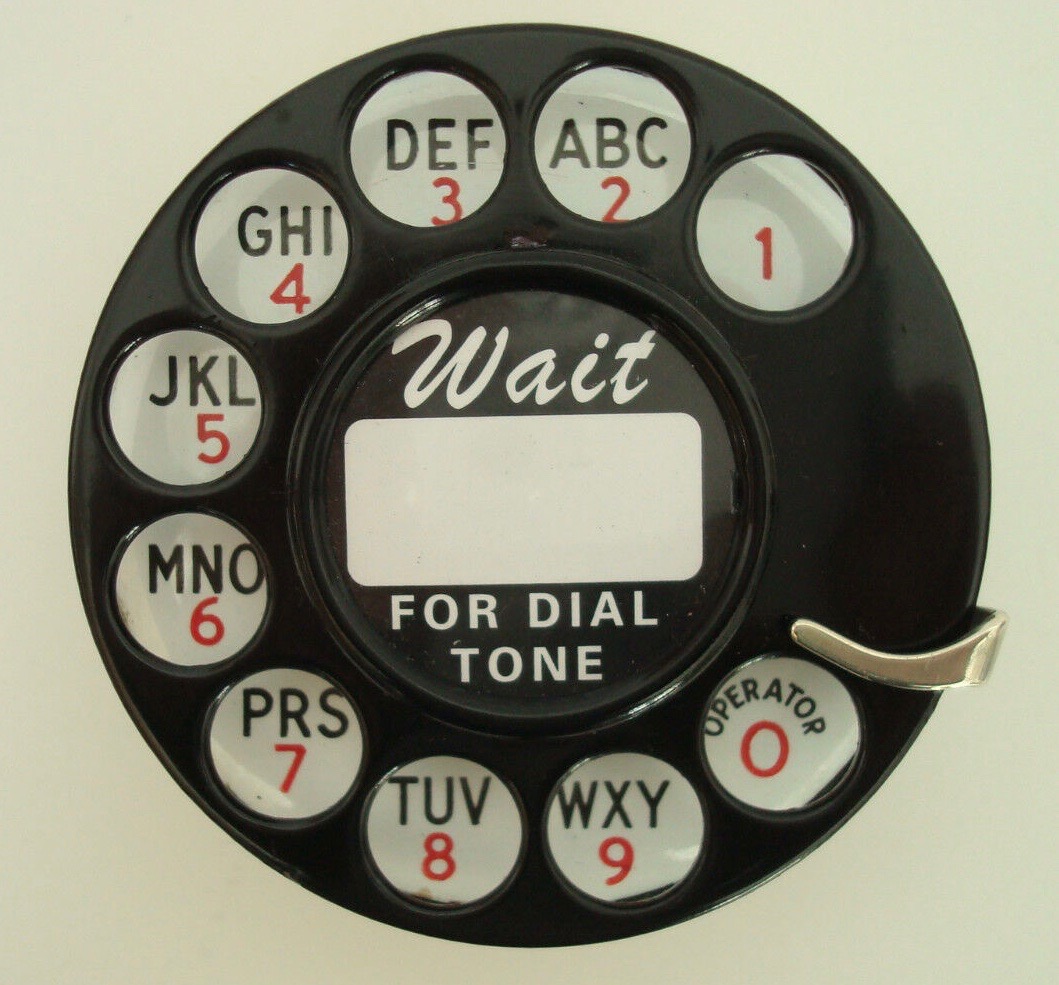
Image from ebay.
I suspect even grandkids know how a “rotary phone” worked: Think of the first digit of the desired phone number, put your index finger in the appropriately numbered opening in the disc, and rotate it clockwise to the little stop; then repeat for each of the other digits.
Sleuthing Advice. The succession of clicks (a familiar radio sound effect of phone calls) gave sleuths a means of identifying the dialer’s intent: “click click (pause) click (pause) click click click.” Aha, 2-1-3, Los Angeles Area Code.
Touch-Tone Replacement. As described by pcmag.com, “Each digit has a physical button that transmits a different audio tone when depressed. Known as the dual-tone multifrequency (DTMF) system, the signal is a combination of the row and column frequencies of the digit key.”
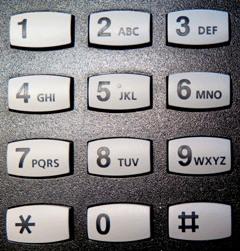
Each row and each column is assigned a different frequency; the audio signal is a superposition of the two frequencies of the depressed key. Image from PC’s Browse Encyclopedia.
I wonder, could the eavesdropping sleuth interpret a called number from the beeps? Or, could an apocryphal cheat mimic DTMF tones (or the various coin-drop sounds of a pay-phone)?
On Eavesdropping. Electronic bugs have all but eliminated the physical practice of eavesdropping, the act of stealthily listening to conversations of others without their consent. Wikipedia notes, “An eavesdropper was someone who would hang from the eave of a building so as to hear what is said within.”

An eavesdropper decorating Hampton Court Palace. Image from Saxon Henry.
Wikipedia continues with an historical bent: The PBS documentaries Inside the Court of Henry VIII (April 8, 2015) and Secrets of Henry VIII’s Palace (June 30, 2013) include segments that display and discuss ‘eavedrops,’ carved wooden figures Henry VIII had built into the eaves (overhanging edges of the beams in the ceiling) of Hampton Court to discourage unwanted gossip or dissension from the King’s wishes and rule, to foment paranoia and fear, and demonstrate that everything said there was being overheard; literally, that the walls had ears.” ds
© Dennis Simanaitis, SimanaitisSay.com, 2023
 Simanaitis Says
Never liked Corvetts, my older brother told me when I was 10, they were just fibre glass dragsters. He drove an Austin Healey in 1959,We mocked the early Vettes for having power windows till we learned they were lighter.Hell. my two Morgans do not even had side windows. Sue my brother would be proud.John McNulty
“. . . could the eavesdropping sleuth interpret a called number from the beeps?”
I am reminded, exactly what Robert Redford did 48 years ago in Three Days of the Condor.
With Faye Dunaway, Cliff Robertson, and Max Von Sydow, that . . . they don’t mak’em the like that anymore. How come?
FWIW, both of those Henry VIII shows are still available to be viewed from PBS. You have to be a paying (above a certain, actually fairly affordable, level) member of a PBS station to view them, though.
Bill U.; Good question. ADD dialog, directing, film editing for a dumbed down audience addicted to e-communication, “educated” by a K-12 trailing at least 16 other modern industrial nations? The proliferation of mindless action since such easier marketed globally than story complexity, nuance? Why many of us drawn to older movies, not that a few good new ones don’t slip through the cracks.